
Jones Street: Album Cover Inspiration to Individual Landmark Designations
Jones Street runs one short block from Bleecker Street to West 4th Street between Sixth and Seventh Avenues. It may be best known as the setting for the iconic cover of Bob Dylan’s even more iconic 1963 breakthrough album, The Freewheelin’ Bob Dylan. While Dylan and then-girlfriend Suze Rotolo were turning Jones Street into a landmark of modern American pop culture, a very different entity was considering landmark designation of a very different sort for the tiny street.

New York City’s landmarks and historic districts are designated and regulated by the NYC Landmarks Preservation Commission (LPC). This city agency was founded in 1965 following the passage of New York City’s landmarks law, but it can be formally traced to June 19th, 1961, when then-Mayor Robert Wagner founded the Committee for the Preservation of Structures of Historic and Aesthetic Importance. The following year, Wagner founded the Mayor’s Landmarks Preservation Commission, which began to prepare for the process of considering sites for landmark designation while legislation to actually legally allow it to do so was being drafted and enacted. The New York City Landmarks Law was formally enacted on April 19th, 1965, and the City’s first landmarks were designated that October.
Jones Street would have some of our neighborhood’s earliest landmark designations. On April 19, 1966, a row of three remarkably well-preserved Greek Revival rowhouses at 26, 28 and 30 Jones Street were designated as New York City Landmarks (they’re not quite visible on the Dylan album cover as they are blocked from camera view by his right arm and the large truck parked just below it, but they are just past the tall building seen just to the left of Dylan’s arm on the album cover, and shown just left of the houses in the picture below).
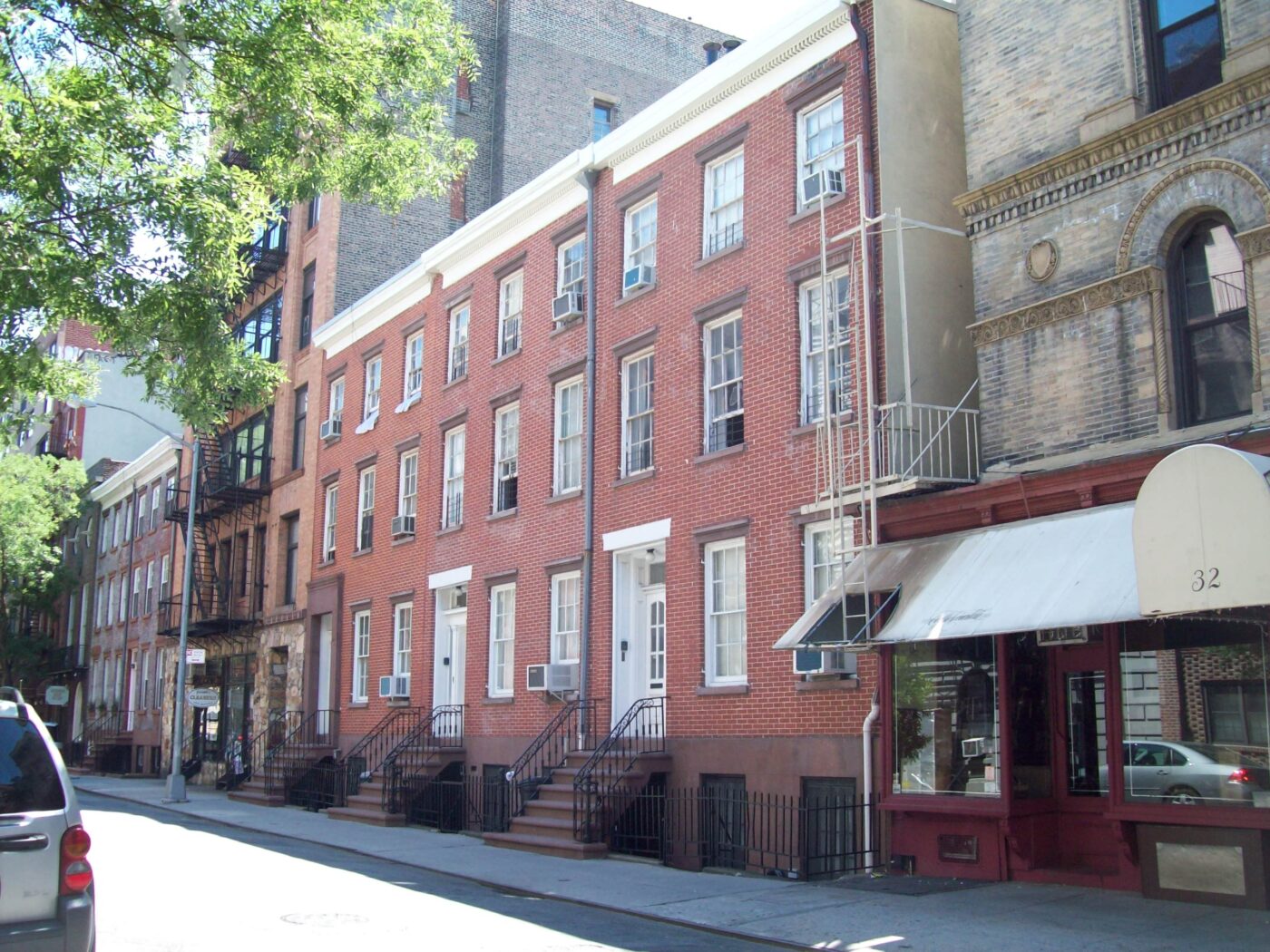
The Greek revival style is one of the most common architectural styles in Greenwich Village. It rose to popularity following Greece’s war for independence from the Ottoman Empire which began in 1821, and as architects and builders of the early 19th century looked to the birthplace of democracy for inspiration. Explore our Greek Revival map to learn more and see other examples of this remarkable style within our neighborhoods.

The style had its heyday from the late 1820s to the mid-1840s. Constructed in 1844, Nos. 26, 28 and 30 Jones Street are fine examples of simple, late Greek Revival style. The row stands at three stories over low basements. Low stoops with handsome wrought iron railings lead to simple wooden doorways. Lintels on top of the doorway and windows are simple; each house is capped with a dentilled wooden cornice.
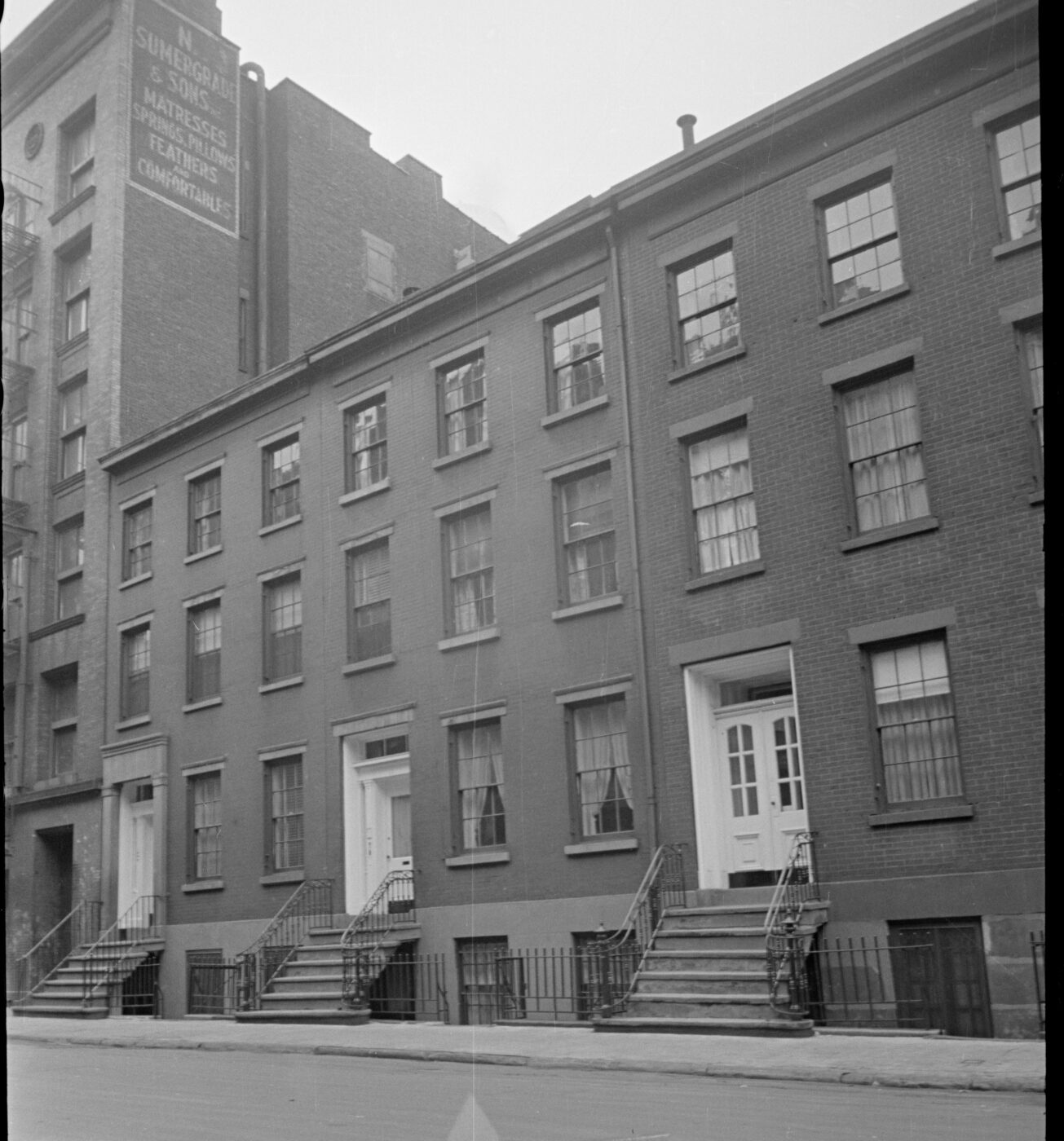
While this row was landmarked in 1966, the rest of Jones Street, and surrounding blocks, were not landmarked until 2010, when it was designated as part of the Greenwich Village Historic District Extension II. This extension, which was proposed and fought for by Village Preservation, was at the time the largest expansion of landmark protections in Greenwich Village since the 1969 designation of the Greenwich Village Historic District. Notably, Suze Rotolo, who stood with Bob Dylan on Jones Street was a staunch advocate for designation of this district, and played an important role in its designation.
You can go to the landmark designation report section of our website to learn more about the history of 26, 28, and 30 Jones Street, of all the buildings on Jones Street in the Greenwich Village Historic District Extension II, and of the many other landmarks buildings in Greenwich Village, the East Village, and NoHo.