
A Day in the Park: Painters’ Notable Depictions of Local Greenspaces
During the long days of summer, there is nothing better than lounging in one of our neighborhood’s parks.
Many notable visual artists have been captivated by the natural beauty of our parks, as well as the interesting convergences of human activity. Today, we will take a closer look at some depictions of our most famous green spaces in paintings by local artists.
Washington Square Park
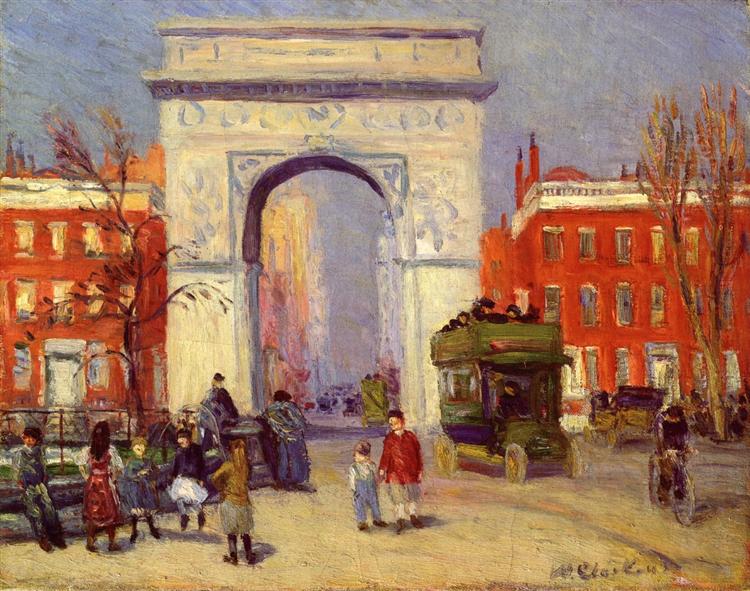
William Glackens, “Washington Square Park” (1908)
William Glackens (March 13, 1870- May 22, 1938) was an American Painter whose work is associated with the Ashcan School. He began his career as a newspaper and magazine illustrator, and his roots in that field lead him to an aesthetic as a painter that was keenly observational in nature and often focused on his immediate surroundings — the Greenwich Village/Washington Square neighborhood.
Glackens owned the 1841 townhouse at 10 West 9th Street, where he lived and worked from 1910 until his death in 1938. The location offered him easy access to Washington Square, where he often painted. Glackens added a mansard roof to the townhouse, which gave its top floor 17-foot ceilings and incredible natural light for use as his studio.
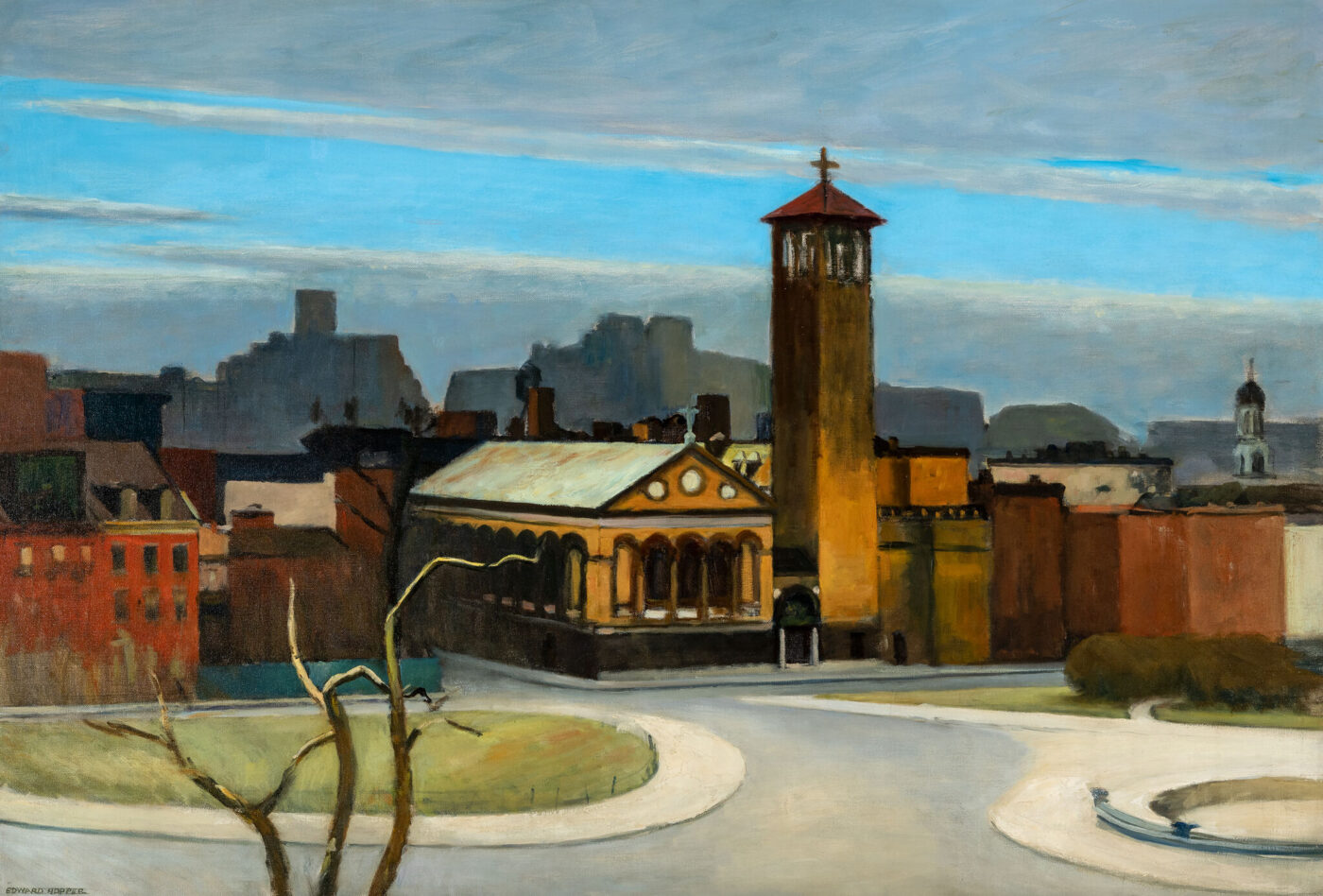
Edward Hopper, “Washington Square” (1932/1959)
Edward Hopper (July 22, 1882 – May 15, 1967) lived and worked in Greenwich Village during nearly his entire adult life, and drew much inspiration from his surroundings. He rarely painted scenes exactly as they were, but focused on elements that conveyed a mood or a feeling. Hopper also liked to capture scenes which were anachronistic, even in the early 20th century.
Hopper lived and worked for 53 years at 3 Washington Square North. This is but one of many sites in the Village intimately connected to Edward Hopper and his paintings. Hopper died in 1967 in this studio home two years before the Greenwich Village Historic District was designated.
Tompkins Square Park
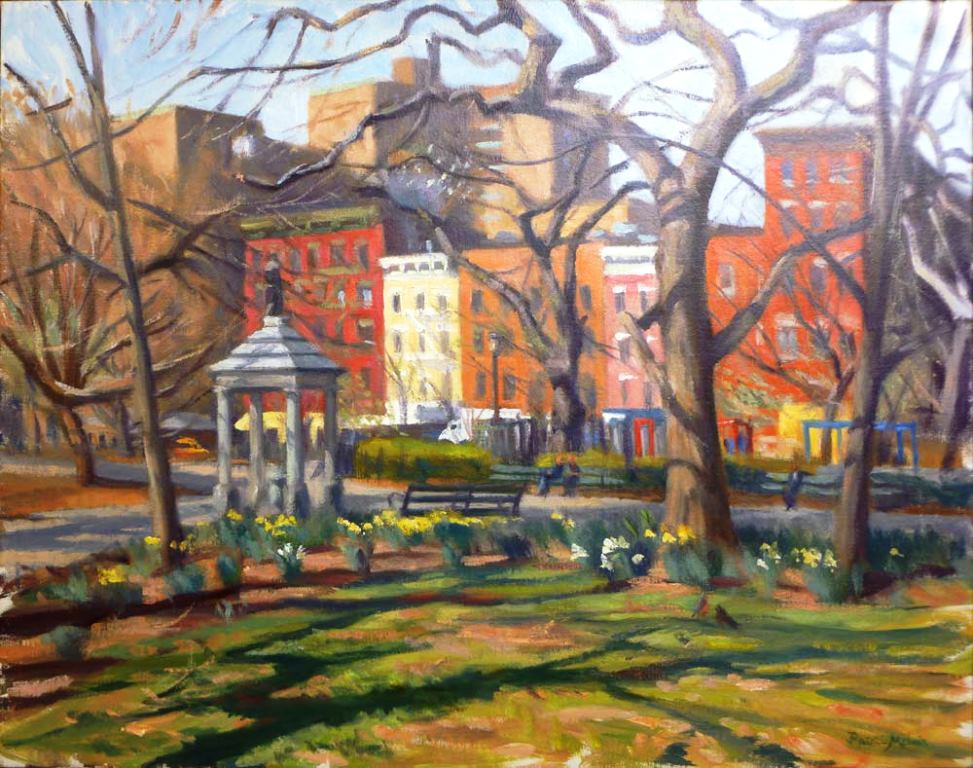
Patricia Melvin, “Tompkins Square Park, Daffodils I.”
Longtime East Villager Patricia Melvin has been painting downtown for more than three decades; you may have seen her stationed with her easel outside near Jefferson Market Library, St. Mark’s Church, on the Bowery, or another of her favorite spots.
Melvin’s work, in both oil and watercolor, has a timeless feeling that evokes scenes by past painters of the Village, such as Glackens and Hopper. A resident of the same Second Avenue apartment for four decades, her sensibilities are perfectly matched with her environment. A great friend and supporter of Village Preservation, she has spoken with us in detail about her work, which you can read about in one of our past blogs.
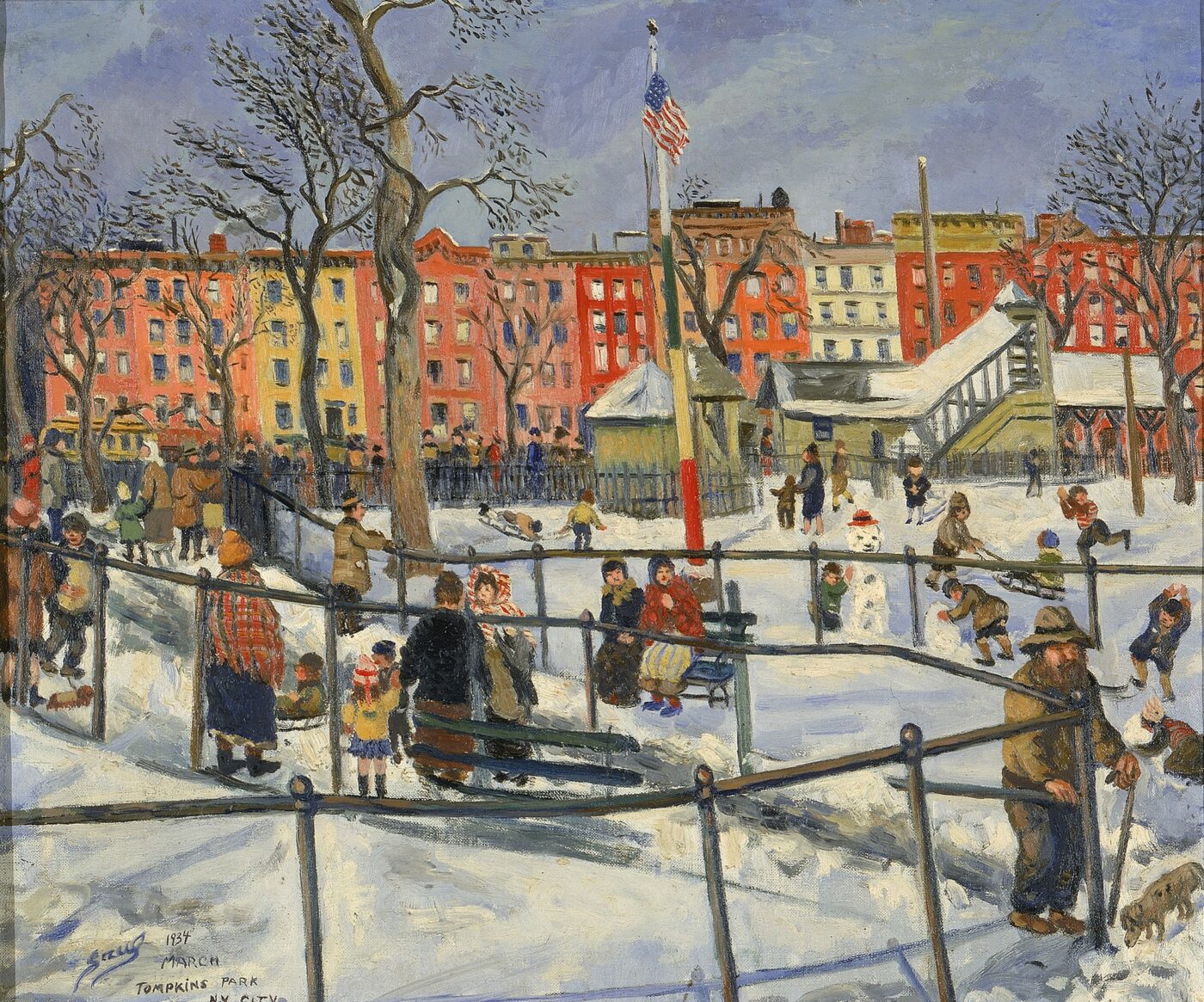
Saul Kovner, “Tompkins Park” (1934)
Painted under the Public Works of Art Project (PWAP), a New Deal program created by the federal government to offer work and financial support to America’s artists during the Great Depression, Saul Kovner’s “Tompkins Park” depicts a busy winter scene at the park in the early 20th century.
Kovner was born in Russia in 1904 and studied painting at the National Academy of Design in NYC with Charles Hawthorne and William Auerbach-Levy. For many years, he maintained a studio near Central Park, depicting many New York scenes in his work. He later moved to California, where he exhibited widely. He passed in 1982.
Learn more about some of the many artists who have lived in, worked in, and been inspired by our neighborhoods in our South of Union Square Artists Tour.
Patricia Melvin moved to West Beth a few years ago.