
The Sophomore Class of Local Landmarks
The New York City Landmarks Law was passed on April 19, 1965. During the first year of the law, some impressive sites in Greenwich Village and the East Village were named into the inaugural class of landmarks, and all but one were in a few blocks of one another, more or less where the neighborhoods intersect. (They were Cooper Union’s Foundation Building, the Astor Library, the Stuyvesant-Fish House, Lagrange Terrace a.k.a. Colonnade Row on Lafayette Street, the Merchant’s House, and Grace Church; the “exception” was the U.S. Federal Building on Washington Street.)
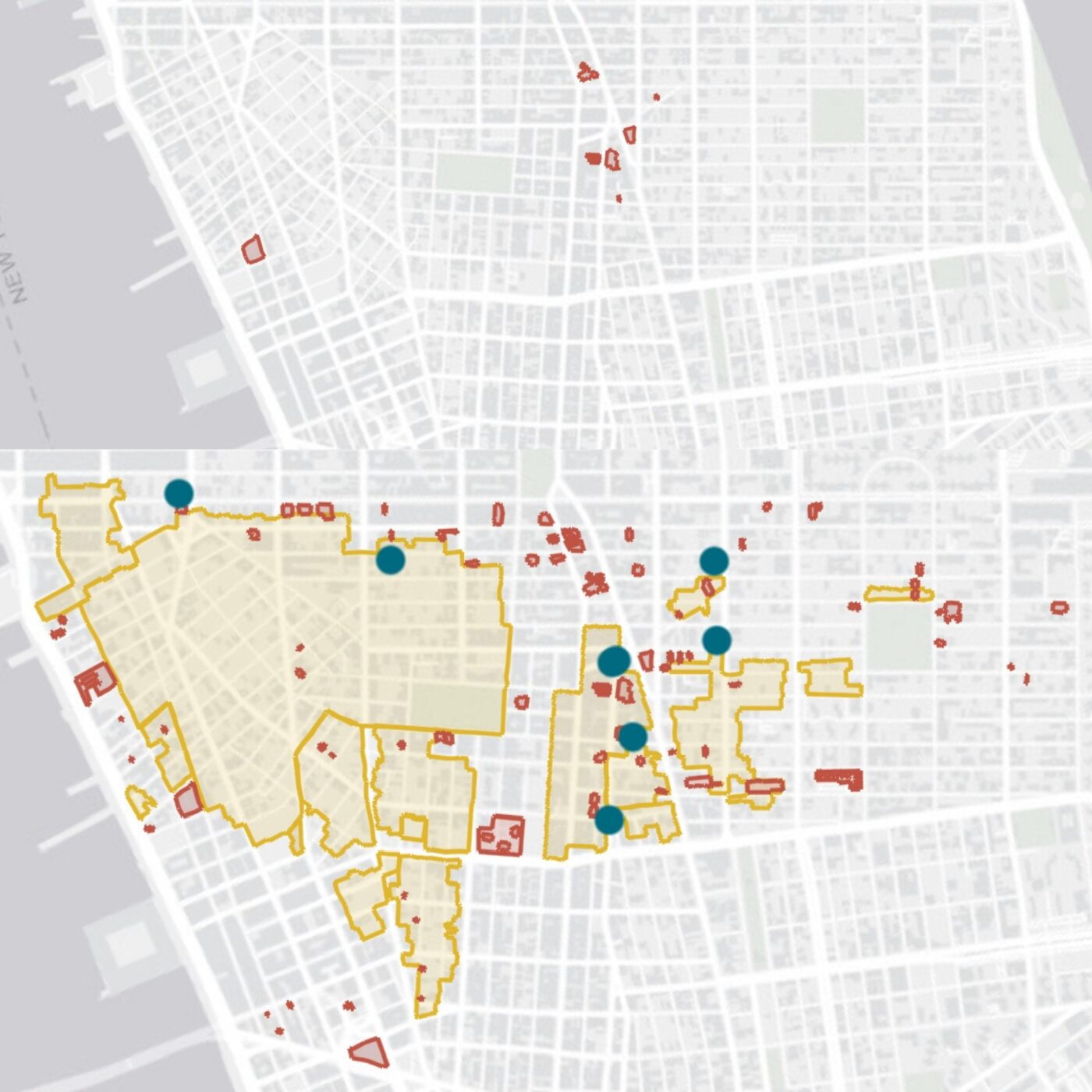
A trip through our Landmarks60 Timeline Map, created this year for the 60th anniversary of the law, shows the second year of the measure brought a new crop of landmarks, perhaps a bit less well known but no less historic and certainly more diverse in location. Today we take a look at a few of those sites, designated from April 19, 1966 to April 18, 1967.
Church of the Immaculate Conception
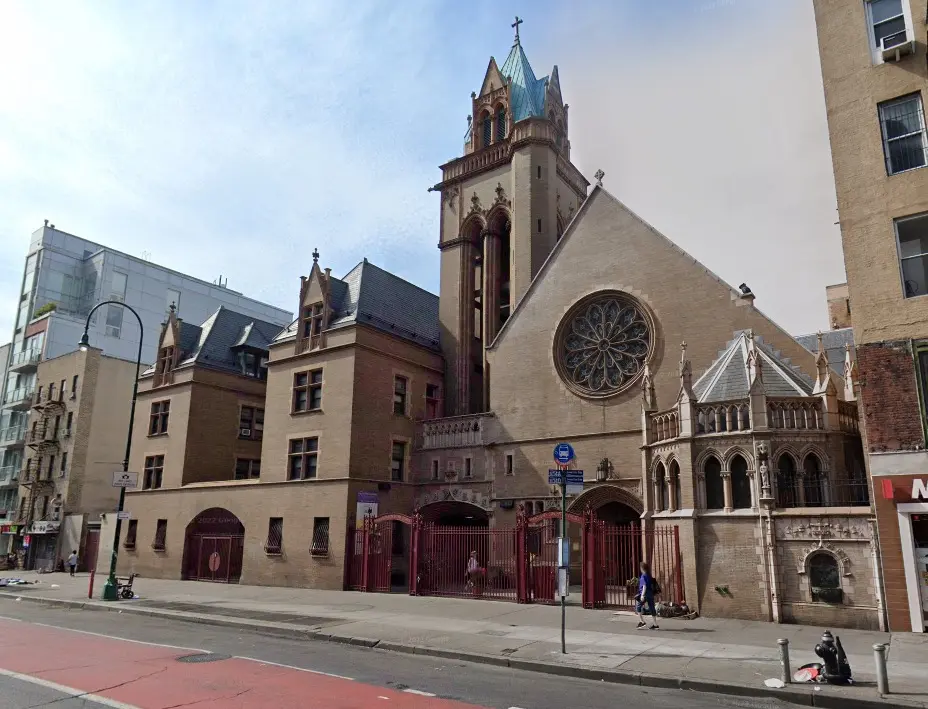
The Church of the Immaculate Conception and Clergy House, located at 406–412 East 14th Street, was built between 1894 and 1896 as Grace Chapel, a “free chapel” and hospital funded by Grace Church. Designed by Barney & Chapman, the centerpiece chapel — constructed of stone and Roman brick with a free-standing tower and steep gables — showcases a blend of intimate chapel scale and soaring ecclesiastical form. Connected to a hospital wing via a bridge, it served both spiritual and social roles in the community. After the mission closed in 1943, the Roman Catholic Archdiocese acquired the site, adapting it for the Immaculate Conception Parish, which lost its previous Gothic Revival church for the development of Stuyvesant Town.
The complex was designated a New York City landmark in June of 1966, and listed on the National Register of Historic Places 14 years later. Architecturally, it embodies the French Gothic Revival style, with its central tower, steep gabled roof, pointed-arch fenestration, and richly detailed stained glass by firms such as Clayton & Bell and Henry Holiday. Alongside the chapel, the three-story brick and stone clergy houses create a cohesive civic and religious presence for the East Village.
Bouwerie Lane Theatre (former Bond Street Savings Bank)
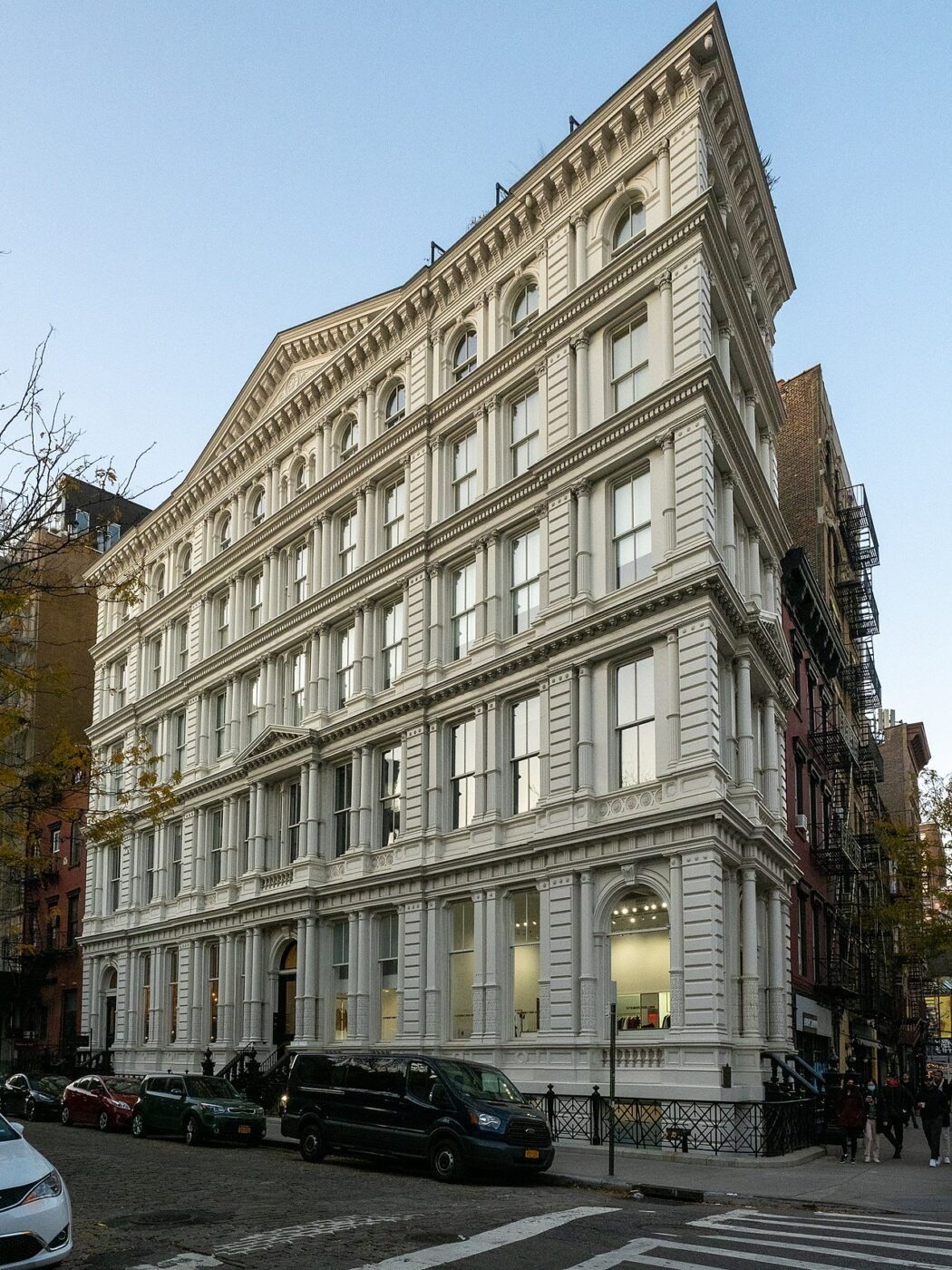
Built in 1873–74 as the Bond Street Savings Bank (originally the Atlantic Savings Bank) at 330 Bowery/54 Bond Street, this building was designed by Henry Engelbert in the elegant French Second Empire style. Like many of its NoHo neighbors, the bank’s facade is composed of cast‑iron elements, with a mansard roof, dormer windows, decorative brackets, and ornate Corinthian and pilaster detailing evoking the era’s sophisticated bank architecture. After it failed in 1879, the bank was taken over by the German Exchange Bank, serving the area’s large and thriving German immigrant community, and later repurposed for warehouse use before being transformed for its next purpose.
In 1963, stage producer Honey Waldman turned the former bank into the Bouwerie Lane Theatre, an early Off‑Broadway venue. Among the theater’s many productions was 1981’s Something Cloudy, Something Clear, the last play by Tennessee Williams to debut in New York during his lifetime.
The building received New York City landmark designation in January 1967, and like the Church of the Immaculate Conception was listed on the National Register of Historic Places in 1980. More recently, a 2012 LPC application approved with modifications allowed for a rooftop addition, tailored to protect the original massing and Second Empire character of the structure.
Schermerhorn Building
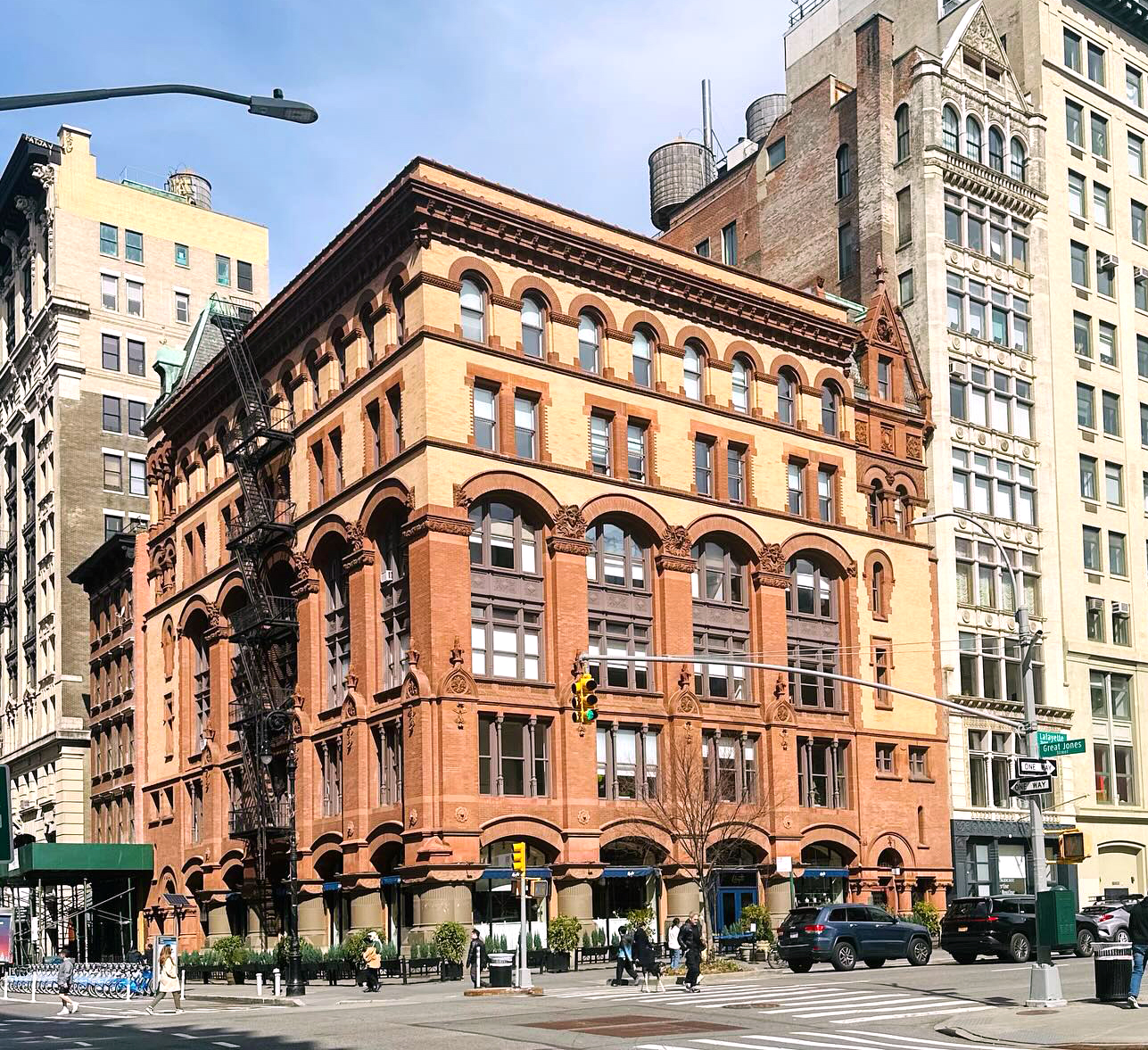
Completed in 1889, the Schermerhorn Building at 376–380 Lafayette Street was commissioned by lawyer and philanthropist William C. Schermerhorn on the site of his former family mansion. Designed by prominent architect Henry J. Hardenbergh, the structure reflects a robust Romanesque Revival aesthetic with touches of Gothic Revival influence. The design is distinguished by rounded Romanesque arches, deeply recessed windows, and a combination of rugged masonry with decorative trimming that highlights the mix of the two popular 19th-century architectural styles. The sturdy, richly textured facade — brownstone, sandstone, and terra cotta — is characteristic of Hardenbergh’s work, which later included the Dakota on the Upper West Side and the Plaza Hotel on Central Park South, as well as the nearby Albert Apartments/Hotel on University Place and 11th Street.
The Schermerhorn originally served as a loft building for a boys’ clothing manufacturer, an example of the mixed-use commercial and industrial structures typical of NoHo in the late 19th century. It was converted from a factory to an office building in 1931, and for a period in the 1930s was a dormitory and dining room operated by the city’s Department of Welfare. It was converted back to manufacturing use in 1943. Designated a landmark in May 1966, the Schermerhorn Building was added to the National Register of Historic Places in December 1979.
26-30 Jones Street
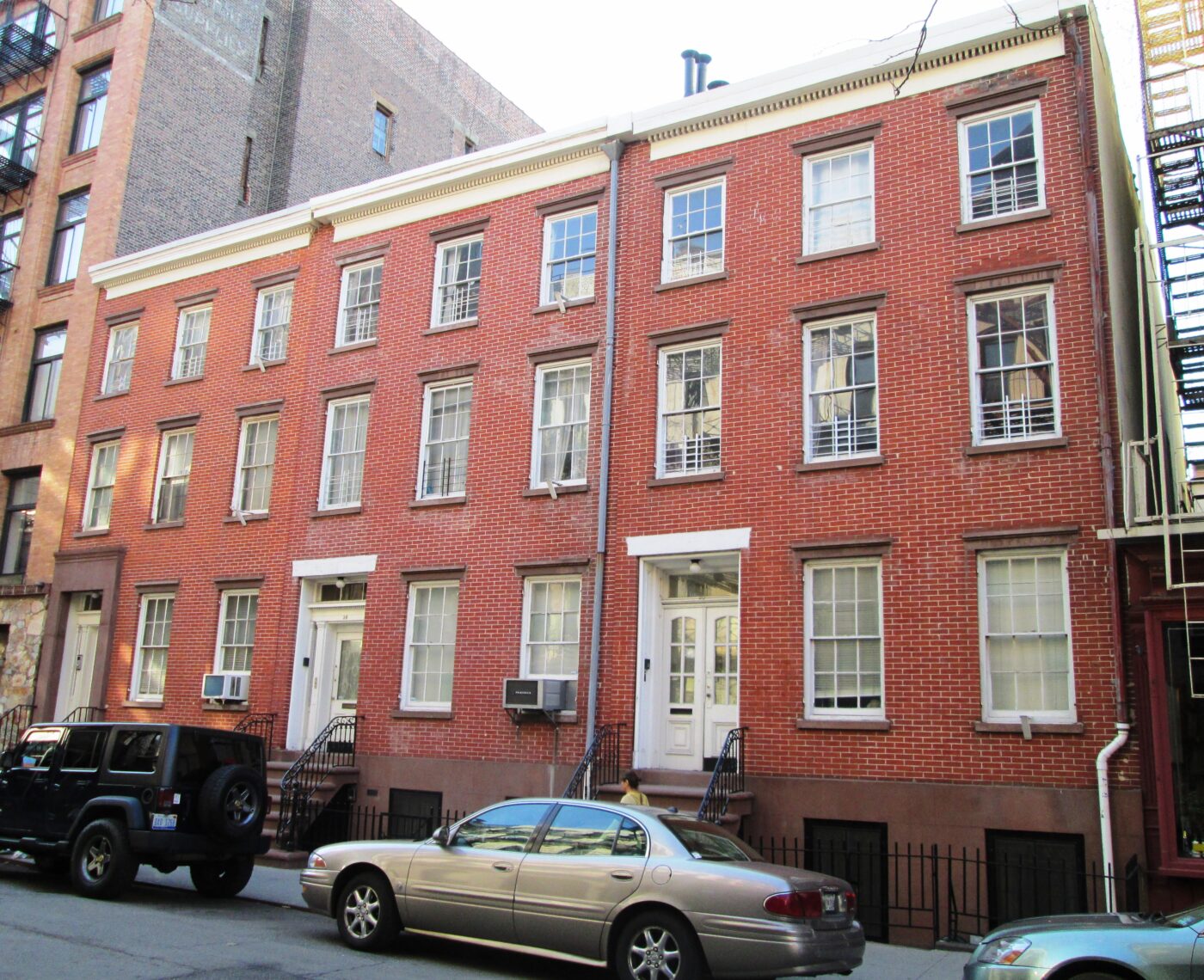
Built in 1844, the rowhouses at 26, 28, and 30 Jones Street are “handsome example[s] of late Greek Revival residential architecture,” as noted in the Landmarks Preservation Commission’s designation report. Each is a three‑story brick structure set over a low English basement, featuring simple brownstone splayed lintels above windows and doors. The facades are unified by modest wooden stoops with delicate wrought‑iron railings leading to recessed entrances framed with pilasters and capped by a plain entablature and a rectangular three‑pane transom, all emblematic of the style’s classical influence. The subtle detailing, such as the understated dentils on the cornice and the simplicity of the entrance surrounds, reflects the architectural shift of the period away from overly ornate motifs toward a more disciplined, inspired-by-antiquity approach.
These three properties were designated on the one-year anniversary of the landmarks law, April 19, 1966. The LPC specifically cited their “special character” and aesthetic value, emphasizing the importance of preserving not just grand monuments but also more intimate, dignified examples of mid‑19th century urban houses.
131 Charles Street
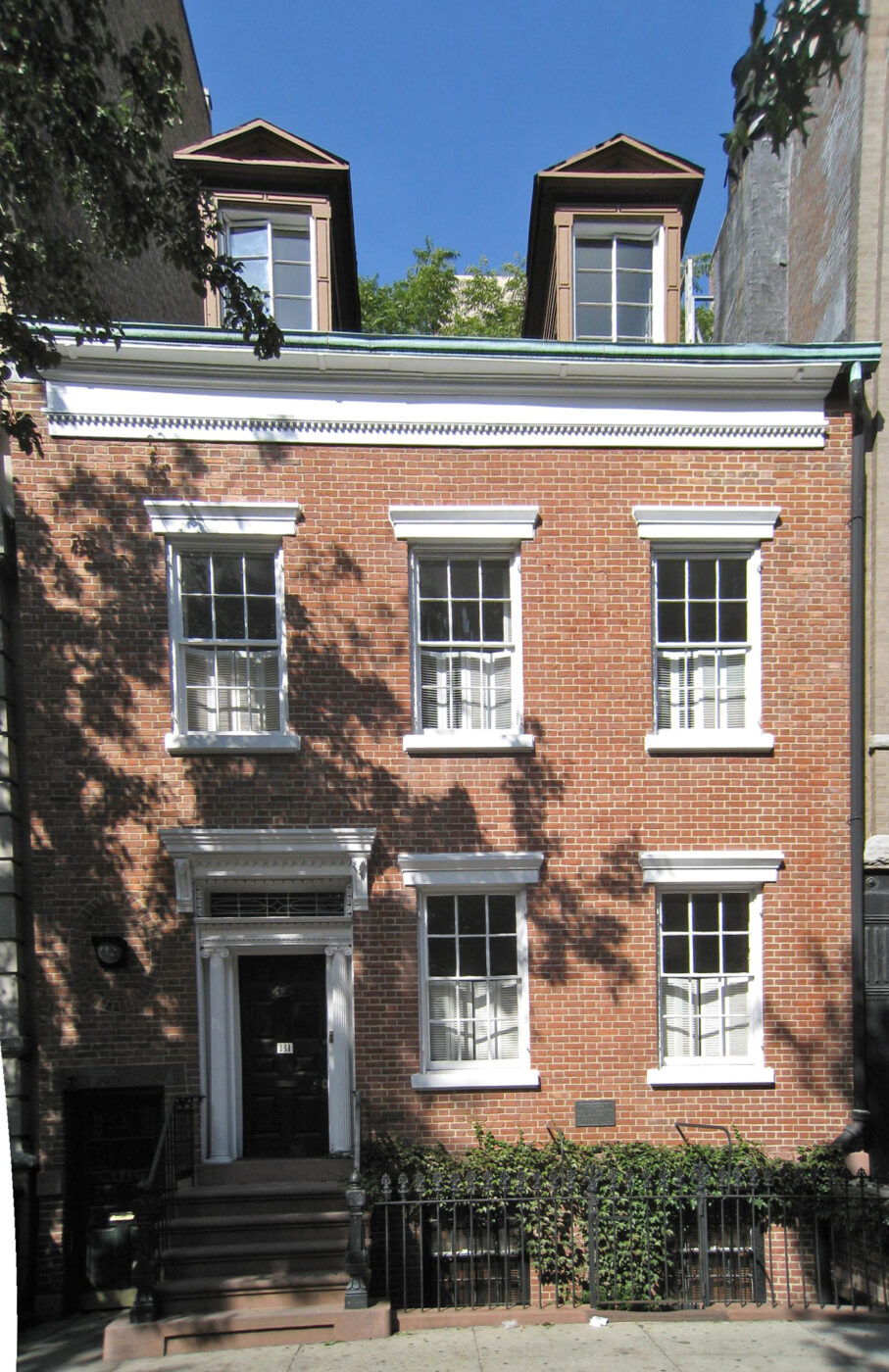
The townhouse at 131 Charles Street, constructed in 1834 by stonecutter David Christie, exemplifies the modest elegance of early 19th‑century Federal-style homes. This two‑story brick residence, set above a high basement and capped with a peaked roof and delicate dormers, represents what the LPC described as “small comfortable Federal street houses, once so abundant in New York City,” distinguished by their intimate scale and craftsmanship. Architectural detailing centers on the refined entryway: a low stoop with wrought‑iron railings leads to an eight‑panel door, framed by slender wooden columns and an entablature topped with a leaded‑light window, original stonework that conveys a blend of Federal restraint with a touch of Victorian ornament.
One of the finest surviving examples of modest Federal townhouses, 131 Charles Street also reflects a bygone era of skilled craftsmanship and urban living that was praised by critic Montgomery Schuyler in 1899 as “the most respectable and artistic pattern of habitation New York has ever known.” The LPC recognized the house for its “special historical and aesthetic interest” in its April 1966 designation. In 2023, Village Preservation successfully fought to prevent massive excavation and alterations there, and preserve that historic character.
These are just some of the landmark designations in our neighborhood covering the second year of the Landmarks Preservation Commission. Explore all the landmark designations in our neighborhoods across sixty years of the Landmarks Preservation Commission on our Landmarks60 Timeline Map here. And you can explore dozens of our other maps covering everything from architectural styles to musical history to women’s suffrage here.