
From Fashionable Rowhouse to Landmark: The Story of the Skidmore House
On August 18, 1970, New York City’s Landmarks Preservation Commission landmarked the Greek Revival gem at 37 East 4th Street. Often referred to as the Samuel Tredwell Skidmore House, it was constructed 1844-45 by leading businessman Samuel Tredwell Skidmore (1801–1881). Skidmore was a cousin, once removed, of Seabury Tredwell of the Merchant’s House Museum, located just a few doors down the block at 29 East 4th Street.
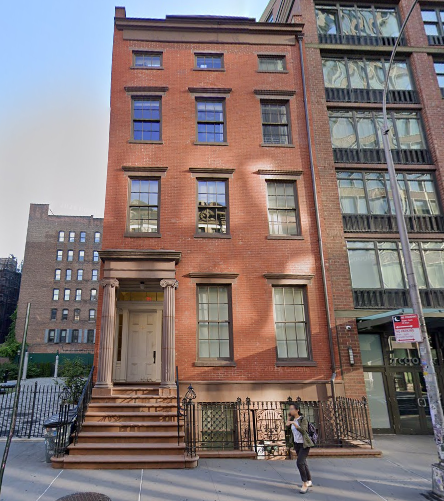
Skidmore, active in the wholesale drug trade under Skidmore & Co., later became president of the Howard Insurance Company and a trustee at the U.S. Trust Company. He also served Trinity Church as vestryman (1845–1874) and Senior Warden (1874–1880). He, his wife Angelina, and their eight children lived in the house for nearly forty years before his passing there on November 8, 1881.
Architecturally, the Skidmore House is unique. Built originally as 369 Fourth Street, it was later renamed 385 Fourth Street, and finally 37 East 4th Street, According to the designation report, it is deep, occupying more of the lot than typical, with a high stoop over a stone basement that still bears traces of rustication. A striking, Ionic-columned entablature frames the entrance, which features a three-pane transom surrounded by remnants of delicate carved molding. Blocked sidelights sit between square pilasters. Third-floor windows preserve crowns of cap moldings, and six-over-six sash still operate. A simple wooden cornice with fascia crowns the low attic windows. Although none of the original 1840s ironwork survives, fragments suggest it once closely matched that of its neighbor at 29 East 4th Street.
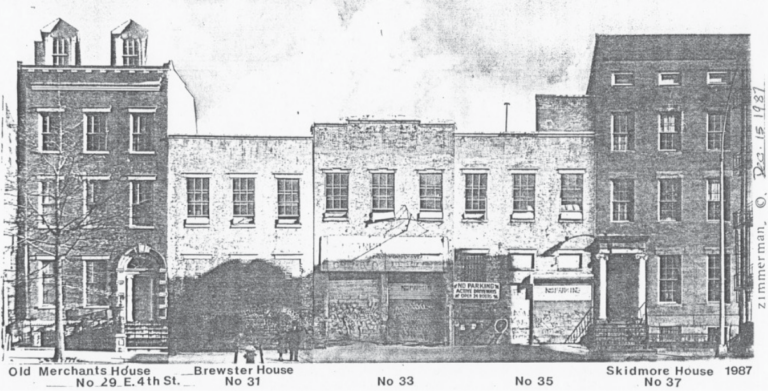
When these properties were built, the area was one of the city’s most fashionable residential neighborhoods. Nearby stood William B. Astor’s residence on Lafayette Place, LaGrange Terrace a.k.a. Colonnade Row across the street, and the famed Vauxhall Garden, dating to 1805, was a hub of music, theater, fireworks, and entertainment, was located in the middle of the block now bounded by Fourth, the Bowery, Astor Place, and Lafayette Place.
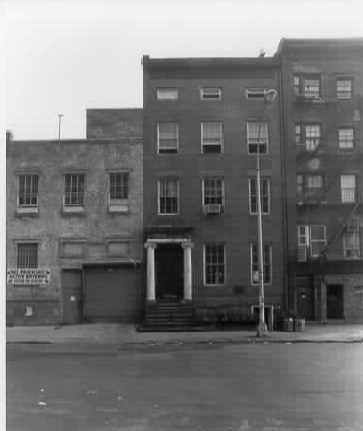
According to the designation report, “The area to the north was still largely undeveloped at the time Skidmore built his house. Grace Church, at Tenth Street and Broadway, was then in the process of construction. Within a few years, however, the Astor Library was erected on the east side of Lafayette PIace, followed by Cooper Union, in 1857.By the early 20th century, the area had become almost entirely commercial, making two surviving early residences, Nos. 37 and the previously designated No. 29, all the more precious.”
Where several buildings once stood in between the landmarked 1840’s Greek Revivals of Skidmore House and the Merchants House, there now lies a “vest pocket plaza” park, Manuel Plaza. Built on DEP land, the plaza is named in honor of Manuel Gerrit de Reus, Big Manuel, Clyn Manuel, Manuel Sanders, and Manuel Trumpeter. These five Black men were among 28 recipients of land grants in the area earned by people of African descent between 1643 and 1663, many of whom were among the first enslaved Africans brought here by the Dutch West India Company. Manuel Gerrit de Reus owned the land this plaza sits on. Read more about the history of the land and North America’s first free Black settlement.
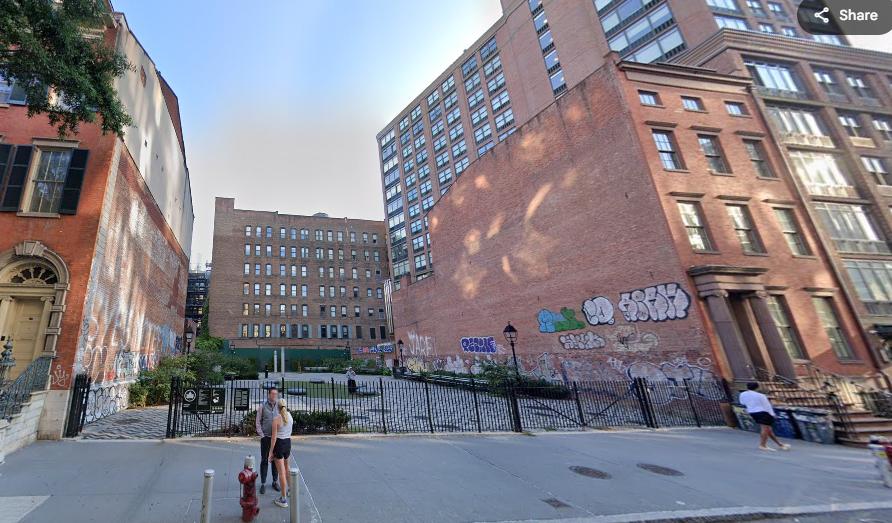
By the early 20th century, the area had been built up and largely commercialized, and very few residences remained. Thanks to these critical landmark designations, the Merchant’s House Museum and the Skidmore House remain the only surviving reminders of a once-elegant row of mid-19th-century residences that defined the block. Read more about the Skidmore House here.