
Churches of the East Village: The East Village Building Blocks Tour

When people think of the East Village, they often think of punk attitudes and political unrest (and for good reason). They don’t necessarily think of religiosity and houses of worship. And that’s unfortunate, because, in fact, the neighborhood has a high concentration of churches that have been built over the past two hundred twenty five-plus years to serve the many different communities that have made the East Village their home. You can explore these through the Church Tour featured on our East Village Building Block website. The tour guides visitors and readers through the rich history and various architectural styles of these institutions. Below is a small sample of some of the churches in the tour, including both one of the saddest and one of the most beautiful and historically significant churches in the city.
St. George Ukrainian Catholic Church, 30 East 7th Street
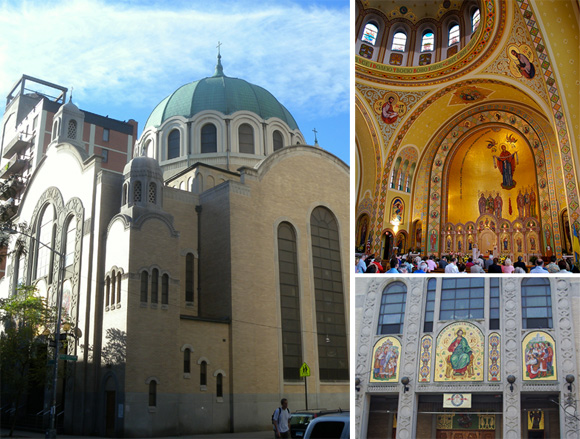
The St. George Ukrainian Catholic Church was constructed in 1978. The congregation, which is in communion with the Church of Rome, first held services in the basement of St. Brigid’s Roman Catholic Church in Tompkins Square in 1890. The Ukrainian community could not afford a building of its own at the time. In 1911, the congregation moved to the Seventh Street Methodist Church, a Greek Revival church built in 1836 on the present site just east of Cooper Square. The congregation then added a squat tower with five onion domes to the top of the front gable. The current Byzantine/Romanesque-style building was designed by the Ukrainian-born architect Apollinaire Osadca. The north entrance bears beautiful byzantine-style polychromatic mosaics.
San Isidoro y San Leandro Orthodox Catholic Church of the Hispanic Mozarabic Rite, 345 East 4th Street
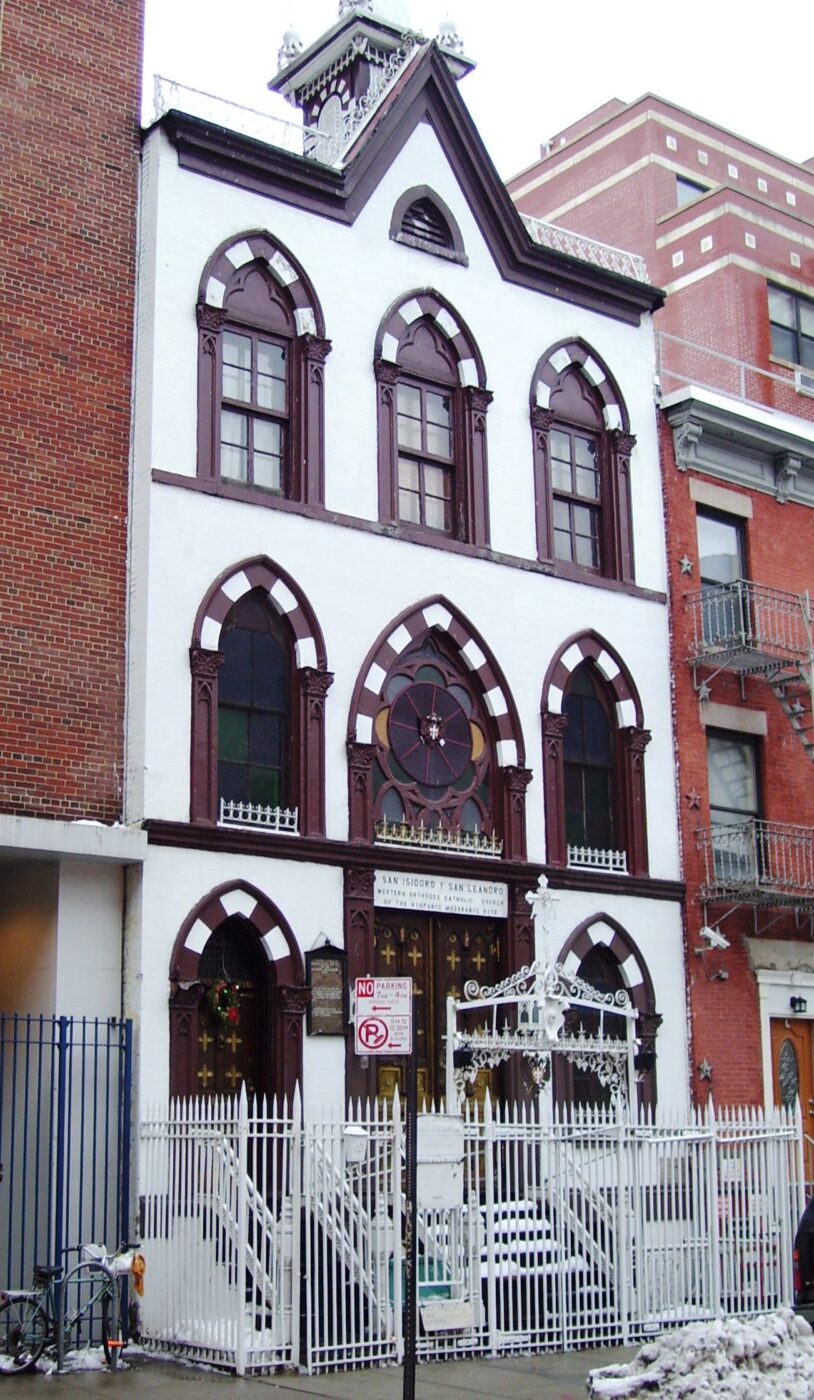
This unique building was constructed in 1891 for the Slovak and Hungarian Catholic Church of the St. Elizabeth of Hungary Roman Catholic Church under the direction of the Reverend Francis Janurchek and architect Edward Wenz. The structure’s form is adorned with Gothic stylings, like multi-color arches and pointed windows with trefoil elements.
The nature of the church’s congregation changed as waves of immigration changed the cultural composition of the neighborhood. By the 1930s, the church had become the home of the Carpathian Russian Orthodox Church of the Holy Trinity, and then of the Russian Orthodox Church of St. Nicholas. The iron gate of the building showcases the coat of arms of the Russian Empire. In 1975, it became home to the San Isidoro y San Leandro Orthodox Catholic Church of the Hispanic Mozarabic Rite (an unusual sect that follows the traditions of crypto-Christians in Moorish-occupied Spain).
The church appears in the background of the cover of Kool Moe Dee’s 1987 album, How Ya Like Me Now.

Church of the Immaculate Conception, 406 East 14th Street

Two buildings currently stand on this lot, both originally built and owned by the Church of Immaculate Conception. No. 406 East 14th Street, the former Grace Chapel, was designed by architect Barney & Chapman and erected in 1894 in stone and Roman brick. The mission closed in 1943, at which point the complex was bought by Immaculate Conception, which had lost its 1858 Gothic Revival church during the construction of Stuyvesant Town.
This building is a great example of Gothic Eclectic architecture and was designated as a New York City landmark in 1966 and added to the National Register of Historic Places in 1980. The church consists of three major sections, a free-standing tower with clean-cut profile at center, a church section with a steep gable facing the street and an attached intimate round chapel, and two wings of three and a half stories with peaked roofs. The four-story building at No. 413 East 13th Street was built in 1945 as a convent and school.
St. Ann’s Church, 120 East 12th Street

In late 2005, NYU announced plans to build a 26-story mega-dorm on the site of St. Ann’s Church, and it demolished the church that same year. All that remains of the once beautiful building is a freestanding shell of its 1847 facade and tower. NYU also demolished the neighboring rectory of St. Ann’s Church along the way.
The church, the architect of which is unknown, was built in 1847 as the Twelfth Street Baptist Church. The building subsequently housed Temple Emanu-El, which was founded by German Jews in 1845, from 1856 until 1868. It then became the St. Ann’s Roman Catholic Church. At that point, the interior was gutted and redesigned in the French Gothic style by architect Napoleon LeBrun, and the new sanctuary was dedicated in 1871. In 1983, the church became St. Ann’s Armenian Catholic Cathedral. In 1985, the funeral mass for performer Jackie Curtis, a “superstar” in Andy Warhol films, was held at this location.
This, reader, is our vote for the saddest church in the city.
Church of the Most Holy Redeemer, 173 East 3rd Street
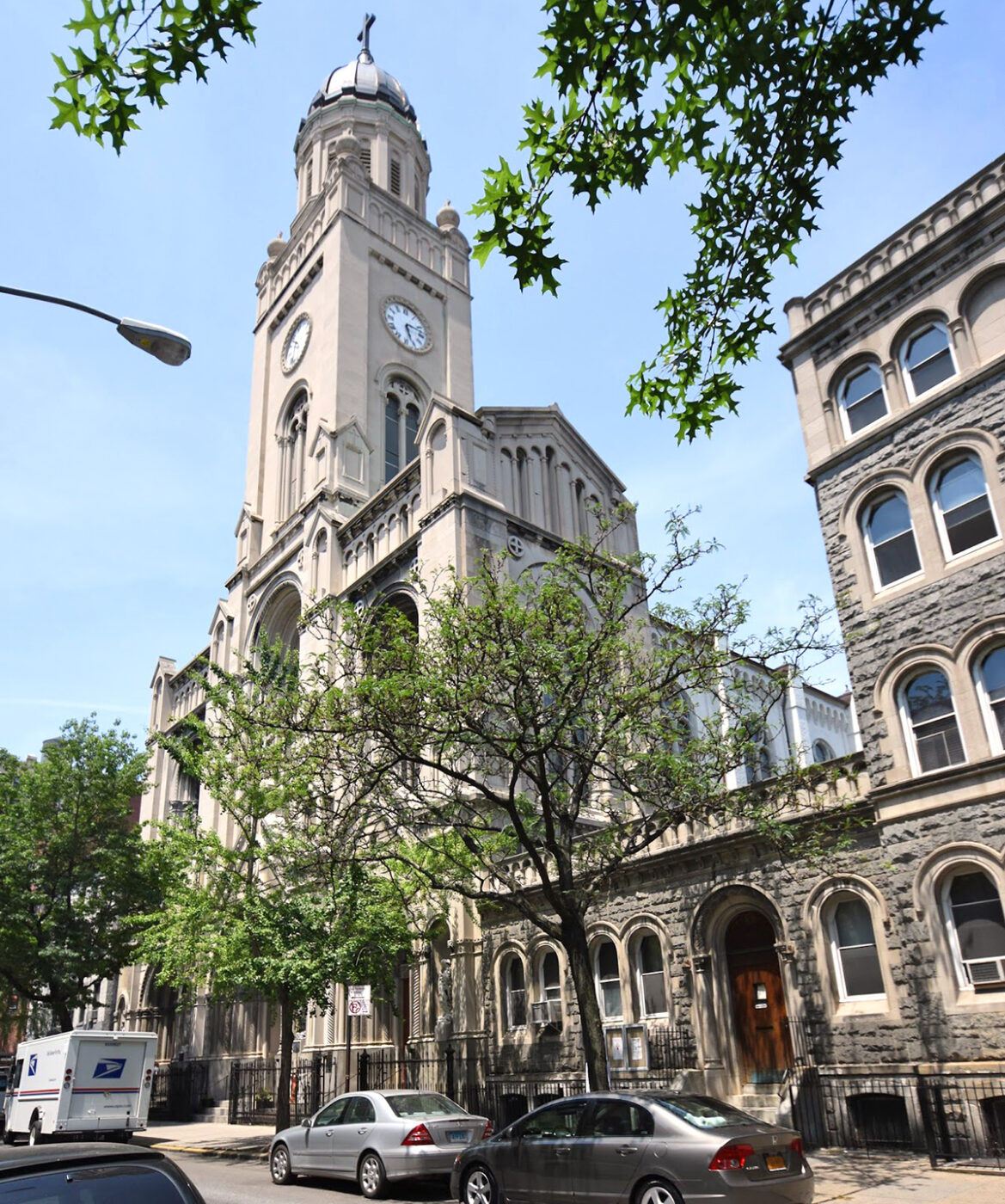
The Church of the Most Holy Redeemer was founded by Redemptorist Fathers and built in 1852 for the surrounding German immigrant community that used to predominate in this part of the East Village. Designed by German architect Joseph Walch, the monumental building was one of the largest churches in New York City at the time of its completion. Although somewhat eclectic, the overall design of the church is in a mix of the Baroque Romanesque and Byzantine Revival styles. Minor interior alterations to the main church building occurred in 1884, when Father Andrew Ziegler, the newly appointed pastor, added new marble flooring, altars, and a communion railing to an already ornate sanctuary that featured original intricate stonework and statuary crafted by German artisans. In 1892, the bones of the martyr St. Daeianus were donated by a private chapel in Italy and laid to rest within the church. Other important figures are interred in the crypt located directly beneath the church, including the remains of 85 Redemptorist priests and brothers.
Despite that rich history, the church’s future remains in doubt, as masses have been halted there. Village Preservation is working with fellow local preservation organizations and parishioners to preserve the church.
Read more about the church’s fascinating history HERE, in our letter to the NYC Landmarks Preservation Commission, urging them to landmark the structures (you can also learn more about the building’s history from our recent program HERE). More importantly, you can join our campaign to save Most Holy Redeemer.
You can learn about other churches in our tour HERE. But why stop there? Check out other tours on the East Village Building Blocks site, such as the ones about Kleindeutschland, the Yiddish Rialto, Little Ukraine, Loisaida, punk rock, or the squats movement. And while you’re there, explore the rest of the site. It contains a comprehensive map of the East Village that allows you to go block by block, learning about each building along the way. Or you can just look up any building individually and discover its date of construction, original architect, original owners, and original use. You will also learn about famous tenants and events associated with it, and find links to additional documents with further information. Finally, East Village Building Blocks also encourages you to share images, artwork, memories, and histories related to any East Village site. That way, everyone can collaborate in the telling of the neighborhood’s story.