
Co-Named Streets Commemorate Local Heroes, Part V
We’ve all seen them: signs tucked under the official names of local streets, honoring a neighborhood notable with a “Way,” “Place,” or “Corner.” Unfortunately, more often than not, the people on these “co-named” street signs are often unknown to most passers-by. But a New York City agency has offered a way for those who are interested to get to know these local heroes and institutions a little better.
The New York City Department of Records and Information Services has assembled an interactive map to help people decipher the signs and connect with the stories behind nearly 2,500 co-named streets, intersections, parks, and other locations across the city. Our own communities feature a number of sites co-named for those who lived, worked, or created in our midst, each with fascinating stories behind them. (Read the first four parts of the series — covering street honors for people known nationally or hyperlocally — here.)
Loisaida Avenue
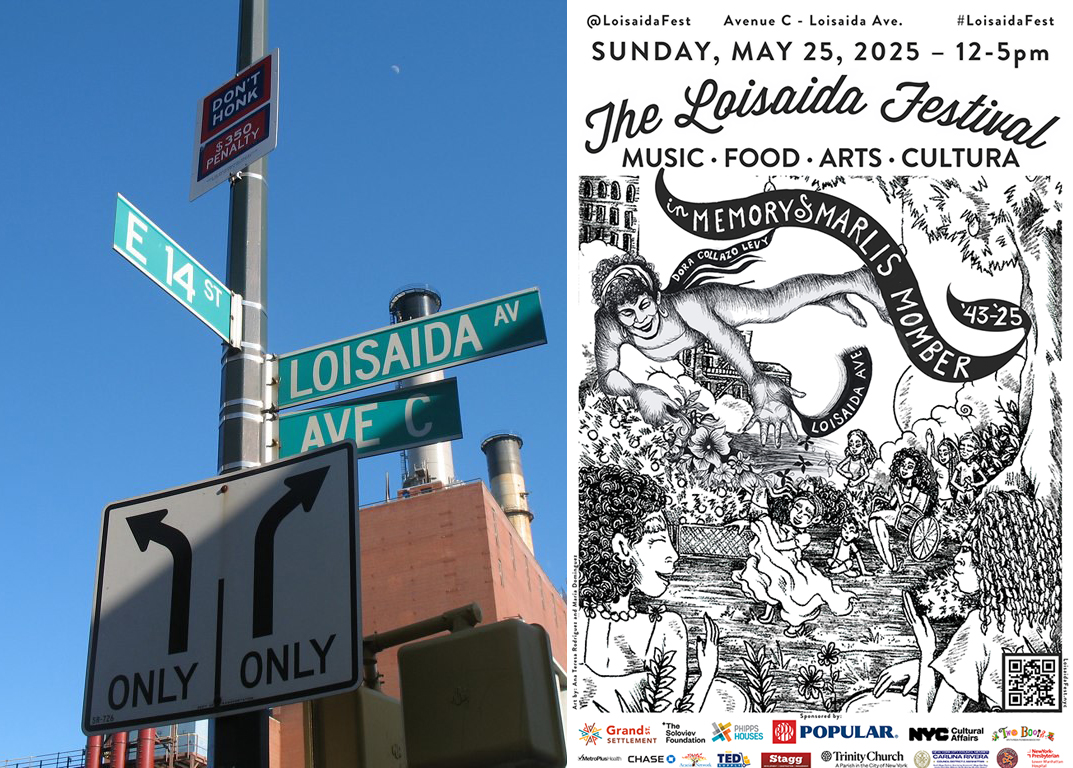
Our first co-named street doesn’t honor just a single individual but rather an entire community. Loisaida is the Spanish/Nuyorican phonetic rendering for the Lower East Side that arose out of Puerto Rican and Latino presence in the neighborhood, which expanded after World War II. The impact of Hispanic life here grew significantly in the 1960s and ’70s as Puerto Rican families, artists, and grassroots groups moved into and fought to preserve their community amid disinvestment and urban renewal pressures.
During the 1970s and ’80s Loisaida became a hub of tenant activism, the arts, and community empowerment projects (including groups like CHARAS/El Bohío and many tenant- and artist-run initiatives), which turned vacant buildings into community space and held together a neighborhood under severe fiscal stress. Those years produced a vibrant local scene of bilingual theater, poetry, murals, festivals, and storefront institutions that anchored Puerto Rican and Latino life in the area even as the city later experienced waves of demographic and economic change.
In recognition of that cultural and civic legacy, the City Council in 1987 designated the stretch of Avenue C from East Houston Street to 14th Street as Loisaida Avenue, a formal acknowledgment of the Puerto Rican community’s imprint on the street and the neighborhood. Since then the Loisaida Festival and other local commemorations have celebrated that history annually.
Read more about the history of Loisaida here.
Wes Joice Corner
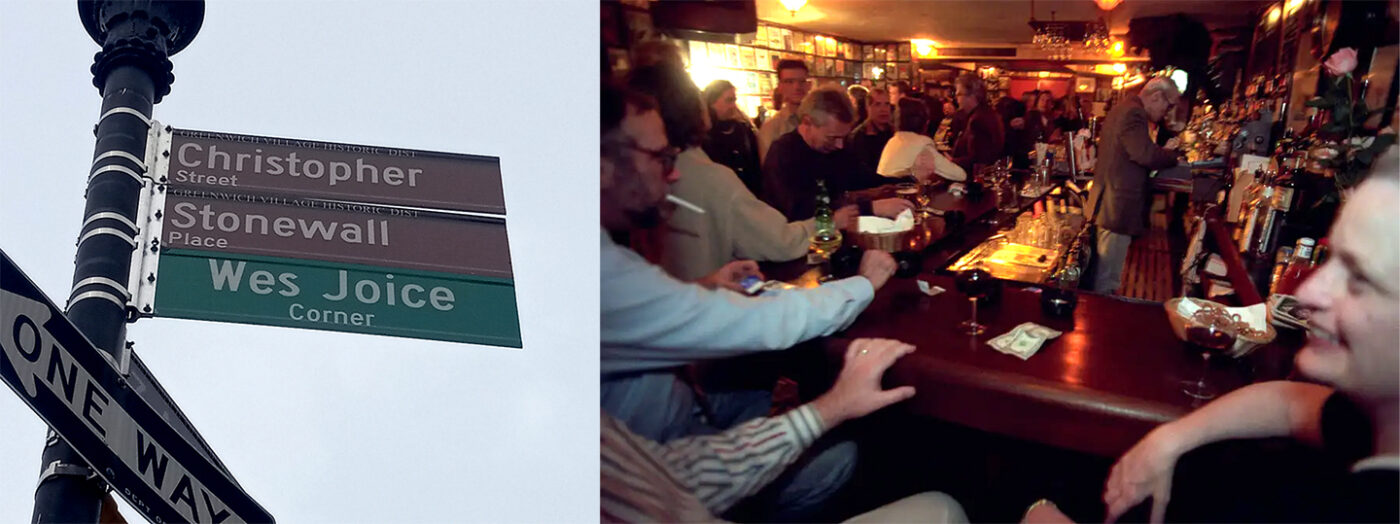
Wes Joice was a minor league baseball player, served in the New York Police Department, and worked as a bartender at watering holes like P.J. Clarke’s. But he was best known as the proprietor of The Lion’s Head, a celebrated bar and literary hangout at 59 Christopher Street. Opened in 1966, The Lion’s Head became known for a diverse clientele, one only slightly eclectic in Greenwich Village: journalists, writers, poets, local politicians, and artists, among others.
The history and character of The Lion’s Head made it a Village institution. The walls were famously decorated with the framed jackets of books published by regulars. The place fostered spontaneous literary and political activity: playwrights scribbled drafts on napkins, and journalist Pete Hamill supposedly talked Robert F. Kennedy Sr. into running for Senate here. Bohemian and blue-collar intersected at The Lion’s Head, a home for drinkers with writing problems that blended conversation, literary ambition, humor, and politics.
By the mid-1990s, however, economic and social pressures caught up with The Lion’s Head. Rising rents, changing drinking and dining habits, shifts in nearby demographics, and the difficulties of maintaining a small-scale institution in a rapidly changing city led to the bar closing its doors in 1996. Three years later, the City renamed the nearby intersection of Christopher Street and Seventh Avenue South as Wes Joice Corner to honor one of the last bastions of the writers’ bar tradition.
Cherry Lane
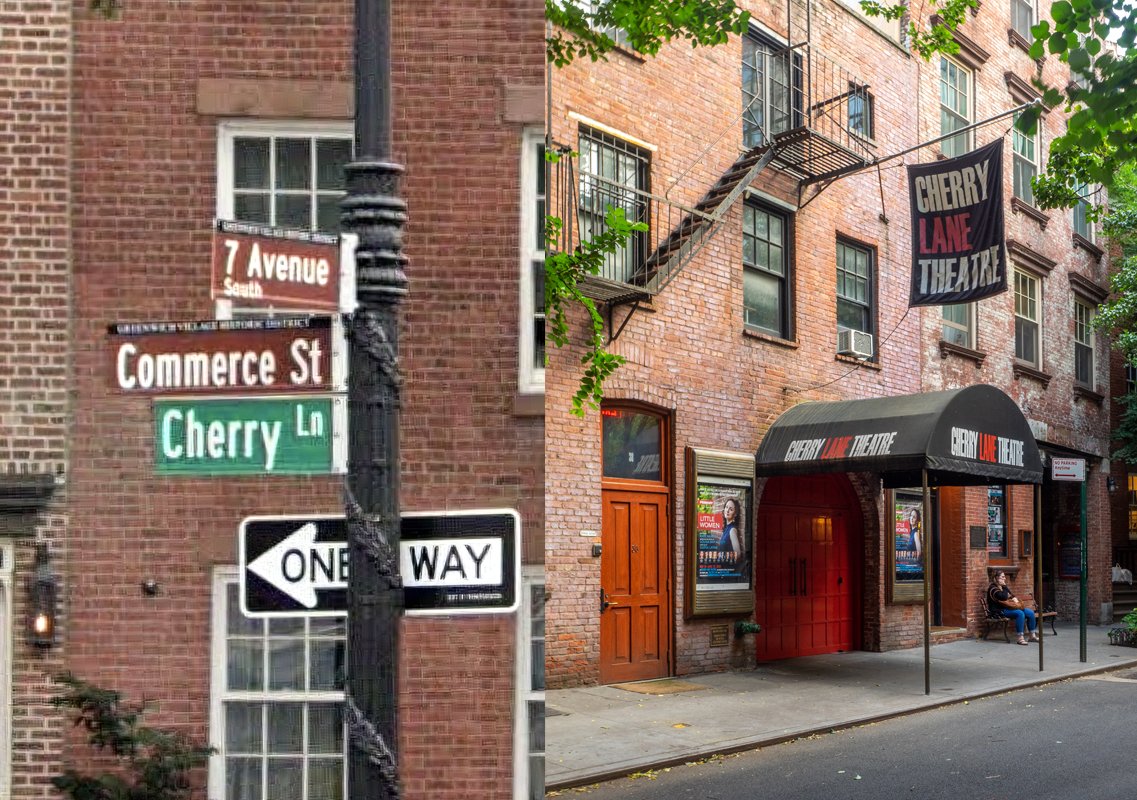
Our third entry was designated to honor one of the city’s most historic theaters. Cherry Lane Theatre at 38 Commerce Street (between Barrow and Bedford Streets) in the Greenwich Village Historic District is the oldest continuously operating Off-Broadway theater in New York City. The building itself dates back to the early 19th century: originally erected as a brewery in 1836 for Alexander McLachlan, it also served as a tobacco warehouse and a box factory before being repurposed in 1923-24 by artists including Edna St. Vincent Millay, William S. Rainey, Reginald Travers, and Evelyn Vaughn. Scenic designer Cleon Throckmorton helped convert the structure into what was then known as the Cherry Lane Playhouse.
Over the decades, Cherry Lane solidified a reputation as a haven for experimental, avant-garde, and boundary-pushing theater. It hosted early work by major dramatists and movements: aficionados of absurdism, the Downtown Theater movement, and The Living Theatre, and writers like Samuel Beckett, Edward Albee, Harold Pinter, Jack Gelber, LeRoi Jones, and Sam Shepard. The setup is modest — a 179-seat main stage and a 60-seat studio for more experimental work — but its impact has been outsized in cultivating new playwrights, taking risks, and anchoring creative life in the Village.
In 2003, Commerce Street between Seventh Avenue South and Barrow Street was both co-named in honor of the theater and renamed Cherry Lane, the original designation for the street.
Thanks to Gil Tauber for creating an honorific, alias-street-name, database that now serves as the city’s standard resource.