
Greenwich Village Writers on Winter
Whose woods these are I think I know.
His house is in the village though;
He will not see me stopping here
To watch his woods fill up with snow.
— Opening stanza to Robert Frost’s “Stopping by Woods on a Snowy Evening.” Frost lived within the Greenwich Village Historic District at 107 Waverly Place in 1920.

Though winter doesn’t technically begin until December 21st, the colder-than-typical temperatures in New York recently have us anticipating the season. And when the seasons shift, we think of the many poets and authors who lived in our neighborhoods and captured snippets of the world around them with their words.
The Greenwich Village Historic District has been home to an abundance of America’s great writers, who were drawn to the neighborhood especially in the 19th and 20th centuries. The recently revamped and updated version of our Greenwich Village Historic District Virtual Map and Tours highlights more than 100 of them in the “Writers’ Homes and Haunts Tours.”
Here is just a sampling from that tour, featuring some of the writers who wrote about winter:
Elizabeth Bishop, 16 Charles Street and 61 Perry Street
We must admire her perfect aim,
this huntress of the winter air
whose level weapon needs no sight,
if it were not that everywhere
her game is sure, her shot is right.
The least of us could do the same.
— Excerpt from “The Colder the Air” by Elizabeth Bishop
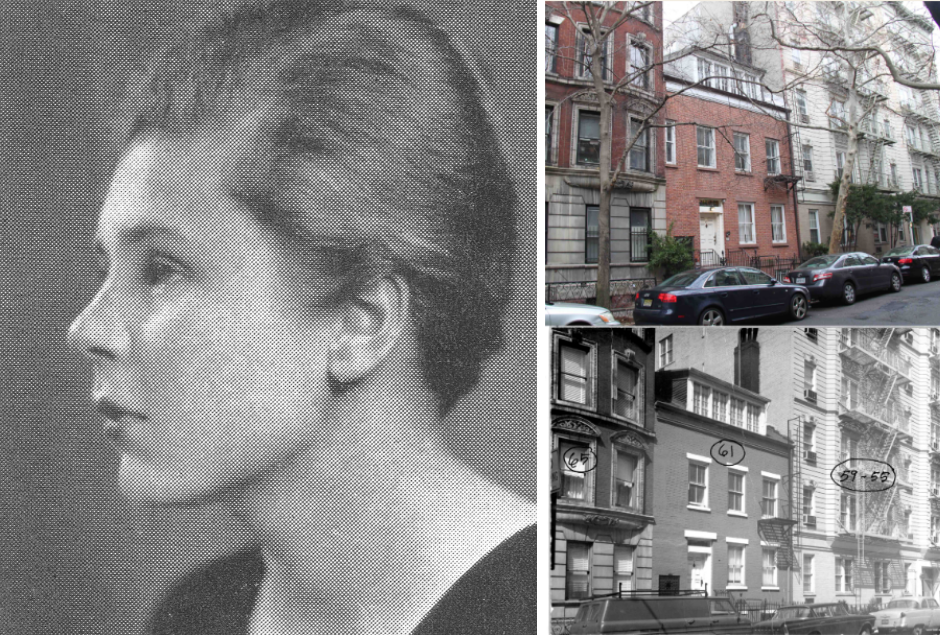
Poet Elizabeth Bishop (1911-1979) lived in a series of apartments in and around Greenwich Village after graduating from Vassar in 1934. The first was a two-bedroom at 16 Charles Street. While living there, she and Marianne Moore, a successful poet 24 years her senior, became close friends. Moore served as a mentor and professional guide to her poetry writing. While Bishop eventually gained celebrity status as a poet, she also produced prose works covering a range of subjects including art, literature, music, fashion, and sports. She was an avid baseball fan and wrote the liner notes for Muhammed Ali’s record, I Am the Greatest!
Another apartment where she often stayed, although her name was never on the lease, was that of artist Loren MacIver and her husband Lloyd Frankenberg at 61 Perry Street. Bishop would visit this apartment from time to time while she lived in Brazil in the 1950s and 60s with her partner, the architect Lota de Macedo Soares. Elizabeth Bishop was the Pulitzer Prize winner for Poetry in 1956, the National Book Award winner in 1970, and the recipient of the Neustadt International Prize for Literature in 1976.
Edgar Allan Poe, 137 Waverly Place
Ah, distinctly I remember it was in the bleak December,
And each separate dying ember wrought its ghost upon the floor.
— Excerpt from “The Raven” by Edgar Allen Poe

Dubbed America’s first bohemian, the writer Edgar Allan Poe’s first home in New York was at 137 Waverly Place. He took up his residence, at the corner of Sixth Avenue and Waverly Place, with his wife Virginia and his mother-in-law, Mrs. Clemm. They did not stay for long, moving in the spring of that year to 113-1/2 Carmine Street, located in the Greenwich Village Historic District Extension II (designated 2010). He would return to Waverly Place in later years to attend Ann Charlot Lynch’s famous literary salons with the likes of William Cullen Bryant, Fitz-Greene Halleck, Horace Greeley, Margaret Fuller, R. H. Stoddard, and Bayard Taylor.
Willa Cather, 35 Fifth Avenue
I sought the wood in winter
When every leaf was dead;
Behind the wind-whipped branches
The winter sun set red.
The birches, white and slender,
In deathless marble stood,
The brook, a white immortal,
Slept silent in the wood.
— Excerpt from “I Sought the Wood in Winter” by Willa Cather
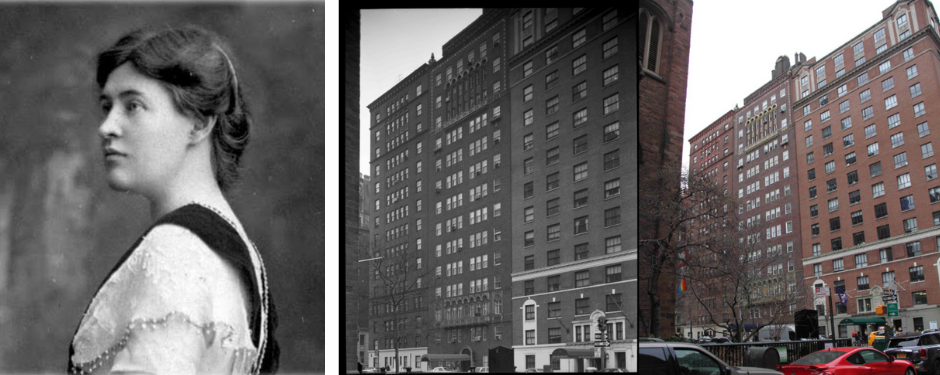
Novelist Willa Cather (1873-1947) and her partner, Edith Lewis, lived in the apartment hotel on Fifth Avenue, the “Hotel Grosvenor,” from 1927 to 1932. Cather was travelling frequently at the time due to a few factors, including family illness and the growing demands of her career, which was at its peak. She also published Shadows on the Rock (1931), a historical fiction novel about a Québécois family in the 1690s, during this period.
It is said that Cather didn’t enjoy living at the apartment hotel, and even considered relocating out of the city entirely, but she was encouraged to stay for the sake of her career. The couple eventually moved to an apartment further uptown, at 750 Park Avenue. The Hotel Grosvener was converted to an NYU dorm in the 1960s.
Edna St. Vincent Millay, 156 Waverly Place and 75 ½ Bedford Street
Never, never may the fruit be gathered from the bough
And harvested in barrels.
The winter of love is a cellar of empty bins,
In an orchard soft with rot.
— Excerpt from “Never May the Fruit Be Picked” by Edna St. Vincent Millay

Edna St. Vincent Millay (1892-1950) lived in several houses in Greenwich Village prior to moving with her husband to Austerlitz, New York in 1925. She is most often associated with her residence at 75 ½ Bedford Street, “the narrowest house in the Village,” where she lived from 1923-24. The house, a three-story building with an unusual stepped gable, is reminiscent of the Dutch tradition. Directly prior to her time on Bedford Street, Millay briefly lived at 156 Waverly Place. She also lived at 139 Waverly Place in 1917 after graduating from Vassar College.
The Greenwich Village Historic District designation report (which, along with all landmark designation reports for sites within our neighborhoods, can be found on our website) says of Millay: “[A] gentle poet, her loving nature made itself felt to her generation, enriching their lives through its beauty.”
“Writers’ Homes and Haunts” is one of many thematic tours in the Greenwich Village Historic District Virtual Map and Tours. Take the opportunity to delve deeper into our neighborhood through the updated interactive map website here.