
Hidden Gems in the Archives: How a Single Line Revealed the Adamses of Richmond Hill
Every so often, a researcher has the joy of stumbling upon a detail so small, so quiet, that it almost feels like a secret whispered across time. At Village Preservation, we’ve grown used to finding delight in the margins, footnotes, and parenthetical asides of the landmark designation reports for sites that have been selected for landmark status by the NYC Landmarks Preservation Commission. But every so often, one of those hidden clues sends us on a journey we didn’t expect, and reveals a new window into the many layers of the history of our great city.
That’s exactly what happened when we were paging through the landmark designation report for the Charlton-King-Vandam Historic District. There on page one, barely more than a passing mention, was a simple note indicating that John and Abigail Adams had lived at Richmond Hill, the grand estate located here before the street grid, rowhouses, and the city as we know it came to replace it.
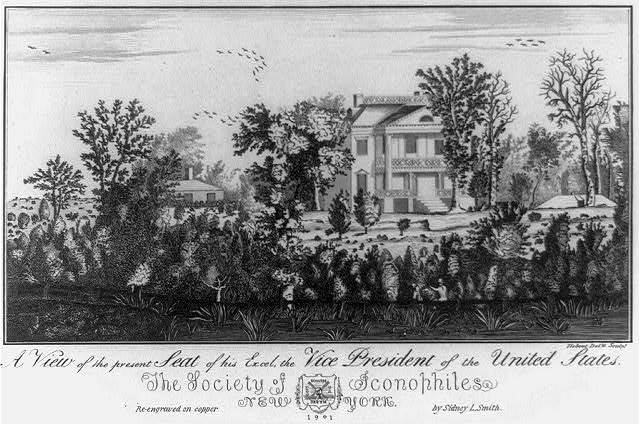
It was the kind of detail that could easily be overlooked. But once we saw it, everything else stopped. We had stumbled upon a thread, and pulling it revealed a remarkable chapter of early American history right in the heart of today’s Charleton-King-Vandam Historic District.
Richmond Hill: A Country Estate for America’s First Leadership
Long before the area was filled with Federal-style rowhouses and the hum of a growing city, Richmond Hill was a sweeping estate complete with gardens, orchards, and commanding views of the Hudson. When New York City briefly served as the nation’s capital, the estate became deeply entwined with the country’s earliest political life.
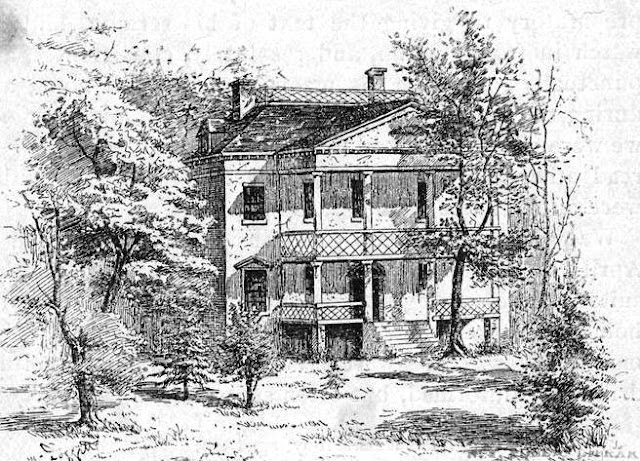
During this period, Vice President John Adams and his wife, Abigail (November 22, 1744 – October 28, 1818), resided at Richmond Hill, which served as the official residence of the Vice President of the United States and his family. For the Adamses, so often separated by duty, travel, and revolution, the house became one of the rare places where the couple spent an extended time together.
The image of John Adams commuting from what was essentially an elegant country house to the seat of the fledgling federal government at Federal Hall on Wall Street adds a wonderfully human dimension to the era. And for Abigail Adams, Richmond Hill represented something even more profound.
Abigail Adams: A Voice Ahead of Her Time
Abigail Adams stands as one of the most influential women in early American history. Though she never held formal office, her intellect, advocacy, and political insight shaped the nation at its birth. She is, of course, remembered for her famous admonition to her husband as he was framing the laws of the new republic: “Remember the ladies, and be more generous and favourable to them than your ancestors. Do not put such unlimited power into the hands of the Husbands.” But she was far more than a writer of pointed letters.
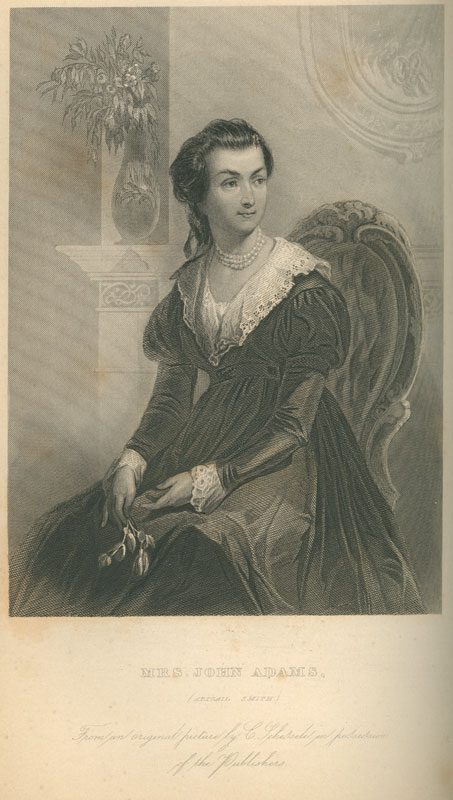
She was a keen observer of politics, a manager of family affairs during long years of separation, and a woman with a fierce sense of justice. She championed women’s education, questioned inequalities, and pushed hard against the boundaries of her time. Her correspondence with John, steadily maintained through war, diplomacy, and political upheaval, and chronicled in the years-long correspondence between the two of them, remains one of America’s great documentary treasures. They provide a comprehensive record of their 54-year marriage and the founding of the United States, providing insights into both private family life and major historical events.
At Richmond Hill, Abigail brought that sharp mind and unmistakable voice into the heart of the young nation’s political life. From this estate, then just outside the dense part of New York, she engaged with visiting diplomats, political thinkers, and community leaders, all while navigating the complexities of being the Vice President’s wife in an era when the role of “First Lady” had barely taken shape.
In her letters, Abigail offered vivid descriptions of Richmond Hill’s natural beauty, calling it “one of the most beautiful spots in the world.” She described the fresh air, wide gardens, and sweeping western views to the Hudson River. It was, for her, a welcome respite from the crowded conditions of lower Manhattan, where the early government buildings were clustered.
Rediscovering History, One Hint at a Time
Finding a reference to the Adamses’ residence at Richmond Hill tucked quietly into a landmark designation report is exactly the kind of discovery that reminds us why preservation work matters so deeply. These reports aren’t just architectural descriptions. They are repositories of memory, context, and stories waiting to be rediscovered.
Village Preservation’s work, and the designation reports that safeguard this district’s significance, ensures that the memory of places like Richmond Hill endures. Through them, we can better appreciate those like Abigail Adams who once found inspiration, refuge, and beauty right here in what is now one of New York’s most historically rich neighborhoods. In the case of the Charlton-King-Vandam Historic District, a single line connected a centuries-old estate, a transformative moment in the nation’s early history, and one of America’s most extraordinary women to the streets we walk every day. We invite you to take a journey through our archives to see what threads of history you can unravel!