
Little Flatirons of the Village: Architecture with Angles
One of New York City’s most iconic landmarks is the Flatiron building. Located just north of our neighborhood on 23rd Street, its relatively rare triangular plot is formed by the intersection of the orthogonal street grid at Fifth Avenue with the diagonal of Broadway. But in Greenwich Village, the meandering, irregular street grid creates a number of similarly odd-shaped lots engendering triangular, or “flatiron” structures. Today we take a look at a some of these “Little Flatirons” which are included on the Little Flatirons of the Village Tour in the newly updated version of our Greenwich Village Historic District Virtual Map + Tours. Originally created in 2019 to celebrate the 50th anniversary of the Greenwich Village Historic District, the map includes Then & Now photographs of the entire district and nearly two-dozen thematic tours.
The Northern Dispensary 163-169 Waverly Place/34 Christopher Street
Perhaps no idiosyncrasy of the Greenwich Village street pattern is more charming than the peculiar fluke of Waverly Place intersecting with itself, just south of Christopher Street, between Grove and Gay Streets. Named in 1833 after the recently-deceased Sir Walter Scott’s novel “Waverly” about the 1745 Jacobite Revolution in Scotland, Waverly Place is an east-west street from its eastern origin at Broadway, though known as Washington Square North between University Place and MacDougal Streets. But west of Gay Street it splits into two branches, with one continuing west a few yards and terminating at Grove Street, with another veering sharply to the northwest, and continuing onward until its abrupt end at Bank Street. This results in a single Greenwich Village block bounded by the intersection of Waverly Place, Waverly Place, Grove Street, and Christopher Street.

Adding to the curious appeal is the building which occupies this unusual block. The triangular (trapezoidal, actually, if you count a chamfered corner) Northern Dispensary, erected in 1827, is one of Greenwich Village’s strangest mysteries. Built on land donated by the city with the stipulation that it only serve the indigent poor who could not afford medical care, it was known as the “Northern Dispensary” because it was where such care was dispensed to those in need, at what was then the northern edge of New York. One of its most famous patients was a down-on-his-luck Edgar Allan Poe, who came in 1837 complaining of a winter cold.
From the 1960s through the 1980s, it was a dental clinic, but it shut down when it refused to treat patients with AIDS. The Archdiocese of New York then purchased the property and sought to locate a hospice for people with AIDS in the building, but that plan was scuttled. In the late 1990s, the building was sold to William Gottlieb, who died a year later. After laying empty for more than 30 years, in 2021, God’s Love We Deliver, a non-profit that cooks and delivers nutritious, medically tailored meals for people affected by severe and chronic illness.
10 Sheridan Square/80-82 Grove Street/139 Washington Place

10 Sheridan Square is perhaps the most elegant “mini-flatiron” in Greenwich Village, and carries an elegance often associated with inter-war Manhattan apartment houses. That’s because it was designed in 1928-29 by Emery Roth, the dean of elegant pre-war apartment designs in New York. Though Roth also designed the equally elegant Devonshire House on University Place, he is more strongly associated with his Uptown apartment house designs, such as the El Dorado, the San Remo, and the Beresford, all on Central Park West.

Now a rental known as The Shenandoah, its narrow west corner actually bears some delightful stone detailing portraying fantastic sea creatures, which appears to have inspired the name of the gay bar, The Monster, found in the building’s ground floor since 1970.
234-240 West 13th Street/110-118 Greenwich Avenue
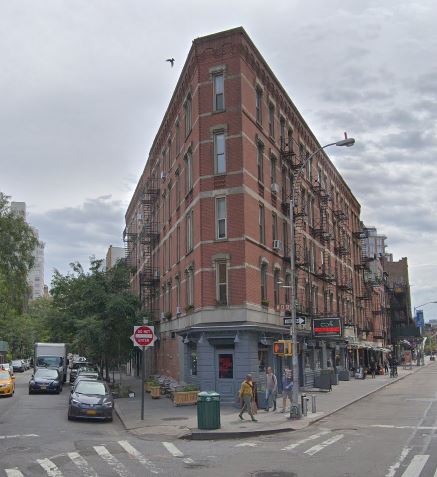
234-240 West 13th Street’s prow-like western edge forms at the intersection of Greenwich Avenue and 13th Street. Also known as 110-118 Greenwich Avenue, and originally known as the Jackson Studio Apartments, the building was constructed in 1882 to the designs of renowned architect George F. Pelham as studio apartments.
82 Seventh Avenue South/301 Bleecker Street
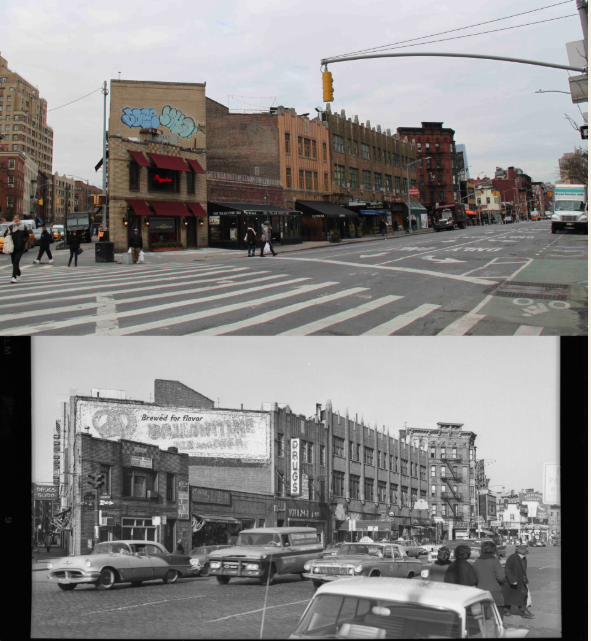
A number of these “Little Flatirons” are located along Seventh Avenue South — which was extended through the neighborhood between 1911 and 1917, creating triangle shaped lots as it jutted through the existing streets. One example is 82 Seventh Avenue South, at the intersection of Bleecker. This delightfully slim, two-story flatiron was constructed in 1926 for the Rayburn Holding Company. Since 1969, its central triple-windows on the first and second floors – representative of its architectural period – have been converted to large single-glazed windows. Still, the building maintains its distinctive stepped parapet with a checkerboard panel of brickwork.
92-100 Seventh Avenue South
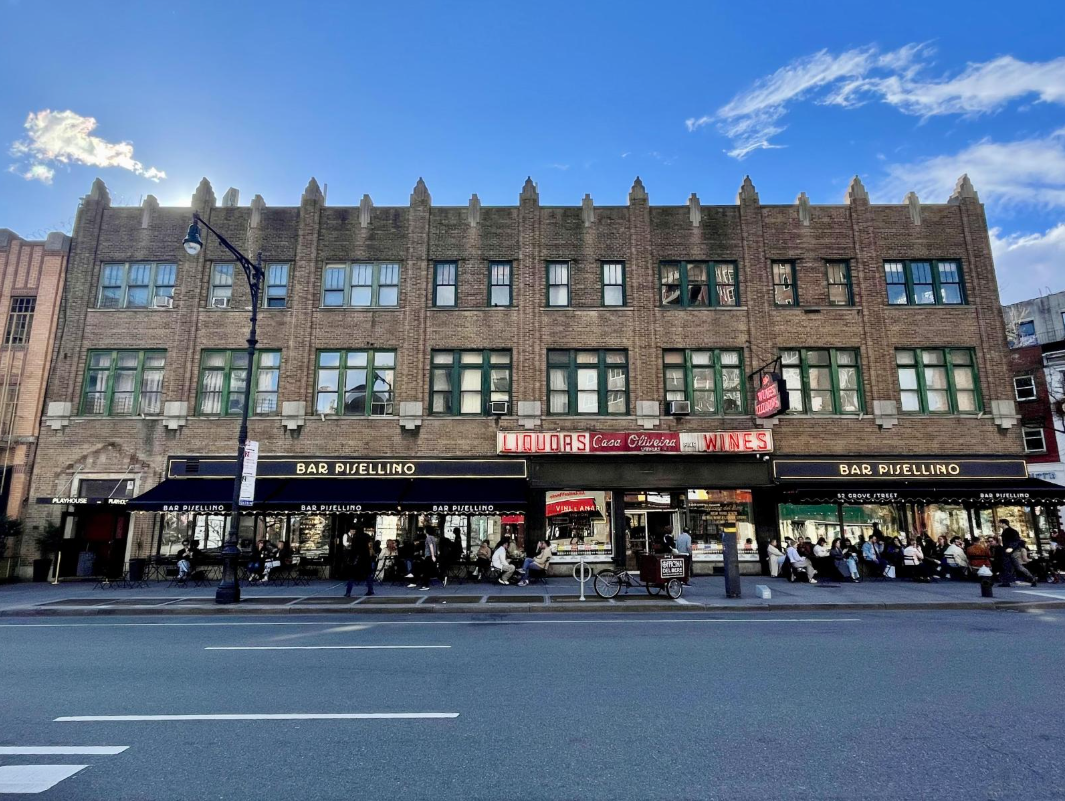
Another instance of the Seventh Avenue South triangular lot phenomenon is located just up the block, at 92-100 Seventh Avenue South, where the avenue meets Grove Street. The three-story flatiron was constructed in 1933 by architect Matthew W. DelGaudio for Raffaele Ruggiero. With its large windows and brick uprights that rise above the parapet line, this building serves as a strong representation of its art deco style and is also included on our Art Deco Map which explores examples of the style throughout our neighborhoods.
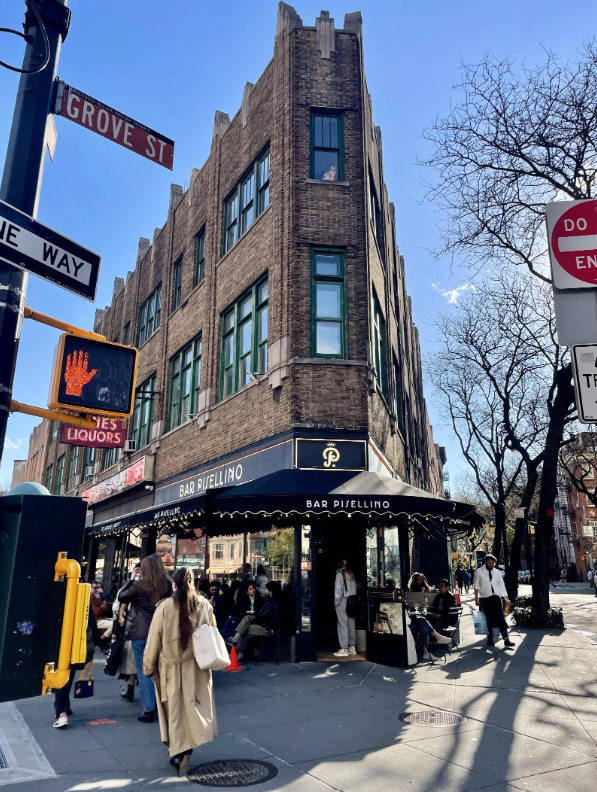
These are only a few of the sites included on our tour of Little Flatirons of the Village, which is one of many tours in the Greenwich Village Historic District Virtual Map and Tours. Take the opportunity to delve deeper into our neighborhood through the updated interactive map website here.