
Winding Origins: How Greenwich Village Streets Got Their Names
Unlike the regimented grid of most of Manhattan, Greenwich Village’s streets meet at irregular angles and follow unique paths. Already a somewhat developed neighborhood by the time of the 1811 commissioner’s street grid plan, the Village’s geography is built upon the roads created from its days of early colonial settlement.
The neighborhood’s street names also depart from Manhattan’s system and feature many unique names with fascinating histories. As a part of Village Preservation’s newly updated Greenwich Village Historic District Virtual Map and Tours, we detail the interesting and often complex processes by which our neighborhood’s streets got their current names. Today, we will take a look at a few of these, which you can peruse in more detail in the “Street Name Origins” tour.
Waverly Place
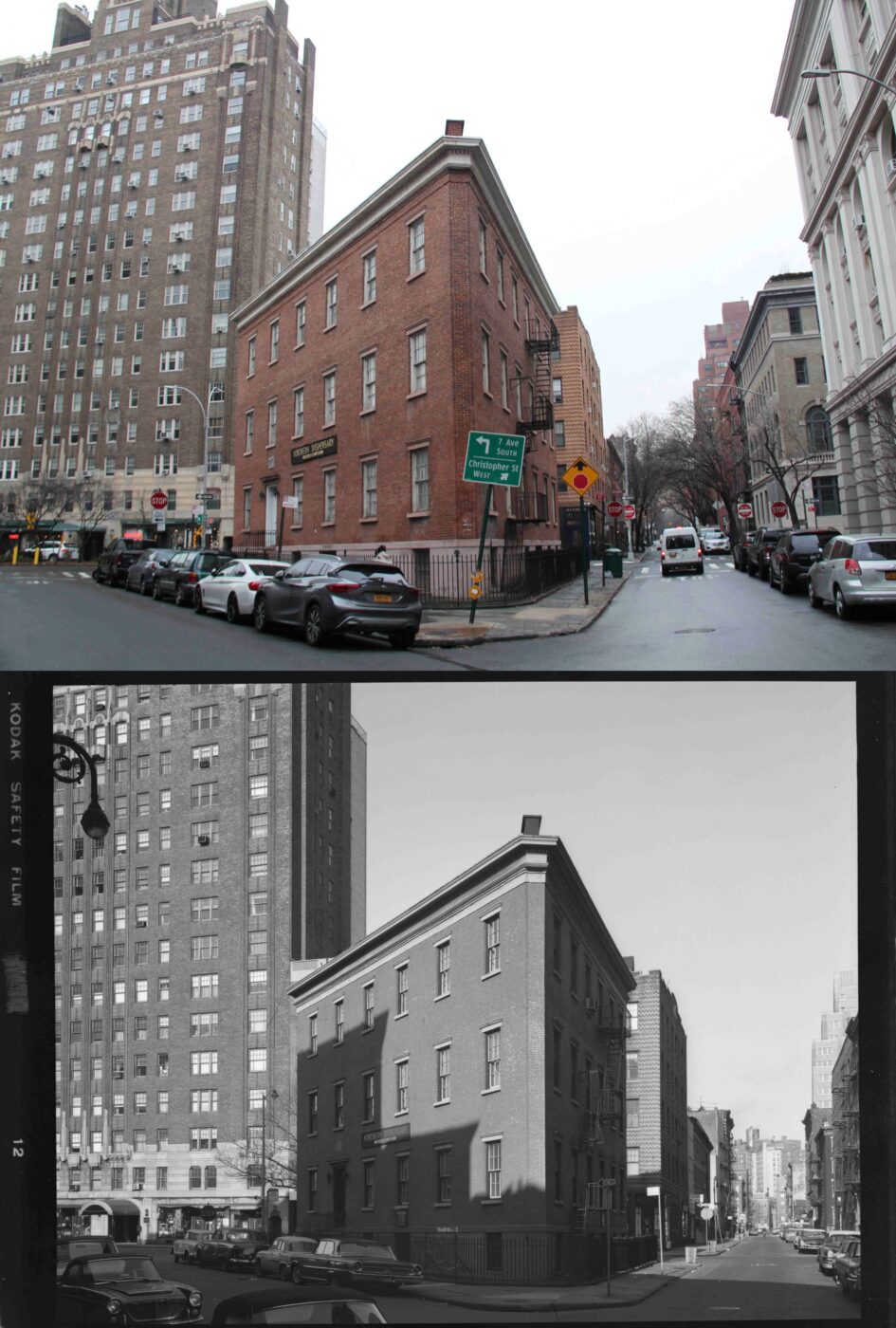
Waverly Place receives its name from Sir Walter Scott’s 26-novel series known as Waverley, which was published between 1814 and 1831.
Waverley was the name of the first title, published in 1814, but Scott did not claim authorship until 1827. Initially, all of the following books simply noted “by the author of Waverley.” When Scott died in 1832, Villagers honored him by naming a street after the novel. Prior to 1833, it was known as Art Street.
“Waverly Place” is a phrase that rings familiar in the ears of newer generations for a host of reasons. It was the film/TV location for Don Draper’s bachelor pad on Mad Men; Will Smith’s character’s townhouse in I am Legend; and the setting of the Disney Channel’s hit series, Wizards of Waverly Place, in which Selena Gomez competed with her wizard siblings to win custody of the family powers with their magical abilities.
Christopher Park
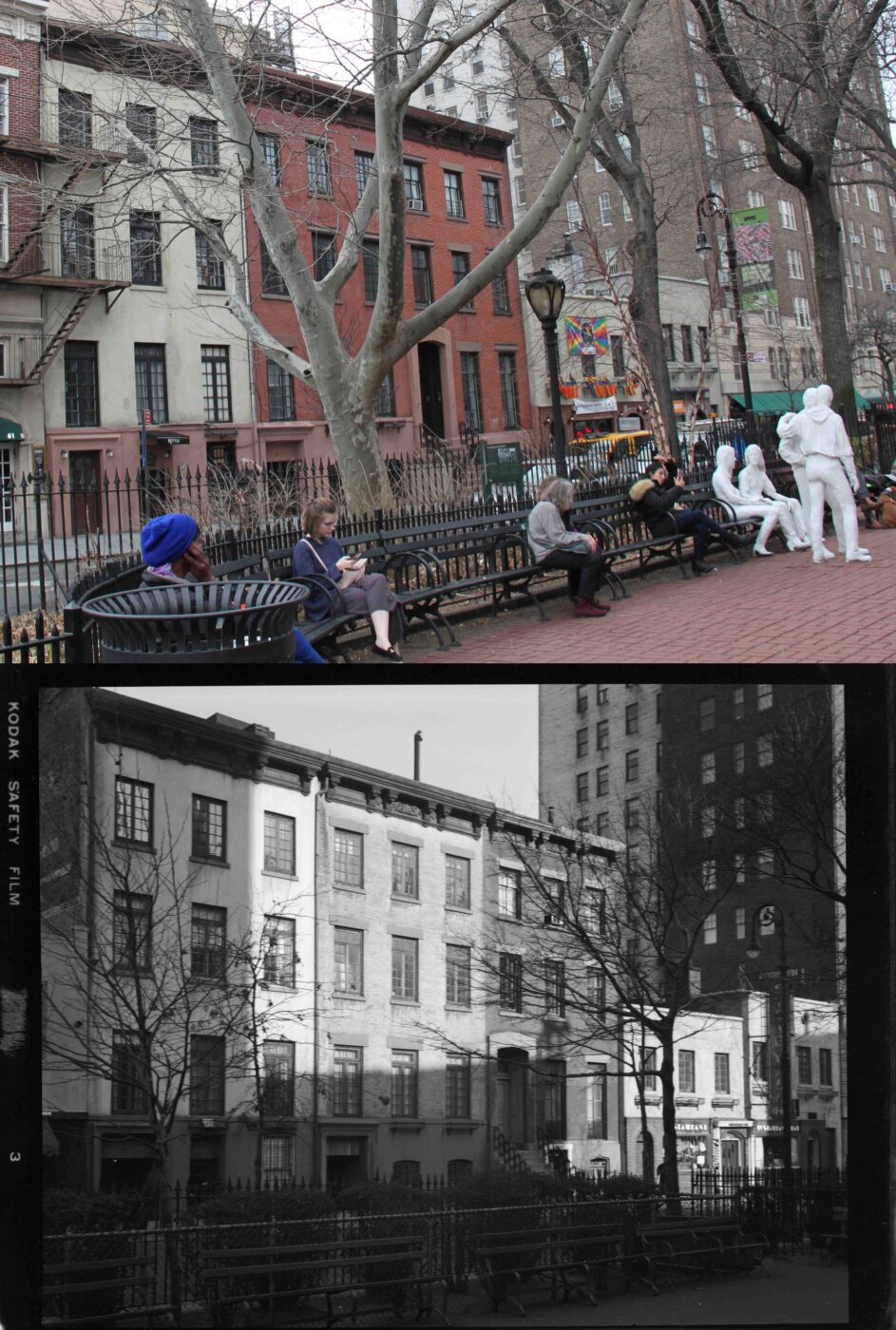
Charles Street, Christopher Street, and Christopher Park were all named for Charles Christopher Amos.
The land under much of Greenwich Village was developed as a tobacco farm by Wouter Van Twiller, who served as the fifth of seven Director-Generals of New Netherland from 1633 to 1638.
Following Van Twiller’s death in 1654, his land was divided into three farms: The Trinity Church and Elbert Herring farms to the south and Admiral Sir Peter Warren’s farm to the north, which were divided by Skinner Road. Skinner Road was named for one of Warren’s sons-in-law, British Colonel William Skinner.
In 1799, Warren’s land was acquired by a trustee of Warren’s estate, Richard Amos, eventually passing to relative Charles Christopher Amos. He renamed Skinner Road Christopher Street, which makes Christopher Street one of the oldest streets, if not the oldest street, in the Village.
He also named Charles Street after himself. Some believe he also named Amos Street after himself, while others believe it was named for Richard Amos. Charles Street remains, but Amos Street was renamed West 10th Street in 1857.
Christopher Park was created in 1835. Following a fire, local residents petitioned the City to condemn the triangular area and provide open space on the block bordered by Christopher, Grove, and West 4th Streets. On April 5, 1837, the City created Christopher Park.
Grove Street / Grove Court
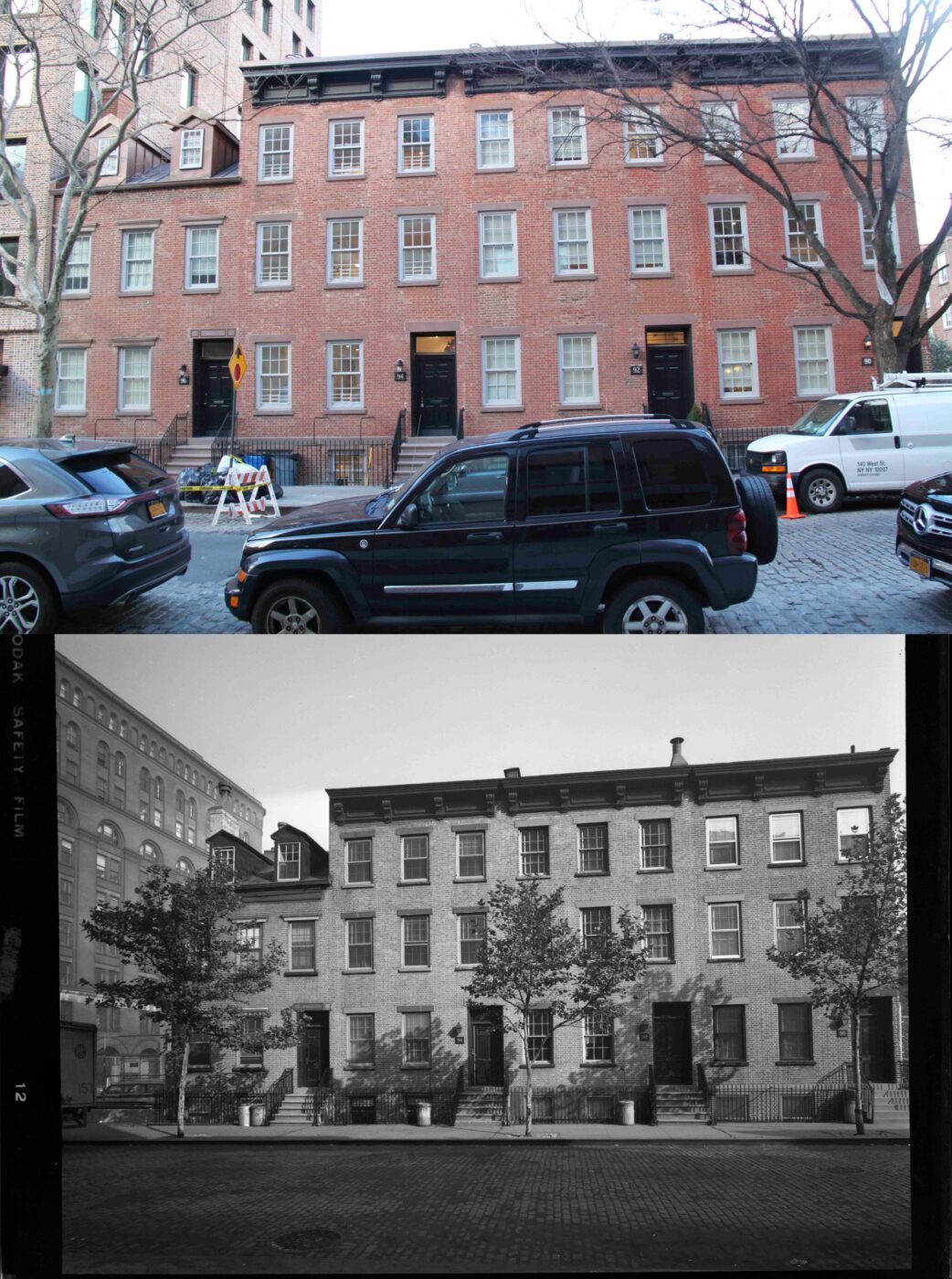
Grove Street and Grove Court are named for the verdant groves that were found in the area prior to its development in the mid-19th century.
In 1799, the street was named Columbia Street. It was soon changed to Cozine Street after a well-known local family, then to Burrows Street after Captain William Burrows. The captain of the U.S.S. Enterprise in the War of 1812, Burrows captured the H.M.V. Boxer in a battle on September 13, 1813 in which both ship captains were killed.
Due to confusion with nearby Barrow Street, the street’s name was later changed to Grove Street. The six small Grove Court brick townhouses were built in 1853-1854 to house laborers and tradesmen. The area was nicknamed “mixed Ale Alley,” after the cheap liquor drank by the working-class residents.
Grove Court survived a 1950s demolition plan, and this private enclave is now one of the most coveted rows of townhouses in Greenwich Village. Grove Court is also well-noted for being the setting to O. Henry’s 1907 short story “The Last Leaf.” The 1952 film version was shot on location.
Barrow Street
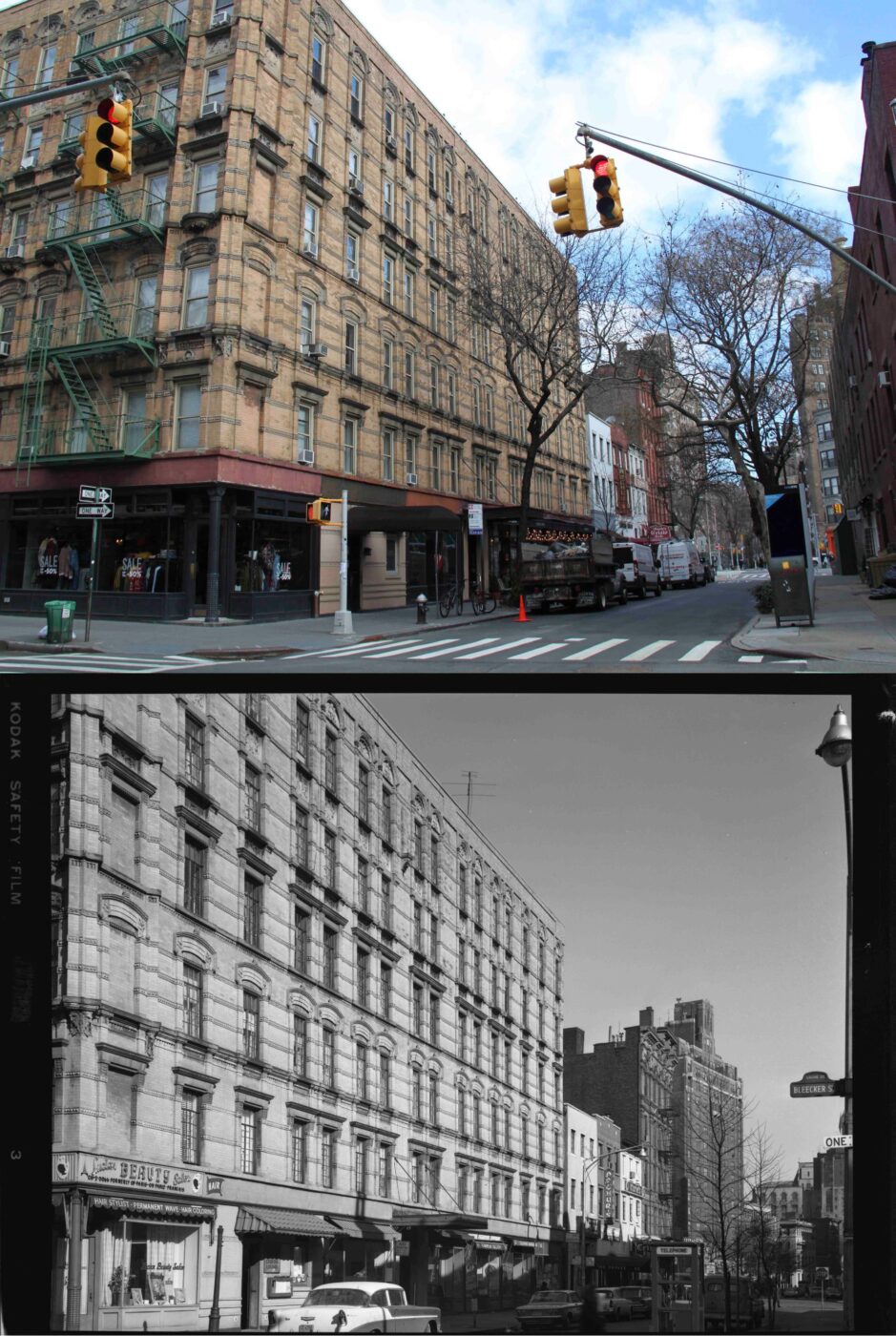
Barrow was originally named Reason Street after Thomas Paine’s Age of Reason, the first part of which was published in 1795.
Paine fell from favor in the early 19th century with both the general public (specifically religious Christians), and Trinity Church (which owned land on the street), because Age of Reason argued for Deism in place of organized religion. In fact, for years, many derisively referred to Reason Street as Raisin Street, mocking the author and his works.
The street was then renamed Barrow Street in 1828 for Thomas Barrow. Barrow was an artist, a wealthy landowner, and a vestryman at Trinity Church. He became famous after his 1807 print of Trinity Church burning to the ground on September 21, 1776, was widely distributed.
The main building of the settlement house, Greenwich House, founded in 1902, has been located at 27 Barrow Street since 1917. It has provided a wide variety of social programs to Village residents, specifically children and seniors, founded the Greenwich House Music School in 1905, and provided critical services during the AIDS crisis.
Bethune Street
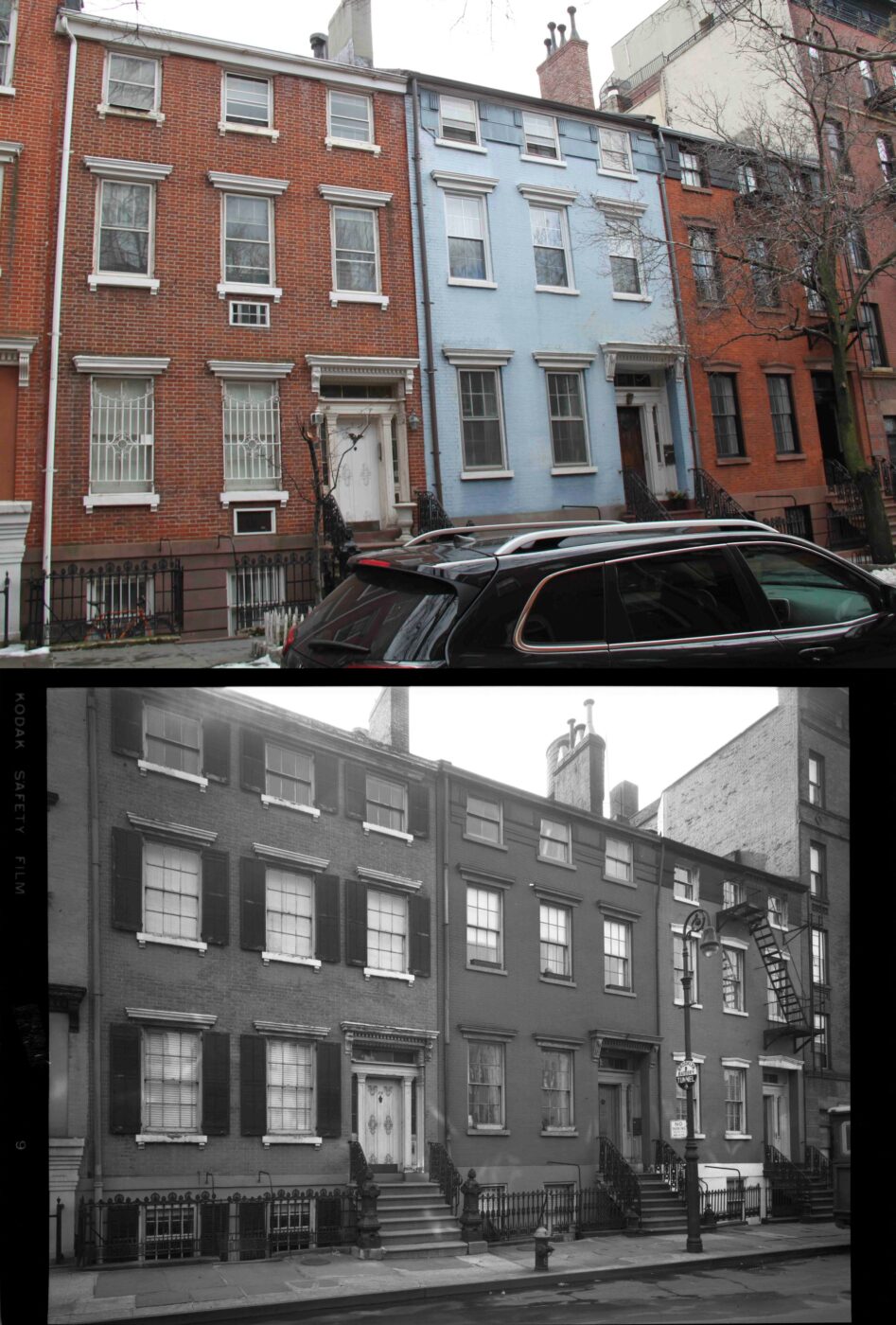
Bethune Street is one of the few streets in our series that is named for a woman. Joanna Graham Bethune was an early 19th-century educator and philanthropist who ceded the land for the street to the city. Joanna, along with her mother Isabella, were founders of some of the first charitable associations to aid poor women and children.
Joanna Bethune opened the first school for “young ladies” and in 1806, joined Mrs. Alexander Hamilton in founding the New York Orphan Asylum at Barrow and Fourth Streets, which was demolished in 1833.
Find out about dozens of other fascinating street name origins as a part of our GVHD Virtual Map + Tours. As a part of this map and series of tours, you can discover many more aspects of Greenwich Village’s history, including the filming sites of notable films and television shows, homes of impactful preservationists, and much, much more.
I realize that the Christopher Amos story retold here originated from what appeared to be otherwise reputable sources, but close inspection of the documentary record shows that it amounts to an urban legend unsupported by primary evidence almost certainly borne from the names of three streets clustered together. Richard Amos was my sixth great-grandfather, and his son-in-law and eventual co-executor of Richard’s will, Joseph Jenkins Van Beuren, was my fifth great-grandfather. My interest in correcting the record comes from direct examination of the land conveyances, probate records, and estate documents associated with the property.
The property indenture recorded in Liber 53, Page 1 clearly shows that Richard Amos purchased the land outright from Willoughby Bertie, Fourth Earl of Abingdon (namesake of Abingdon Square), who held title through his wife Charlotte Warren, daughter and heiress of Admiral Sir Peter Warren. Amos was the buyer, not a trustee. The Earl’s trustee in the transaction is explicitly identified as John Watts. The indenture also names the prior tenant, Charles Oliver Bruff, who evacuated New York for Nova Scotia in 1783. If Charles Street and Charles Lane were named for any individual associated with the property at that time, Bruff is the only Charles documented in possession of the land prior to Amos’s purchase. Richard Amos indeed had a son named Charles, but he was born in 1804 (after the streets were already established) and he predeceased his father, therefore did not have controlling interest in any land, and certainly not enough to go around naming everything after himself.
The record of Amos’s own conveyances makes his ownership clear. Beginning with his purchase in 1788, Amos subdivided and sold portions of the tract continuously until shortly before his death in 1837, averaging roughly one sale every eight to nine months over nearly fifty years. This sustained pattern of sales is consistent with a private landowner developing his property—not a trustee temporarily holding land for someone else. Amos also conveyed land to the City of New York for the laying out of Greenwich Street, Hudson Street, and Amos Street (later West 10th Street), further demonstrating his full proprietary control.
The kernel of truth that the “Charles Christopher Amos” street naming urban legend sprung from rests solely in the fact that West 10th Street was originally named Amos Street for Richard Amos. All alternate theories regarding namesakes for either Charles or Christopher Streets lack confirmation and only the unconfirmed Charles Oliver Bruff theory conveyed above is supportable by primary evidence.
Equally telling is the complete absence of any “Charles Christopher Amos” in the documentary record. No such individual appears in family records, land conveyances, probate documents, census records, or Richard Amos’s will. Upon his death in 1837, his remaining property passed to his family, who continued conveying parcels from the estate.
In short, the primary records establish that Richard Amos was the purchaser and long-term owner of the land, not a trustee, and that he personally subdivided and conveyed it over several decades. If primary evidence exists to support the Christopher Amos story, I would be very interested in seeing it. In the absence of such evidence, the surviving records make clear that Richard Amos—not a “Charles Christopher Amos”—was responsible for the ownership and development of this portion of Greenwich Village.