
The Village Years of Joan Baez
A folk singer, social justice activist, and leading figure of the counterculture movement that inspired generations, Joan Baez is undeniably a Greenwich Village icon. Born January 9, 1941, on Staten Island, Joan came of age amid political, social, and civil unrest that would go on to define her life and career.

Both sides of Joan Baez’s family were deeply connected to faith and moral conviction. Her father, Albert Baez, held a PhD in mathematics and physics from Stanford University, but early in life he considered following in his own father’s footsteps and becoming a minister. Joan was named after her mother, Joan Chandos Baez, whose father was an English Anglican priest and a possible descendant of the Duke of Chandos. Although the family converted to Quakerism during Joan’s early childhood, she would carry its values of pacifism and social justice throughout her life.
Joan was the middle child of two sisters: Pauline (1938–2016) and Margarita or “Mimi” (1945–2001). All three Baez sisters grew into prominent musicians and political activists, shaped by a household where ethical responsibility and creative expression were closely intertwined.
Despite this supportive environment, Joan’s childhood was not without hardship. She regularly faced racism, with classmates and strangers directing slurs and discrimination at her because of her Mexican heritage. These early experiences left a lasting impression and would later inform both her activism and her art.
The Baez family did not stay in Staten Island for long. Rather, her father’s work with the United Nations Educational, Scientific and Cultural Organization (UNESCO) required frequent moves across the United States and abroad, including time spent in England, France, Switzerland, Spain, Canada, and Iraq. Still, the family stayed long enough in California’s Bay Area for Joan to attend and graduate from Palo Alto High School in 1958. Against the backdrop of the Cold War, her teenage years marked the start of her lifelong activism. Before graduating, she carried out her first known act of civil disobedience by refusing to evacuate her classroom during an air raid drill.
Alongside her activism, Joan was simultaneously cultivating her musical skills and craft. At thirteen, she attended a Pete Seeger concert with her aunt and was deeply moved by his fusion of music and social protest. She picked up the ukulele, then graduated to the guitar, and began covering and performing Seeger’s music. Years later, she would open her memoir And a Voice to Sing With with the declaration, “I was born gifted,” a reflection on the extraordinary vocal talent that would soon captivate audiences.
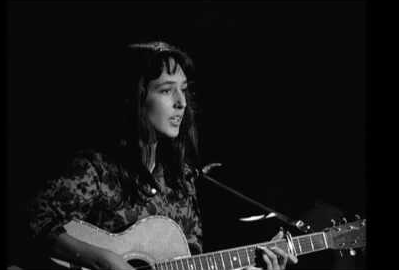
After high school, Joan’s family relocated again, this time back to the East Coast, after her father accepted a teaching position at MIT. Joan briefly attended Boston University, but dropped out after about six weeks. Soon after, she performed her first concert at Club 47 in Cambridge, Massachusetts, immersing herself in the emerging Boston folk scene. Her career gained momentum quickly, and in 1959, she performed at the inaugural Newport Jazz Festival alongside Bob Gibson.
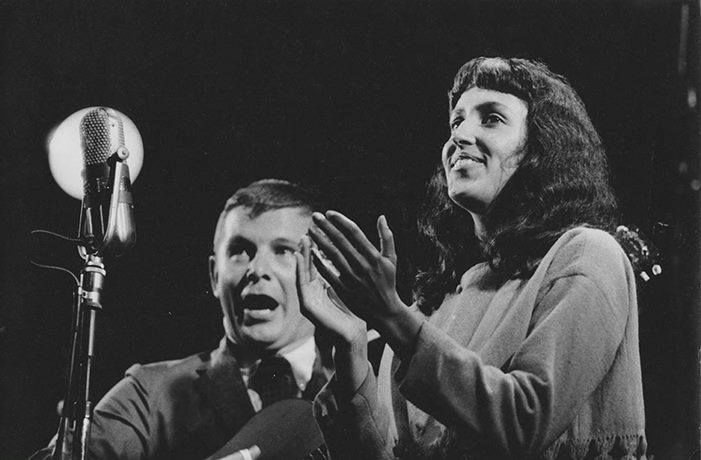
Not long after Newport, Joan recorded her debut album, Joan Baez, with Vanguard Records in New York City. On November 5, 1960, she made her New York concert debut at the 92nd Street Y. Just one year later, on November 11, 1961, she sang to a sold-out crowd at Town Hall on West 43rd Street. Performance invitations poured in, and Joan rapidly became an unmistakable voice of her generation.
While her earliest New York appearances took place uptown, Joan soon found herself downtown—in the heart of Greenwich Village, where a vibrant folk scene was taking shape. “Greenwich Village had become world headquarters for a folk music scene that, to its own occasional shock and horror, was beginning to matter in the music and popular culture biz,” wrote critic David Hinckley. Throughout the Village, artists and creatives gathered in parks, cramped bar basements, and coffeehouses to share ideas, music, and hope for a better future. United by a shared reverence for prewar folk traditions, these musicians became an influential force within the broader civil rights and peace movements. The collaboration between artists became just as important as the music itself—with individuals and acts continually covering one another and inspiring new work.
Perhaps one of the most legendary partnerships of the folk scene was between Joan Baez and Bob Dylan.
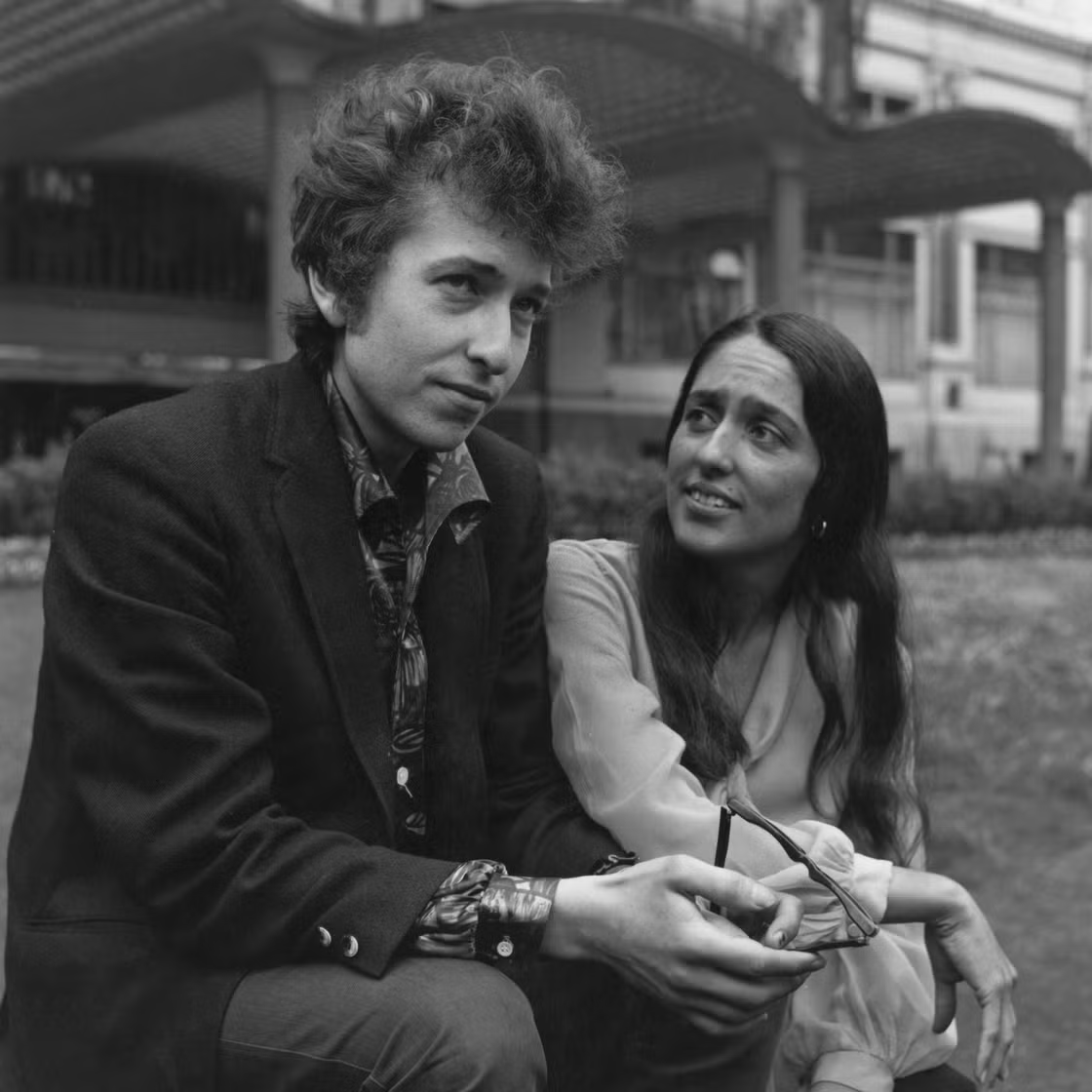
Dylan, whose career began just a few years after Joan’s, was similarly inspired by the likes of Pete Seeger and Woody Guthrie. His 1961 performance at Gerdes’ Folk City on West Fourth Street caught Joan’s attention and marked the beginning of a relationship that was both creatively rich and personally tumultuous.
Their on-again, off-again partnership unfolded both onstage and off, resulting in memorable duets and songs that resonated for decades. In 1964, the couple rented Room 305 at the Hotel Earle, near Washington Square Park—a stay Baez later immortalized in her song “Diamonds and Rust” as “that crummy hotel over Washington Square.” Their relationship ultimately unraveled during Dylan’s 1965 European tour, when he invited Baez along but did not include her in his performances. The couple parted ways during the trip.
Even after their relationship ended, Baez and Dylan continued to serve as muses for one another, with later songs such as Baez’s “To Bobby” and Dylan’s “To Ramona” widely believed to reflect their shared history.
In the decades that followed, Joan Baez continued to perform while deepening her commitment to activism. For more than sixty-five years, she has devoted her life and career to advancing civil rights and social justice in the United States and around the world. Her advocacy has encompassed prison and death penalty reform, LGBTQ+ rights, opposition to the Vietnam and Iraq wars, support for civil rights in Iran, and participation in Occupy Wall Street—cementing her legacy as both a musical icon and a steadfast voice for change.
In 2023, Village Preservation followers voted Joan Baez one of the “25 Most Impactful Women of Greenwich Village, the East Village, and NoHo.”