
A New Administration, a New Chance to Protect South of Union Square

We are looking forward to working with recently inaugurated Mayor Mamdani and his administration, which we hope will repudiate the misguided and failed development and preservation policies pursued by the Adams Administration. We hope, for one, that Mayor Mamdani will offer a break from his predecessor’s record-breaking aversion to new landmark designations.
Landmark designations under Mayor Adams reached all-time lows, achieving rates as much as ten times lower than those of his predecessors (see our report here). His Administration also refused to act upon several proposed landmark designations with broad support from the local community, local elected officials, scholars, academics, preservationists, and a broad range of interest groups and New Yorkers connected to the histories they embody. Notable among these was the area South of Union Square.

The proposed South of Union Square district was determined eligible for the State and National Registers of Historic Places and was named one of the Preservation League of New York State’s “Seven to Save” in 2022-2023. The area is distinguished by a broad range of 19th and early 20th architecture by some of New York’s most notable architects. It also features an incredible array of sites connected to Black, LGBTQ, and civil rights history, as well as to the women’s and women’s suffrage movement, and to artistic, musical, literary, and publishing history. An increasingly large number of buildings in the proposed district are threatened or have been demolished.
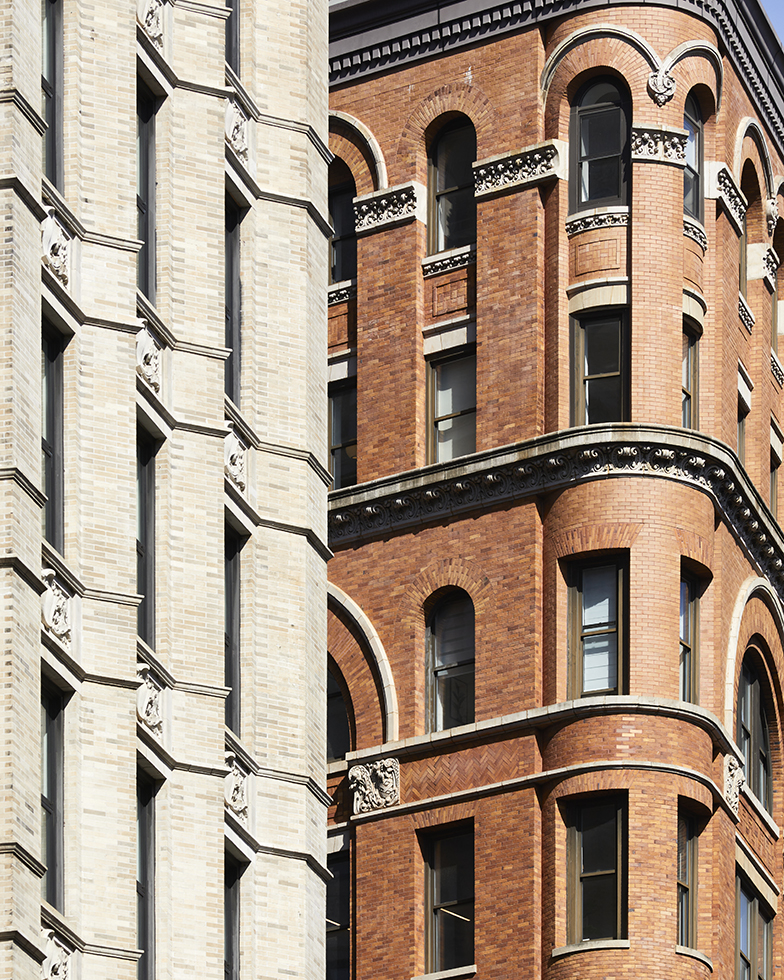
Our online resources offer a wealth of materials to help the public learn more about the South of Union Square’s remarkable history. These include, for instance, an archive of photos by the renowned architectural photographer Dylan Chandler that capture several of the many striking buildings in the neighborhood. The collection includes some of our favorite ones in the city, like 821 Broadway, the eleven-story loft building at the corner of 12th Street. This 1906 structure designed by Samuel Sass for Richman Realty & Construction Company makes a statement with its two-story cast-iron base, rounded corner, and brick cladding. This address was once the home of one of Book Row’s longest-running shops, the University Place Book Shop, which was renowned for its extensive selection of books by Black authors and on subjects such as Black Studies and socialism. The archive includes many other buildings like this, worthy of admiration (and landmark protection).

A wide range of histories that have shaped our city and our nation have converged in the neighborhood South of Union Square. We have explored many of these from a variety of angles. To use one of many possible examples, let us say one were interested in the emergence of the right to free press and free speech in this country. That story runs through this neighborhood thanks to people like Elizabeth Gurley Flynn, the precocious radical who co-founded the ACLU at 70 Fifth Avenue and about whom you can read in this blog. We organized a panel, available for streaming, on this very topic, featuring experts such as a former General Counsel of the ACLU, a biographer of Elizabeth Gurley Flynn, and one of the country’s foremost First Amendment scholars.

Another key figure in our national struggle over the right to free speech was Barney Rosset, who operated Grove Press from this neighborhood, an entity that litigated vehemently against the censorship of literary expression during the 1950s and ‘60s, securing legal decisions that went a long way toward enshrining the right to free press in this country. You can read his story in this blog post. One of our maps of South of Union Square allows you to take a virtual tour of all the sites where Grove Press was located. This neighborhood was the most important publishing hub in the country. Beyond the Grove Press tour, the map allows you to survey the many publishing houses located in the area and to learn about how their work helped shape our cultural and political landscape.

Of course, the neighborhood’s connection to our national free speech battle is just one example. As the Union Square Map makes clear, whether your interest is music, civil rights, dance, libraries, German communities, film, the Civil War, labor history, or much else, the South of Union Square has a story to tell, offering yet another reason why its preservation is crucial.
If you want to support our efforts to help protect the tremendous cultural and architectural legacy of South of Union Square, you can do so here.