
Exploring Black History Through Village Preservation’s Online Resources
The stories of Black New Yorkers are deeply woven into the history of Greenwich Village, the East Village, and NoHo. From early community institutions and cultural leaders to activists who reshaped American society, these neighborhoods have long been places of creativity, resistance, and reform.

To help make these histories visible and accessible, Village Preservation has created a rich collection of online resources that allow anyone to explore the people, places, and movements that shaped Black life in our communities.
Mapping Civil Rights and Social Justice
One of the most powerful tools is Village Preservation’s Civil Rights and Social Justice Map, an interactive resource that documents more than 50 sites connected to African American history and activism. These locations include early Black churches, meeting places of reformers, homes of influential figures, and sites of protest and organizing.
The map shows how national movements for equality were rooted in real buildings and streets, revealing the Village as a vital stage for struggles for justice that still resonate today.
Self-Guided Tours and Historic Maps
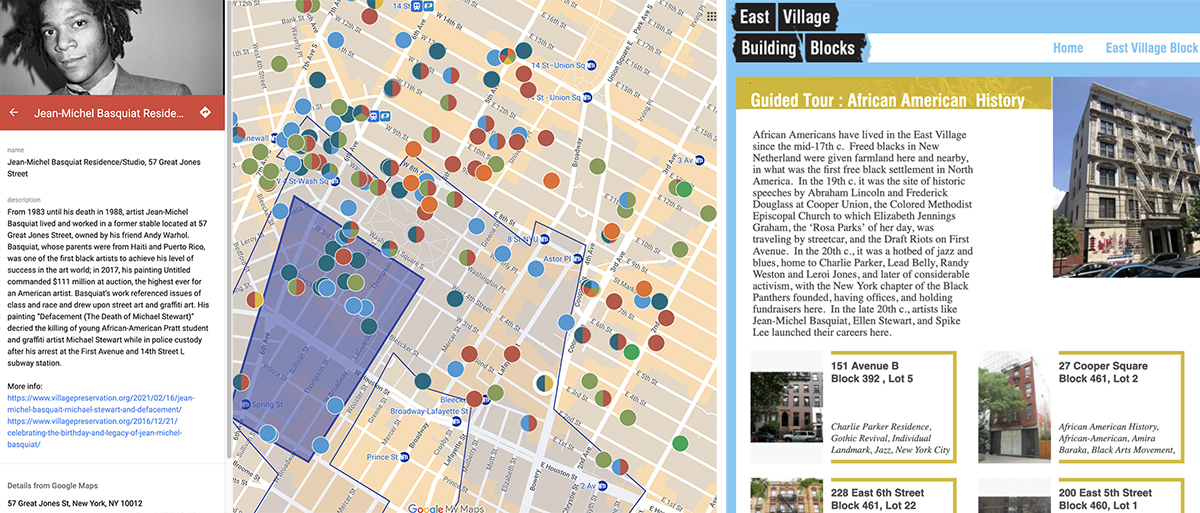
Village Preservation’s broader Maps and Tours collection allows users to explore neighborhood history through place-based storytelling. Several of these tours highlight Black history alongside other social and cultural narratives, offering a fuller picture of how African American residents helped shape the artistic, political, and civic life of these districts.
Our Greenwich Village Historic District Map + Tours offers a Black History tour with 25 sites in the Greenwich Village Historic District connected to significant African American figures, from some of the first Black churches in New York to the home of author Richard Wright.
Our East Village Building Blocks website features an African American history tour with more than two dozen sites connected to prominent figures, locations, and groups in black history, from the home of Charlie “Bird” Parker to the site of the founding of the NYC Chapter of the Black Panthers.
Our Hip-Hop’s Second Birthplace Map explores the myriad locations in Greenwich Village, the East Village, and NoHo where hip-hop history was made.
These tools make it possible to walk the same streets where history unfolded and see how preservation connects past and present.
Blog Articles and Research
The Village Preservation blog includes a growing collection of posts tagged under Black History, featuring essays on individuals, institutions, and moments that are often overlooked in traditional histories. These articles draw from original research and archival materials to tell stories of musicians, writers, reformers, and community leaders whose lives were intertwined with these neighborhoods.
Together, these posts form an expanding digital archive that deepens public understanding of Black history as local history.
Programs and Videos

View more than a dozen videos from Village Preservation exploring and celebrating Black history, from plaque-unveiling ceremonies honoring Lorraine Hansberry, Alex Haley, James Baldwin, and Jean-Michel Basquiat, to tours of African American historic sites in our neighborhoods, to past programs about the Underground Railroad, Black Bohemia, the first Black theater in America, and the “Little Africa” neighborhood located in the heart of Greenwich Village.
Oral Histories and Community Memory
Village Preservation’s oral history projects and neighborhood research further enrich this work by preserving firsthand accounts and personal stories. These voices help connect historical events to lived experience, reminding us that preservation is not only about buildings, but also about memory, culture, and community identity.
Explore our oral histories with Kevin McGruder, Alex Harsley, Christina Maile, and Ayo Harrington.
Why These Resources Matter
By bringing these stories together through maps, tours, blogs, and oral histories, Village Preservation ensures that Black history is not treated as a footnote, but as an essential part of the narrative of our neighborhoods. These resources make clear that our neighborhoods are places where barriers were challenged, institutions were built, and history was made.
As we reflect on the past and look toward the future, these digital tools invite everyone to explore, learn, and help protect the places where these stories unfolded. Preserving Black history in our neighborhoods is not only about honoring those who came before us; it is about understanding the foundations of the communities we live in today.
To explore these resources and learn more, visit Village Preservation’s online maps, tours, and blog, and discover the many ways Black history continues to shape our neighborhoods.