
Oy! A History of the Village East
At the corner of Second Avenue and East 12th Street stands a neighborhood staple, and one of New York’s rare interior landmarks. At 181-189 Second Avenue, the Village East by Angelika movie theater opened in 2021, but its history long predates that. With the help of our East Village Building Blocks webpage and the Landmarks Preservation Commission Designation Report for the building (also found on our website), we can explore the story behind the Village East landmark and how it became the institution it is today.
Long before the Angelika took over the space at 181-189 Second Avenue, the building embodied a profound cultural presence in the neighborhood. Between 1880 and 1920, approximately two million Eastern European Jews immigrated to the United States, most settling in New York City. By 1920, the city’s Jewish population had reached a peak of 1,643,000, accounting for 29% of the city’s residents; New York City housed the largest Jewish population in the world. Many of those Jewish immigrants originally settled in the Lower East Side, which includes what we today call the East Village. The population boom led to tightly-packed communities with less-than-favorable living conditions within the area’s already-cramped tenement buildings. To keep up with the growing population, the Jewish Lower East Side expanded, from its original bounds closer to Delancey Street, with a new center of Jewish life forming on Second Avenue between Houston and East 14th Street, still on the Lower East Side, but in the heart of what we today call the East Village (a name which wouldn’t begin to come into use until the 1960s).
Particularly the Yiddish theater scene, which was vibrant throughout the East Village and the Lower East Side, exploded along Second Avenue and the Bowery, the former coming to be known as the “Yiddish Rialto” offering dramas, comedies, and musicals that entertained and inspired the masses.
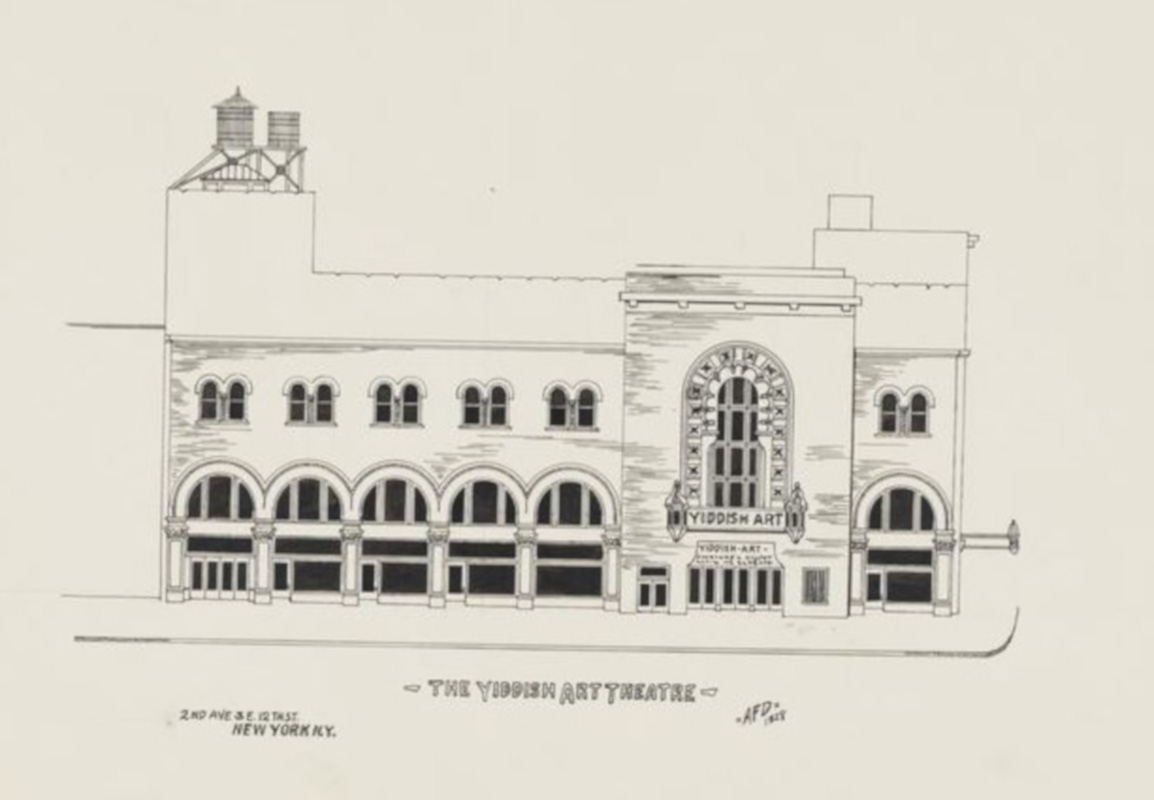
The Yiddish Art Theater, at 181-189 Second Avenue, just one of many institutions built in response to this growing scene. In 1925, Brooklyn lawyer and prominent Jewish civic leader Louis Jaffe purchased six lots on the southwest corner of Second Avenue and East 12th Street. Once belonging to the Peter Gerard Stuyvesant estate, Jaffe demolished the mid-nineteenth-century townhouses and set out to build his own theater. For $325,000, he commissioned the renowned theater architect Harisson Wiseman to design and build the Louis N. Jaffe Art Theater Building. Wiseman also designed the Waverly Theater, now IFC Center, a few block west on Sixth Avenue. Jaffe envisioned the building as the next leading Yiddish “art theater” company and appointed Maurice Schwartz, a prominent Yiddish actor colloquially known as Mr. Second Avenue, to be the face of the project.
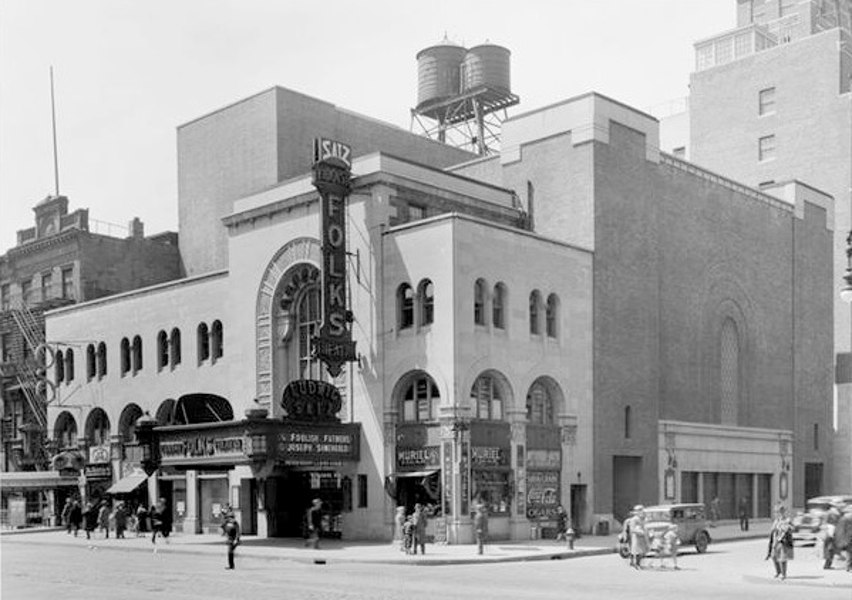
Mirroring the growing Jewish population, there was much excitement surrounding Jaffe’s new playhouse; during its construction, the New York Times wrote it was “intended to be the most elaborate art temple of lower New York.”
Although the theater’s construction was not complete until January 1927, the opening performance took place months earlier, on November 17, 1926, and highlighted the neighborhood’s lively art scene.
Wiseman’s work reflected several architectural trends of the 1920s. The original design was in a 1920s Moorish Revival style, incorporating Alhambraic motifs and Judaic references. At three stories, the Second Avenue facade is faced in cast stone, with a taller brick auditorium block to the west along East 12th Street. The cast-stone portion features a two-story arcade incorporating storefronts, surmounted by an arcade of small pairs of windows above, interrupted near the north end by a taller entrance pavilion. Perhaps what’s most eye-catching is the elaborate monumental arch found at the theater’s entrance. The arch features panels of foliate and geometric ornamentation and is adorned with several Jewish motifs, such as a cusped arch supported by large half-menorahs.
While the theater changed its names several times, and hosted numerous companies, its connection to Yiddish Theater persisted from its opening until 1945 (at the end of the Yiddish Theater heyday). In 1946, the space changed yet again—this time becoming a movie theater known as the Stuyvesant Theater (it had first been used as a cinema in 1937, then called The Century). And like many art scenes, nothing stuck around in the original Jaffe Art Theater Building for too long. The building went through several names and incarnations throughout the latter half of the twentieth century, including a film exhibition house, burlesque and off-Broadway performance hall, and a stint as the East Village landmark Phoenix Theater.
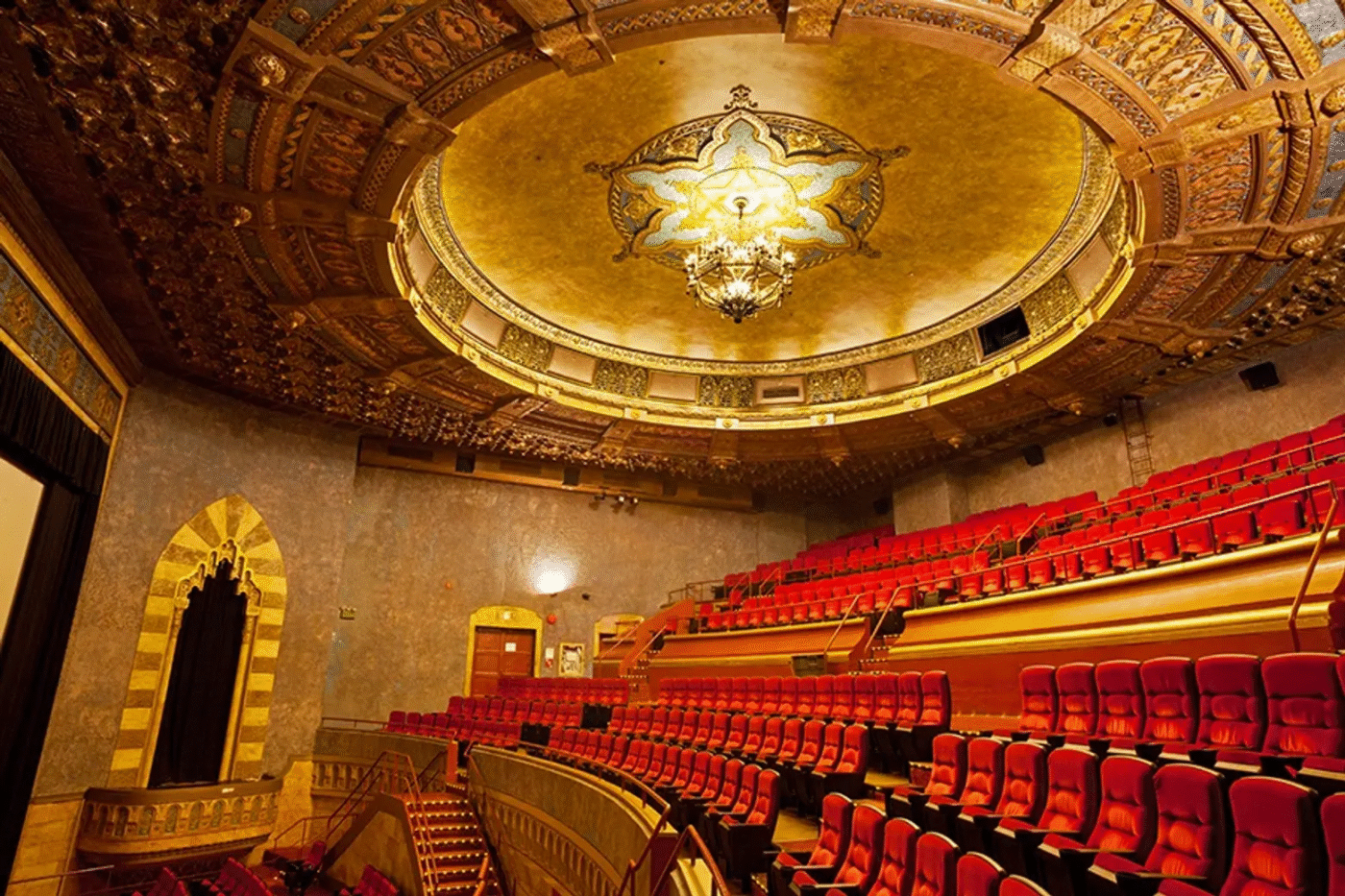
After one last Yiddish stint in 1985, the theater officially closed in 1988. The interior was subsequently converted into a complex of seven movie theaters by John Averitt Associates, the architects; it reopened in 1991 as the Village East City Cinemas. In 1993, the interior and exterior of the theater were designated landmarks by the New York City Landmarks Preservation Commission. Following its 2015 restoration, the theater rebranded again, this time to the Village East by Angelika.
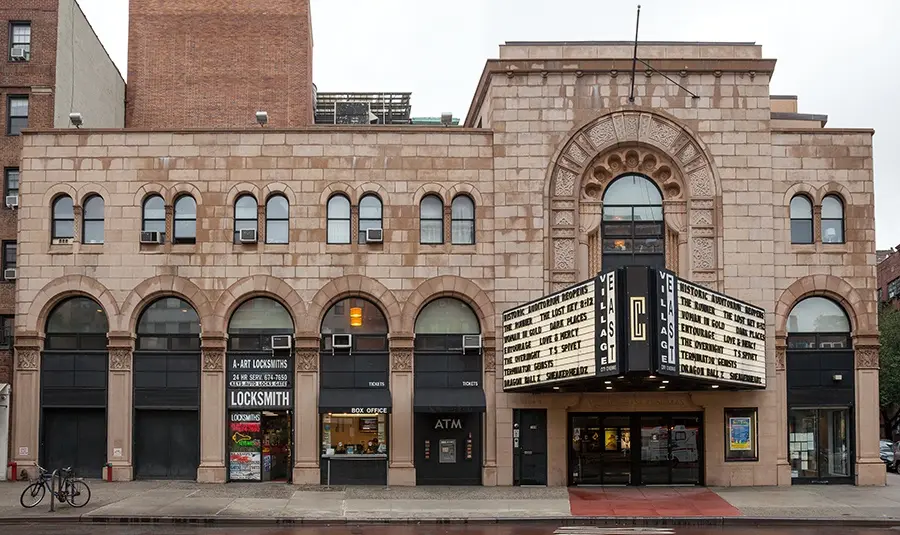
Similar to the West Village’s IFC Center, the Village East by Angelika showcases a mix of indie and box office cinema, catering to popular interest and the more offbeat, artistic scene still found in the East Village.Learn more about the history of the building by exploring the East Village Building Blocks as well as the Landmarks Preservation Commission Designation Report.