
Why Isn’t 61 Fourth Ave Landmarked?
On January 27, 2021, we submitted crucial information to support our application for landmarking 61 Fourth Avenue to the Landmarks Preservation Commission. What we documented was not merely architecture, but a place where some of the most influential artistic and cultural voices of the 20th century lived and worked (see our TikTok here). Our letter extensively documented the property as the studio of Robert Motherwell, one of the most significant figures of the Abstract Expressionist Movement and “New York School” of artists. But Motherwell was just one of several influential figures who lived and worked in this building. Read about the full history of the building, plus what you can do to help protect this amazing property:
61 Fourth Avenue
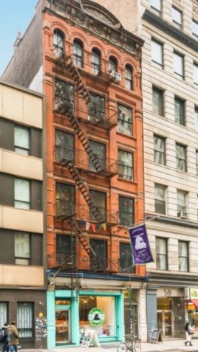
This six-story Romanesque Revival building was built in 1889. Many, if not all of its original design features are intact, including its brick facade with brownstone details, cast iron storefront, and cornice. It was designed by architect Benjamin E. Lowe, who designed a number of NYC landmark designated buildings. 61 Fourth Avenue is in the heart of our proposed South of Union Square Historic District. Read more about our efforts to protect this history.
Robert Motherwell
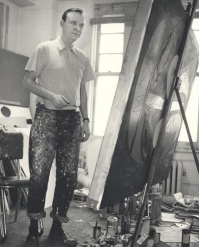
Influential artist Robert Motherwell had his studio in this building from 1949-1952, a critical period in his career. Motherwell is considered one of the great American Abstract Expressionist painters and was the theorist and leading spokesperson of the New York School. His art references political, philosophical, and literary themes, and he served as a bridge between the pre-war Avant-Garde movement in Europe and the post-war Abstract Expressionist movement in New York. It was at 61 Fourth Avenue where Motherwell, at the peak of his career, started the Robert Motherwell School of Fine Art Parinting, Drawing, Theory.
Robert Indiana
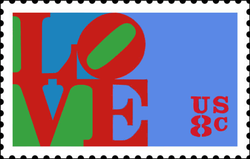
A decade later, artist Robert Indiana had his studio in the building. Indiana, best known for his iconic LOVE design and sculpture, worked in this space from 1959-61. This was a formative period for his career just prior to his first solo exhibition in 1962. He designed the iconic LOVE image a couple of years later, in 1964. While living here, Indiana claimed, he could see into Willem de Kooning’s studio at 88 East 10th Street and watch him paint. It was here where he began his lengthy series of paintings, Elegies to the Spanish Republic, which memorialized the lost Republican cause in the Spanish Civil War.
Barney Rosset & Grove Press
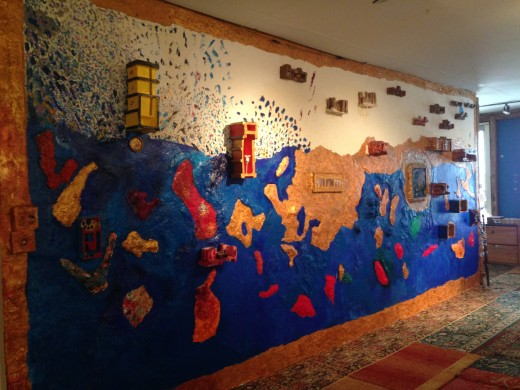
61 Fourth Avenue was the last (but not least) of many locations where influential publisher Grove Press was led by owner Barney Rosset. It was here where he served as editor of the Evergreen Review, a publication that challenged censorship, embraced sexual freedom, and gave voice to ideas others would not print. And it was here where he created a large, 12 foot high, 22 foot long mural about his life.
Read about more sites associated with Barney Rosset and Grove Press in our area or about the many important movements that took place in the area south of Union Square.
Take action to save this building and others in the area south of Union Square.