
Before Camelot: Carolyn Bessette on Second Avenue
John F. Kennedy Jr. and Carolyn Bessette met, fell in love, and tragically died within a span of a decade. The two had a love story that captivated a nation…and the press.
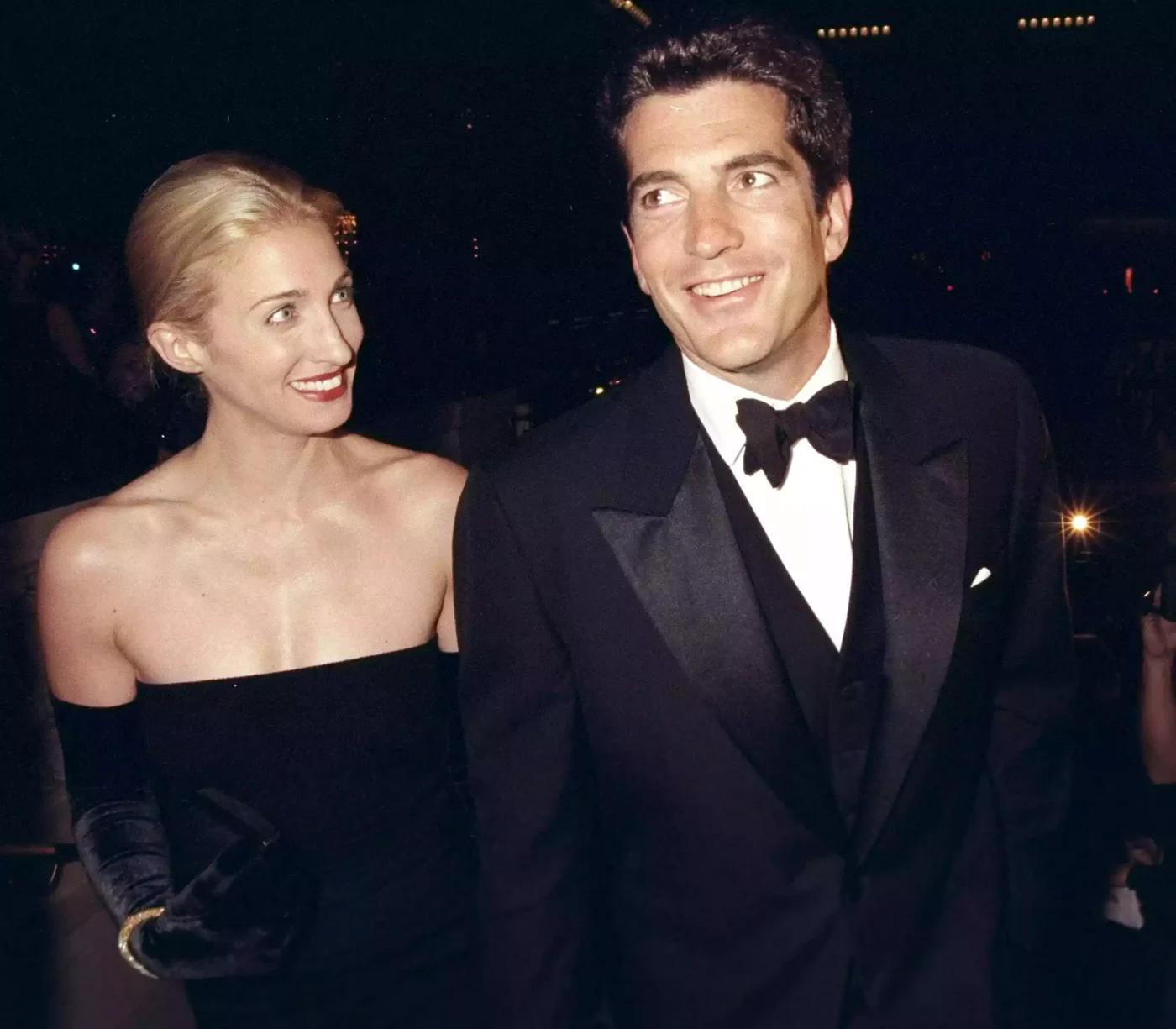
But their history and connection to New York were far greater than tabloid fodder. Behind the glamour, charm, and politics were two people, finding themselves personally and professionally as they navigated adulthood. He was the son of perhaps the most idolized president in contemporary history, raised by a single mom (who happened to also be tragically widowed and the youngest former first lady in U.S. history). She was born in White Plains, New York, but grew up in nearby affluent Greenwich, Connecticut, after her parents divorced (and her mom remarried) when she was in elementary school. He was the founder and editor-in-chief of George magazine, a short-lived publication that aimed to connect politics with pop culture. She climbed the ranks at Calvin Klein, starting as a mall sales associate, working her way up to a high-profile publicist position.
At the time of their death, the married couple lived in their shared Tribeca loft. Outside, a red carpet awaited, ready to photograph the it-couple of the 1990s (and of the 2020s).
Through all the frenzy, though, the pair did their best to keep a private life—especially Carolyn Bessette. Still, their short-lived story is well-documented and widely told. In February 2026, the latest iteration of the Camelot media myth premiered. The series, aptly called American Love Story, is a highly dramatized depiction of the relationship between John F. Kennedy Jr. and Carolyn Bessette-Kennedy.
Like many Hollywood stories, the show took some liberties. Before the couple’s partnership, the show featured Bessette living at 48 Stuyvesant Street. But she actually never lived there, on one of Manhattan’s most unique city blocks. But they weren’t that far off — Bessette actually lived across the street, at 166 Second Avenue.
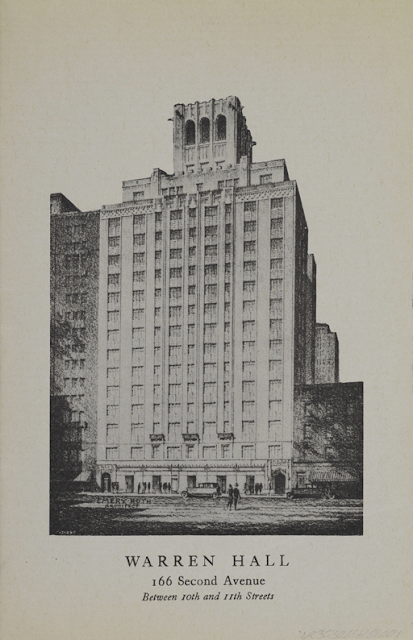
Soon after graduating from Boston University, Carolyn Bessette moved to New York City to start a career in fashion at Calvin Klein. Unlike many of her cosmopolitan colleagues, Bessette lived in the gritty and eclectic East Village. Named Warren Hall, the 15-story apartment building with a tower was erected in 1929 by architect Emery Roth for the N.Y.C. Baptist Mission Society. Before there was an apartment building, however, the Second Avenue Baptist Church occupied the lot.
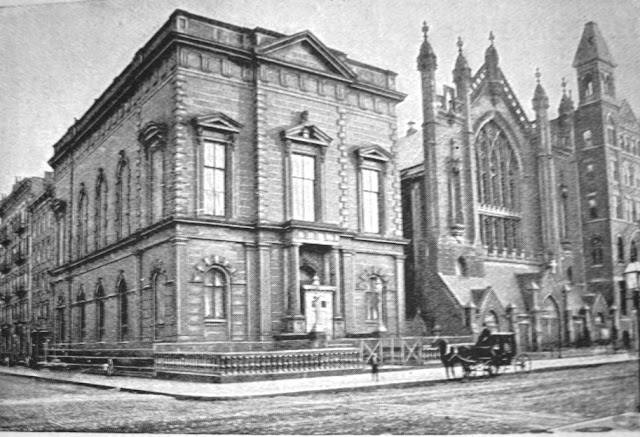
Originally founded on Mulberry Street in the Lower East Side as the Baptist Tabernacle, the congregation relocated to 166 2nd Avenue in 1850 when architect David Henry Arnot designed a striking Gothic Revival church. In 1886, the congregation expanded when a large parish house was constructed next door. The population, demographics, and character of the East Village underwent a fundamental evolution in the latter half of the nineteenth century. By 1900, the neighborhood was one of immigrants and tenement buildings. And the church reflected this. Its congregants were a melting pot of varying backgrounds, with one local newspaper citing the congregation welcoming worshippers who spoke some thirty languages.
No longer was the neighborhood the Stuyvesant family playground; as the immigrant population soared, wealthy New Yorkers moved closer to Fifth Avenue or went uptown. And so did their money. By the 1920s, the Second Avenue Baptist Church was in financial trouble, reflecting a larger national shift. Across the country, congregations were demolishing their old structures and replacing them with apartment or office buildings that incorporated a ground-floor church space. Colloquially referred to as the skyscraper church, it was the hope that these rental properties would prove very lucrative for congregations. Consequently, the construction of Warren Hall began. The building facade features projecting brick piers, banding, recessed point-arched entrance openings with incised ornament, three round-arched openings on the central tower, and decorative panels beneath roof railings. Architect Emery Roth acknowledged the site’s ecclesiastical past with an engraving of the church’s name and with three angels that serve as the balcony bases on the third floor.
In spite of this arrangement, the congregation’s financial pressures continued to grow, and it could not keep up. In 1953, storefronts were installed on the ground floor, vastly reducing the church’s presence. And four years later, in 1957, the Gate Theatre replaced the church entirely. And Warren Hall continued to see change throughout the rest of the twentieth century. Over the decades, other theaters occupied the space, and it was also a nightclub, serving as the setting for many illicit activities.
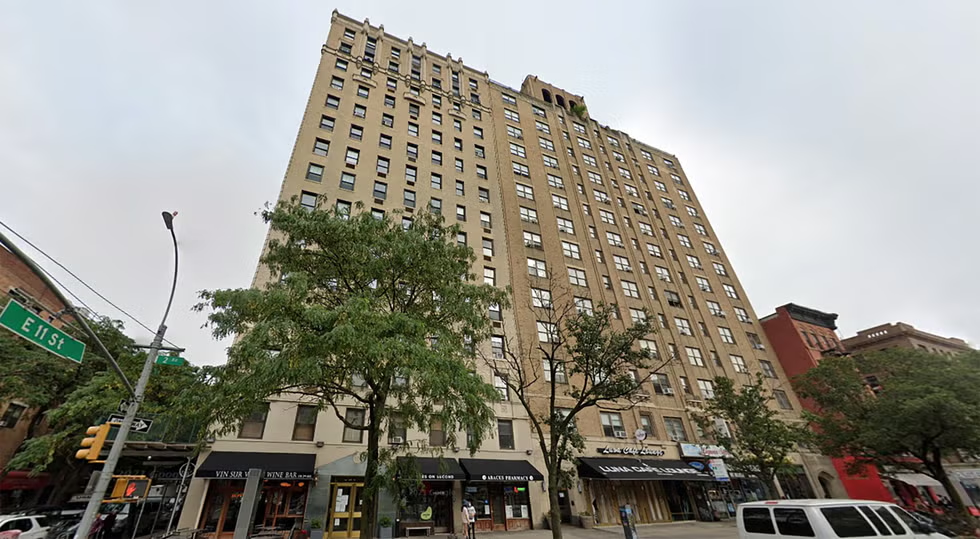
By the time Carolyn Bessette moved in, it was firmly an apartment complex, but there were remnants of the building’s indulgent past. It was a small, no-frills apartment in the heart of the unpolished East Village. Yet, it was fitting for a post-graduate young professional like Bessette. Learn more about the unknown history of other East Village sites by exploring our collection of East Village Building blocks.