
Waiting on a Friend on St. Mark’s Place
The year was 1981. The Rolling Stones entered the decade still considered the greatest rock-and-roll band in the world. But the industry was changing. The launch of MTV that year revolutionized music, making video and image essential parts of an artist’s work. While the Rolling Stones had a long history of music video production in the 1960s and 1970s, these were mostly live-performance videos rather than the kind of choreographed, scripted productions the new medium favored. They were at this pivot point when, in late 1981, they recorded a video for their single “Waiting on a Friend.”
Shot in July 1981 in the East Village, the video avoids soundstages and elaborate sets. Instead, the band roams St. Mark’s Place and First Avenue, capturing the essence of 1980s lower Manhattan. Professional photographer and East Village local resident Peter Bennet captured their early July shoot. At the time, Bennet worked at night as a bartender at various local establishments, and he spent his days photographing the neighborhood around him, including Mick Jagger himself during the filming of Waiting on a Friend.
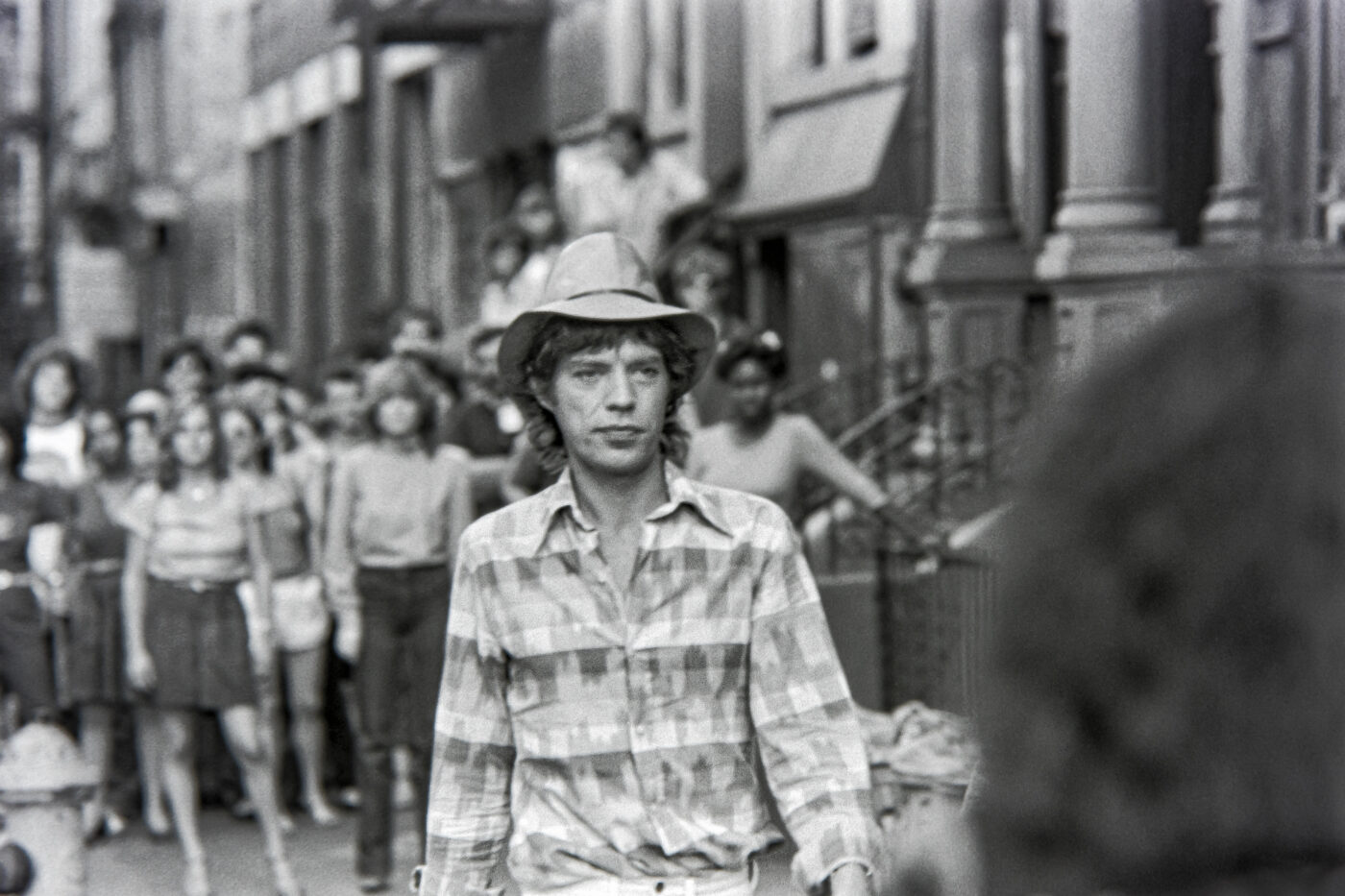
The video opens on a pouty Mick Jagger, standing atop a nondescript Manhattan stoop, donning a multicolored striped button-down and khaki fedora. As the music picks up and the lyrics begin, the scene expands, now to follow Jagger’s bandmate and legendary guitarist Keith Richards, as he meanders through a crowded East Village block. The video continues to cut between Jagger and Richards, and as the song reaches its chorus, audiences understand that Jagger is increasingly annoyed as he waits on a friend, that friend being Keith Richards.
Mick Jagger stations himself in the doorway of 96–98 St. Mark’s Place. Unable to leave the confines of the stoop, he continues to wait for the arrival of his friend. While increasingly annoyed by Richards’ tardiness, Jagger, though, is not alone; joined by three other men on the stoop and by all the pedestrians of St. Mark’s Place, the video balances his loneliness with his friend against the constant human contact of city life.
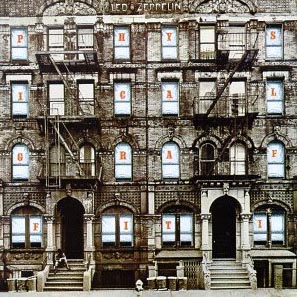
But the Rolling Stones were not the first rock and roll band to immortalize this East Village stoop. Just a few years earlier, in February 1975, Led Zeppelin released Physical Graffiti, an incredibly successful double studio album whose cover art features those same twin tenement buildings on St. Mark’s Place. The award-winning design featured the two buildings (with the fourth floors removed to make them fit the square shape of the album cover) with the windows cut out to reveal the letters of the album title printed on the inner sleeve, or, if the sleeve was reversed, a series of images of different characters seeming to occupy the building, including lead-singer Robert Plant in drag.
The building did not change much in the six years between Led Zeppelin’s album release and the Stones’ music video shoot. So, when Keith Richards finally greets an awaiting Mick Jagger, rock and roll fans get a closer look at the round-arched portico entrance and the decorative segmental-arched window enframements.
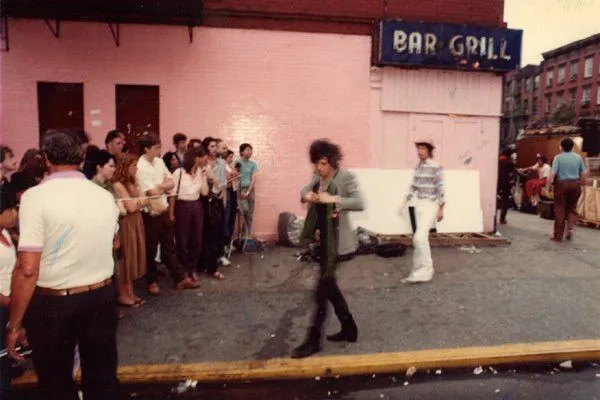
Now together, Jagger and Richards make their way through the East Village, passing grungy apartments and graffiti-covered buildings, all while soaking in the neighborhood’s eclectic nature. During an instrumental break, they enter the strikingly pink St. Mark’s Bar and Grill, located at 132 First Avenue, where the rest of the band is expecting their arrival. Back then, the bar was a gritty yet renowned neighborhood dive bar, and it would not have been utterly shocking for rock and roll stars or people in the punk scene to hang out and have a drink (or two).
Today, though, the corner of First Avenue and St. Mark’s Place is the much-frequented Lion’s Bar & Grill—and while it still serves hamburgers and beer, the joint is certainly less seedy than it was back in the 1980s. But it’s actually the same five-story building that architects Berger & Baileys constructed in 1888, with a storefront on the first level and one apartment per ascending story. The building features brick belt-courses that wrap around the facades with angled brick detailing and a bracketed cornice. The northern facade along St. Mark’s Place features an elevated cornice centerpiece with decorative panels below, two chimneys with projecting brick details, and a slightly recessed center bay capped by a segmental arch with figural carving. The western facade along First Avenue features hooded window lintels and large sills at the third through fifth stories. Historic fabric has been removed from the first story, and window lintels have been stripped along the northern facade.
The video ends with the band hanging out in the bar, Mick Jagger reunited with all his friends, and eventually moving towards the back to play a set for a somewhat apathetic crowd.
Explore more of Peter Bennet’s photos, many of which feature this gritty East Village in our historic image archive. Or, take a look at our East Village Building Blocks website and learn more about the history behind every building and street in the neighborhood.