
The Churches of the Greenwich Village Historic District
Village Preservation recently released a revamped and updated version of our Greenwich Village Historic District Virtual Map + Tours. Originally created in 2019 to celebrate the 50th anniversary of the Greenwich Village Historic District, the map includes Then & Now photographs of the entire district and nearly two-dozen thematic tours.
Among these is a tour highlighting churches of the Greenwich Village Historic District. Reflecting two centuries of architecture and development across the neighborhood, with the earliest built in 1820-21, these ecclesiastical sites feature a variety of styles, materials, and uses over time.
Church of the Ascension, 36-38 Fifth Avenue
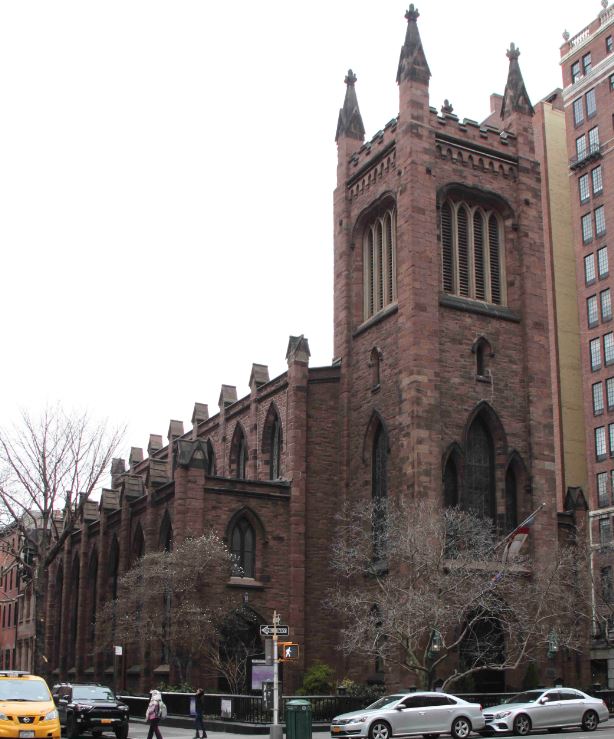
This Gothic Revival church was built in 1840-41 and serves an Episcopal congregation. It was designed by Richard Upjohn, who was largely responsible for the proliferation of the Gothic Revival style throughout the United States in the mid-19th century. The Church of the Ascension features a traditional Gothic Revival plan with a tower at the entry and a high nave with clerestory and side aisles.
First Presbyterian Church, 48 Fifth Avenue
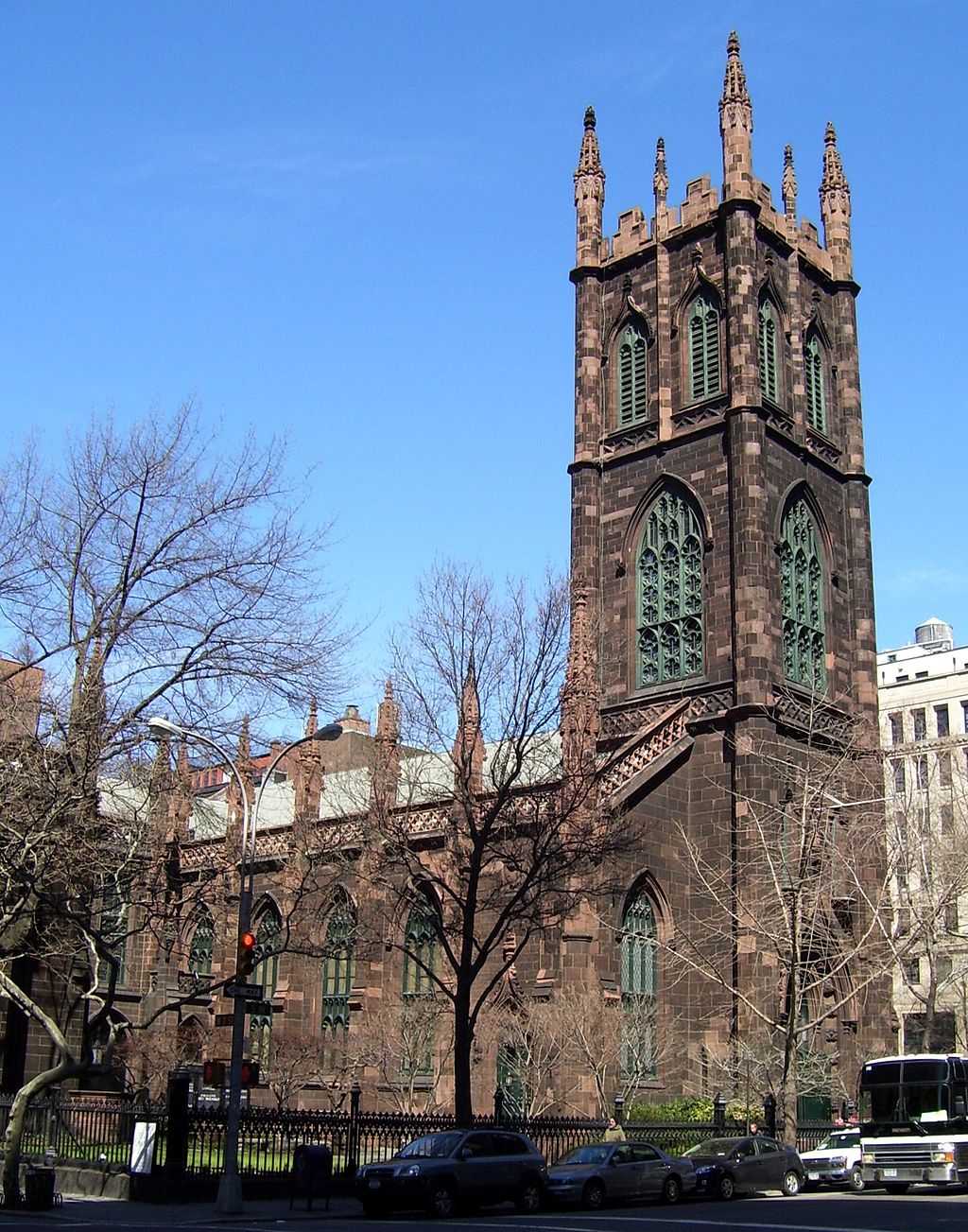
Described in the Greenwich Village Historic District designation report as “one of the adornments of lower Fifth Avenue,” this Gothic Revival church was built between 1844 and 1846. It was designed by English-born architect Joseph C. Wells, who later co-founded the American Institute of Architects. Clad in brownstone, it features a large square tower at the eastern end of the nave, and ornamentation typical of the Gothic Revival style, including pointed arches, quatrefoil tracery, and crocketed finials.
Metropolitan-Duane Methodist Church, 42-46 Seventh Avenue
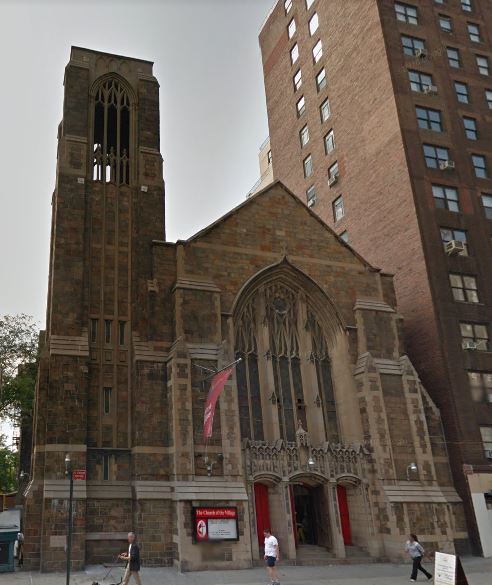
This Gothic structure was built in 1931 and designed by Louis E. Jallade. Asymmetrical in its arrangement with the square tower to the side of the nave, it is clad in irregularly sized stone blocks with ashlar used at the quoins seen at the wide corner buttresses.
In 2013 Village Preservation, the church, and PFLAG (Parents, Families, and Friends of Lesbians and Gays placed a plaque on the building, marking the very first meeting of what would become PFLAG, which had taken place there 40 years earlier.
St. John’s Evangelical Church, 81 Christopher Street
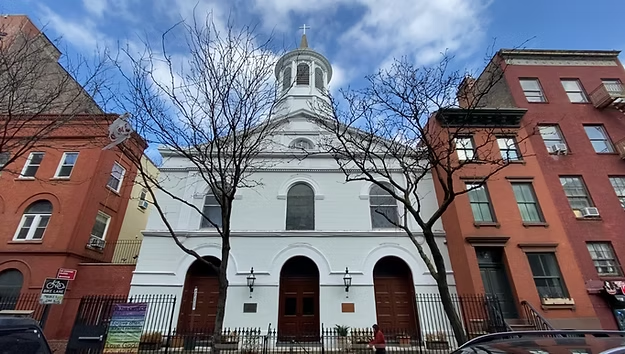
This church was built in 1821-22 in the Federal style. Originally known as the Eighth Presbyterian Church, it is simple and symmetrical in its design, featuring round-arched openings, stone veneer cladding, and topped by an octagonal domed tower and a miniature octagonal spire with ball and cross atop.
St. John’s in the Village, 220 West 11th Street
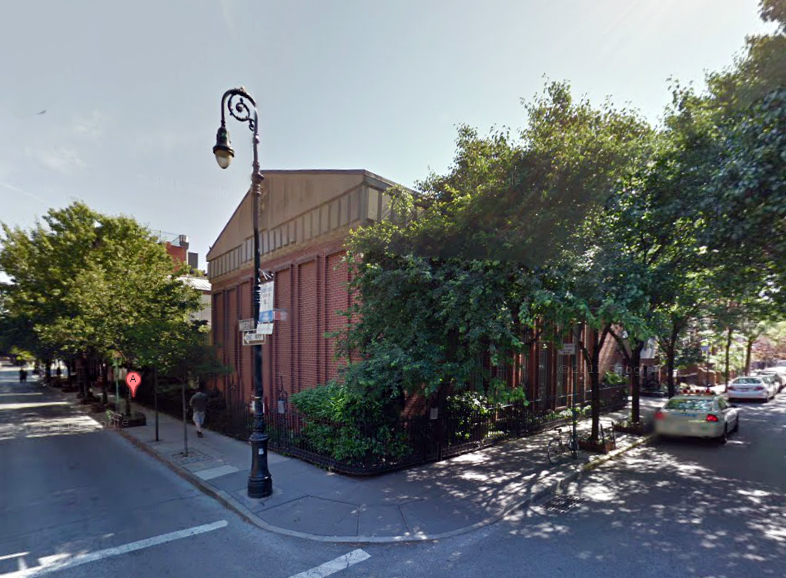
The church on this site today is not the one described in the designation report. That church, a Greek Revival edifice built in 1847, was lost to a fire in 1971. The new and current structure was built between 1974 and 1978 to a design by Edgar Tafel, a protégé of Frank Lloyd Wright.
St. Joseph’s Church, 365 Sixth Avenue
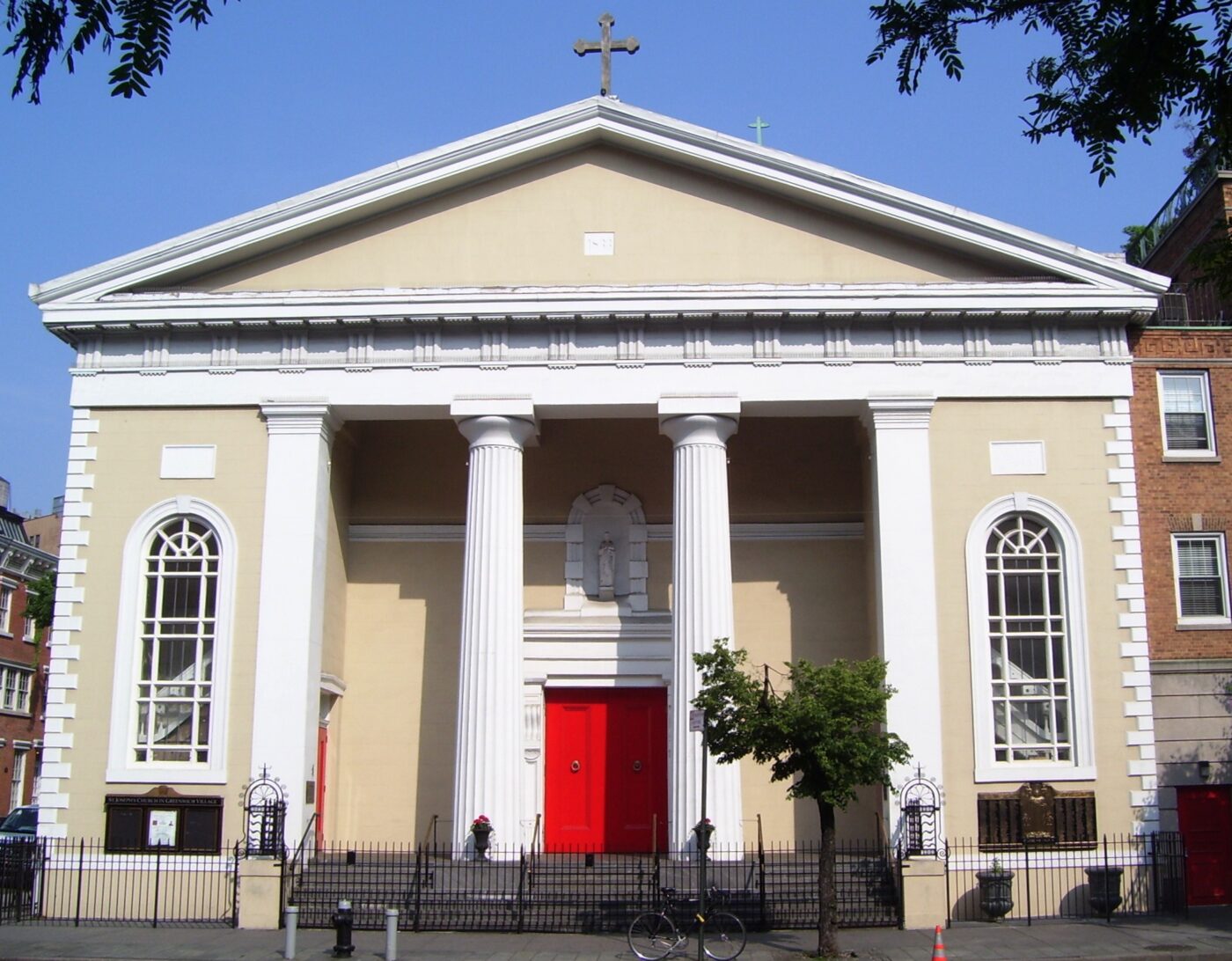
The oldest intact Catholic church building in Manhattan, this Greek Revival temple-form structure was built in 1834 and designed by John Doran. Two large Doric columns are set in the entrance portico below a substantial pediment and Doric cornice with triglyphs. The arched windows at the Sixth Avenue facade were added during repairs following a fire in 1885.
St. Luke-in-the-Fields, 479-485 Hudson Street

This little church was built in 1821-22, and originally served as the uptown chapel of Trinity Parish. According to the designation report, it is the third oldest church building still in use in Manhattan. Built by James N. Wells, it is constructed of brick in the Federal style, and simply massed and adorned as would befit a church originally set in “the countryside” and surrounded by relatively open farmland. While its context has changed, the original building remains.
Tenth Church of Christ Scientist, 171-173 MacDougal Street
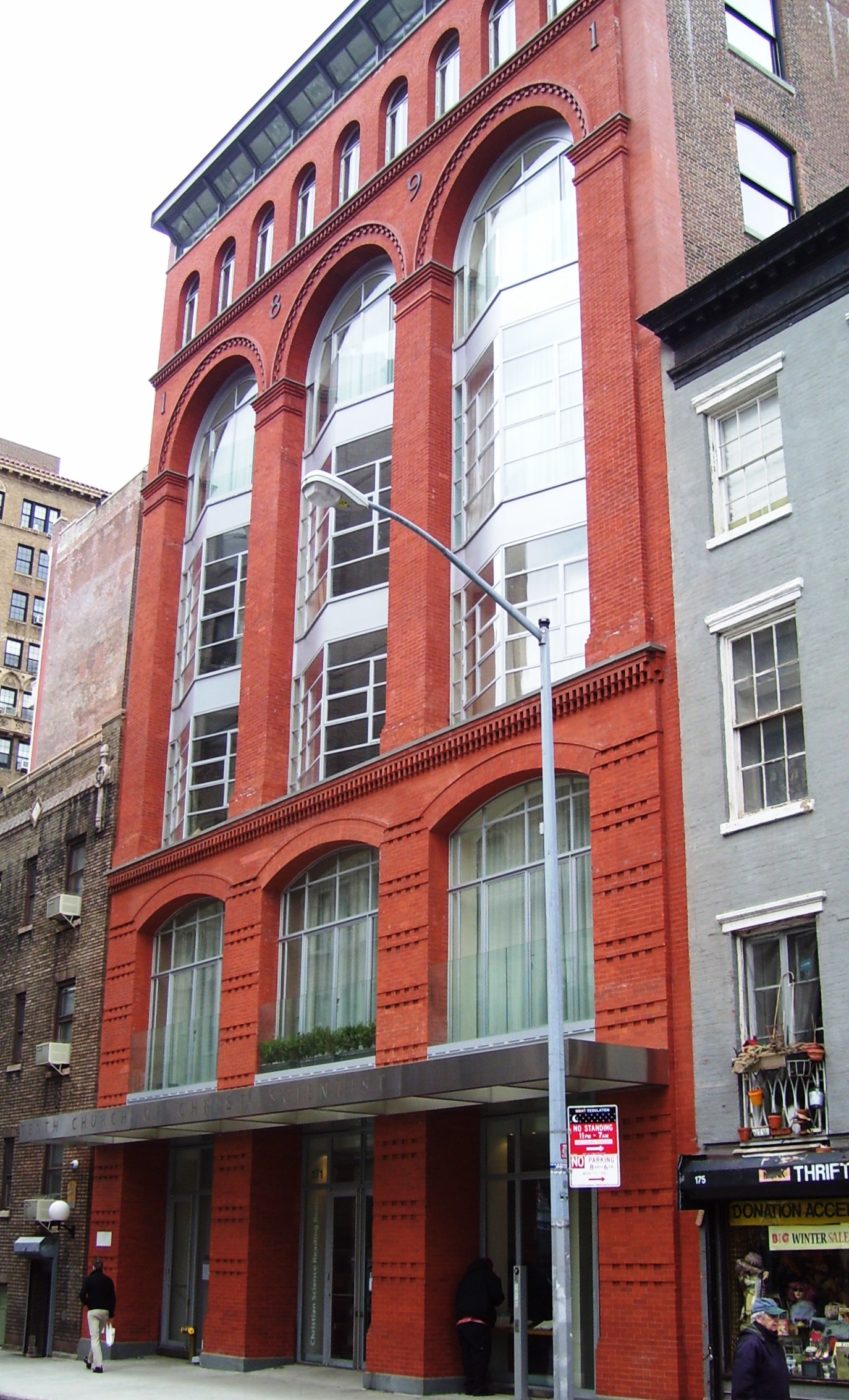
This church was the result of first a remodel and later a renovation of a six-story Romanesque Revival factory and store built in 1890-91 and designed by Renwick, Aspinwall & Russell. The design for the remodel was done by Victor Christ-Janer & Associates in 1966; the original facade was covered in red brick with a single narrow window.
The subsequent 2009 renovation involved restoration of much of the original facade. This renovation was the result of the successful cooperation of many players, including the architecture and design firm TRA Studio, who headed the project for the developer, Property Markets Group; Hanrahan Meyers Architects for the Church; Walter B. Melvin Architect, who oversaw historic preservation of the remaining masonry; and the preservation contracting company Preserv, Inc. The project team was awarded a Regina Kellerman Award at Village Preservation’s 2009 Annual Meeting and Village Awards.
The City Temple, 232-236 West 11th Street
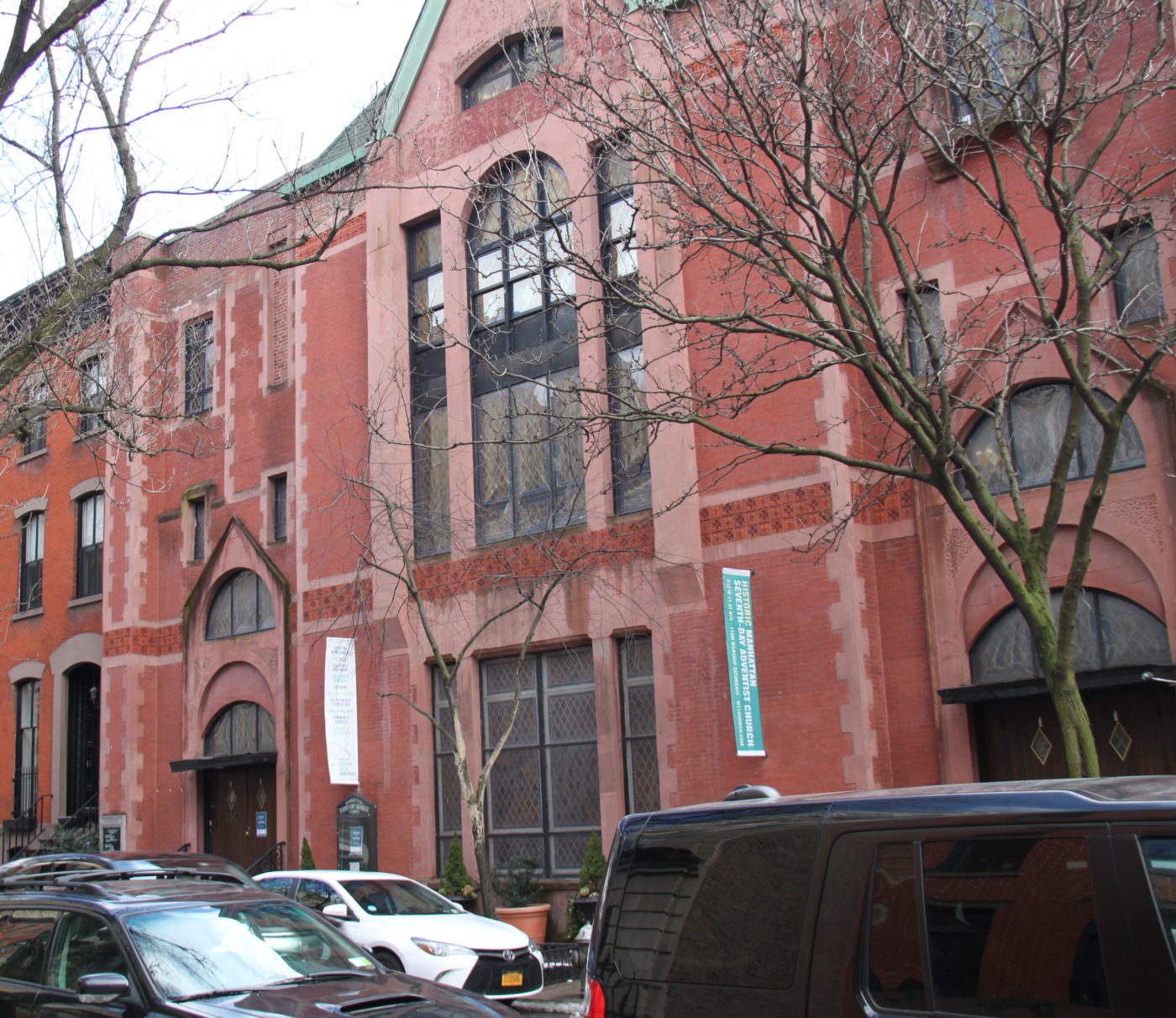
Currently the Emmanuel Anglican Church and originally the North Baptist Church, this structure was built in 1881 in the Queen Anne style and designed by Laurence B. Valk. It is clad in red brick with band courses of decorative tile work and ashlar stone used at the door and window surrounds as well as for the quoining.
Village Community Church, 143 West 13th Street
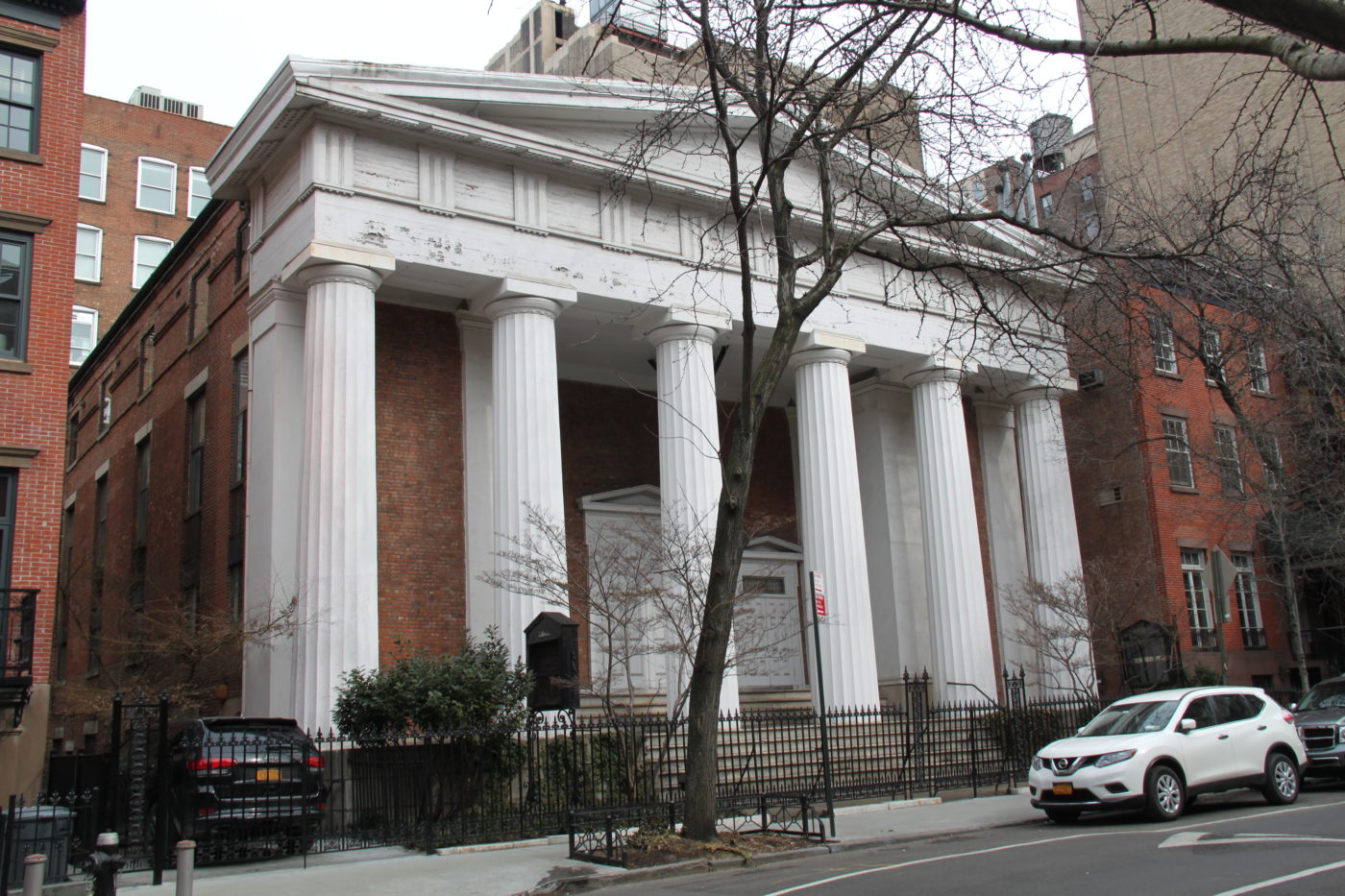
This Greek Revival church was built in 1846 to a design attributed to architect Samuel Thomson. The church has been rebuilt in accordance with its original design twice due to fire, in 1855 and 1902. Described as hexastyle due to the six Doric columns at its temple-front, it was originally known as the Thirteenth Street Presbyterian Church. In 1982, the building was converted into co-op apartments by architect Stephen B. Jacobs.
Washington Square Methodist Church, 135-139 West 4th Street

Built in 1860 in the early Romanesque Revival style, this marble church was designed by Charles Hadden. Its doors and windows are all round-arched with semicircular drip moldings above, and the entry is recessed within a large archway surmounted by a central window with elaborate tracery. In 2007 the building was converted for residential use.
This is one of many tours in the Greenwich Village Historic District Virtual Map and Tours. Take the opportunity to delve deeper into our neighborhood through the updated interactive map website here.
Help Us Save More Buildings Like These
While the churches within the Greenwich Village Historic District benefit from landmark status, Village Preservation continues to advocate for such properties elsewhere in our neighborhoods lacking in these protections — historically and architecturally significant buildings that are facing disuse, neglect, and even possible demolition. These include Our Lady of Guadalupe and Most Holy Redeemer churches. Click here and here to find out how you can support these advocacy efforts.