
Deborah Glick: A Legislative Life for the Village
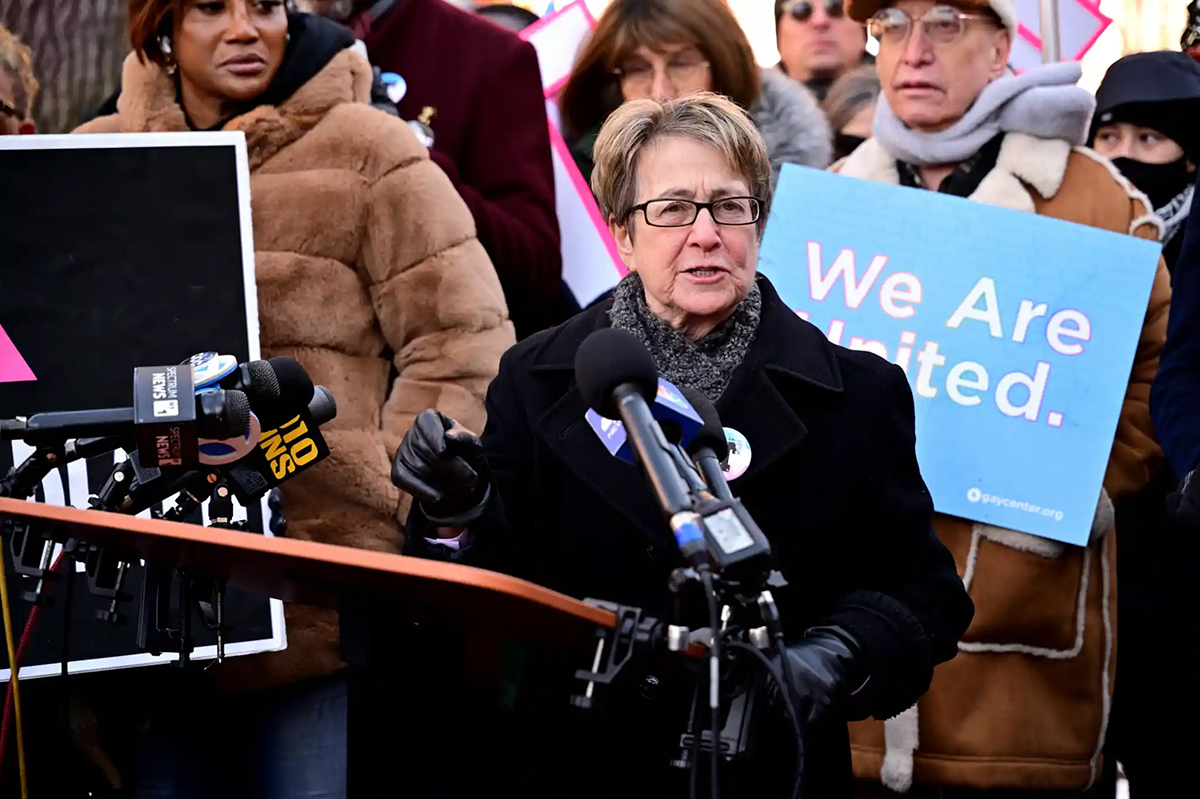
Deborah Glick has proudly served Greenwich Village in the New York State Assembly for three and a half decades. When elected in 1990, she became the first openly gay member of the legislature, and continued to break ground throughout her career, including leading the fight for marriage equality in the state. Shortly before she announced her retirement at the end of her current term, the longtime Village resident sat down with Village Preservation for the latest in our series of oral histories.
Born in Queens, Glick became familiar with Greenwich Village at an early age thanks to her father’s and uncle’s printing and stationery business on Hudson Street and St. Luke’s Place. “When I was really fairly young,” she said, “I would go with my father on Saturday mornings. He’d wake me up and take me to work with him. And I learned how to set type, and I learned other, you know, bits and pieces of the printing trade, as a kid. … I did [many] kinds of errands on school holidays and walked around the neighborhood. And I remember the commercial enterprises were very different.” Such early experiences formed a lasting attachment to a part of New York defined by its working businesses and distinctive character.
Moving to the Village in the early 1970s while still a student in Queens College, Glick found a community with a vibrant social life and nascent gay culture primarily found in bars, “usually Mafia-controlled and dark, dingy places.” In this time shortly after the Stonewall riots, “we weren’t afraid, particularly, of being raided. The raids were over. Doesn’t mean harassment was over, but the raids were by and large over.”
Glick came out “in, I guess, ’72. There was the Gay Activists Alliance Firehouse on Wooster Street. Friday night, there were women dances. On Saturday night, men.” On Sunday afternoons, the alliance held social programming through panels and social events. In 1973, “I came out on a public affairs television program” called New York Illustrated that came to interview the Lesbian Liberation Committee of the Gay Activists Alliance. “And I was willing to be out, thinking, Well, I have this job. If I lose it, I’ll get another one. [H]aving that sort of carefree early twenties attitude of … it’s not a great job anyway, what the hell. … I had to tell my family before they learned TV-wise.”
The future assemblymember shifted into formal political engagement after Ronald Reagan’s election as president in 1980, when she recognized a broader need for political action. “I not only got involved with [the National Organization for Women], but I also started going to [Village Independent Democrats] meetings now and again. And being more aware of those activities at the same time that I was still probably more focused on gay politics. Because we still didn’t have a civil rights bill until 1986 in the city of New York. We didn’t have a statewide bill until I had been serving in the legislature for 11 years.” Her activism in groups like Lesbian Feminist Liberation and Gay & Lesbian Independent Democrats laid the groundwork for her later campaigns.
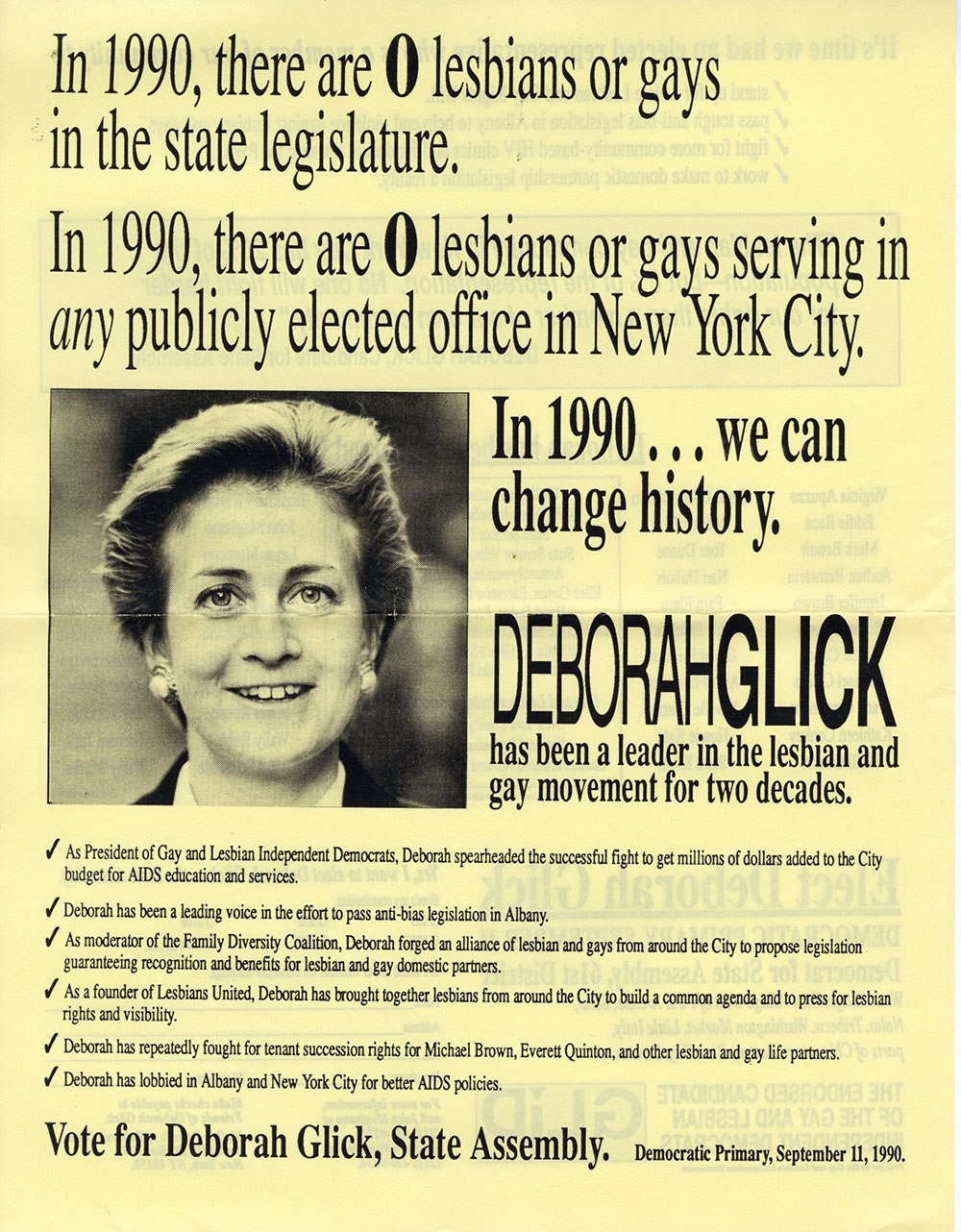
When Glick ultimately decided to run for office, she did so with the support of community advocates who felt representation was long overdue. She recalled sitting “around in a living room and said, you know, we haven’t, as gay people, we have no representation,” and described her campaign strategy rooted in everyday neighborhood engagement. “Every day it didn’t rain, I was at a subway station, and every evening at a supermarket or a laundromat.” This grassroots work helped her secure victory, even when she and her friends thought they “probably would run and lose.”
Once in the State Assembly, Glick’s work continued to reflect her Village roots and broader commitments. She faced such legislative battles as pushing the Sexual Orientation Non-Discrimination Act through the Assembly in her third session — it took 10 more years to pass in the Republican-controlled State Senate — as well as securing the wider protections embodied in the Gender Expression Non-Discrimination Act, both in the midst of the AIDS crisis.
Glick’s reflections also extend to how the Village itself has changed over time and why preserving its character matters. She noted that block associations once thrived in the neighborhood, and recalls how “20 years ago… dancing under the stars to live music was a hallmark” of the Ye Olde Village Faire organized by the Bedford Barrow Commerce Block Association, taking over three blocks for that day and night — something then-Mayor “Bloomberg didn’t like all of that stuff at night, so it was, you have to close up at six o’clock.” The neighborhood’s social fabric has also changed thanks to “the shift to increasingly more expensive shops” and a focus on the “tourist trade” on Bleecker Street and elsewhere.
“Change is inevitable and change is not inherently bad,” Glick said. That’s why “it’s important for us to maintain things like — the Landmarks [Preservation] Commission [which] should actually be worried about maintaining landmarks. And not being concerned about a very well-to-do person deciding that they can’t find anything that’s move-in ready for $17 million. That is the thing that is disturbing. The need to eliminate affordable housing to create single-family McMansions. That is not helpful to the community. … We have to push hard on the LPC” so that neighborhood scale and history are respected.
Even after decades of change, Glick said, “on quiet nights when I walk around the neighborhood, I still reminisce and remember things,” from pony rides on West 11th Street to the echoes of long-gone shops and services. Her oral history emphasizes that the special nature of Greenwich Village isn’t just architectural but also one woven into the memories and lives of those who have championed its culture and community.
Read or listen to Glick’s full oral history here, and explore more than 70 more such histories here.