
Architectural Innovation in the NoHo Historic District
Designated on June 29, 1999, the NoHo Historic District contains some of our neighborhoods’ grandest buildings, representing early feats of structural engineering, innovations in architecture, and urban-scale design.

Village Preservation’s NoHo Historic District Highlights Tour tells the stories of just some of these magnificent structures and how they influenced later construction in lower Manhattan and beyond. The highlighted buildings represent the range of construction periods and array of building types, styles, and uses that occur throughout the district. Part 3 of the tour, in particular, identifies several turn-of-the-20th-century structures that epitomize the architectural transformation taking place during this period in New York City. These impressive buildings are lasting examples of how new construction can be designed to be contextual and harmonious with our historic districts, even as it may set itself apart from smaller historic houses and institutional buildings.
Cable Building

Designed by renowned architecture firm McKim, Mead & White, this imposing, through-block Beaux Arts style powerhouse and office building was built in 1892-94 for the Broadway & Seventh Avenue Railroad Company. The basement once held giant wheels that powered the Broadway cable car line, giving the building the name it retains to this day. The basement continued its use as a powerhouse until May 21, 1901, when the final steam-powered car ran its route and the Broadway line switched to electric power. Click here and here for more information about this history.
By the 1930s, the building had been sold and its upper floors were occupied by different small businesses and manufacturing companies. In 1989, the basement that once held the wheels was transformed into the Angelika multiplex cinema.
Extending from Mercer Street to Broadway, the Cable Building was built with a steel and iron frame, with terra cotta and stone facing. The formal symmetry of its oversized bays of arched windows are emblematic of the Beaux Arts style. The building is topped by a unique and elaborate copper cornice, and the main Houston Street entrance features a round window flanked by two stone female figures, designed by sculptor J. Massey Rhind.
Bayard-Condict Building
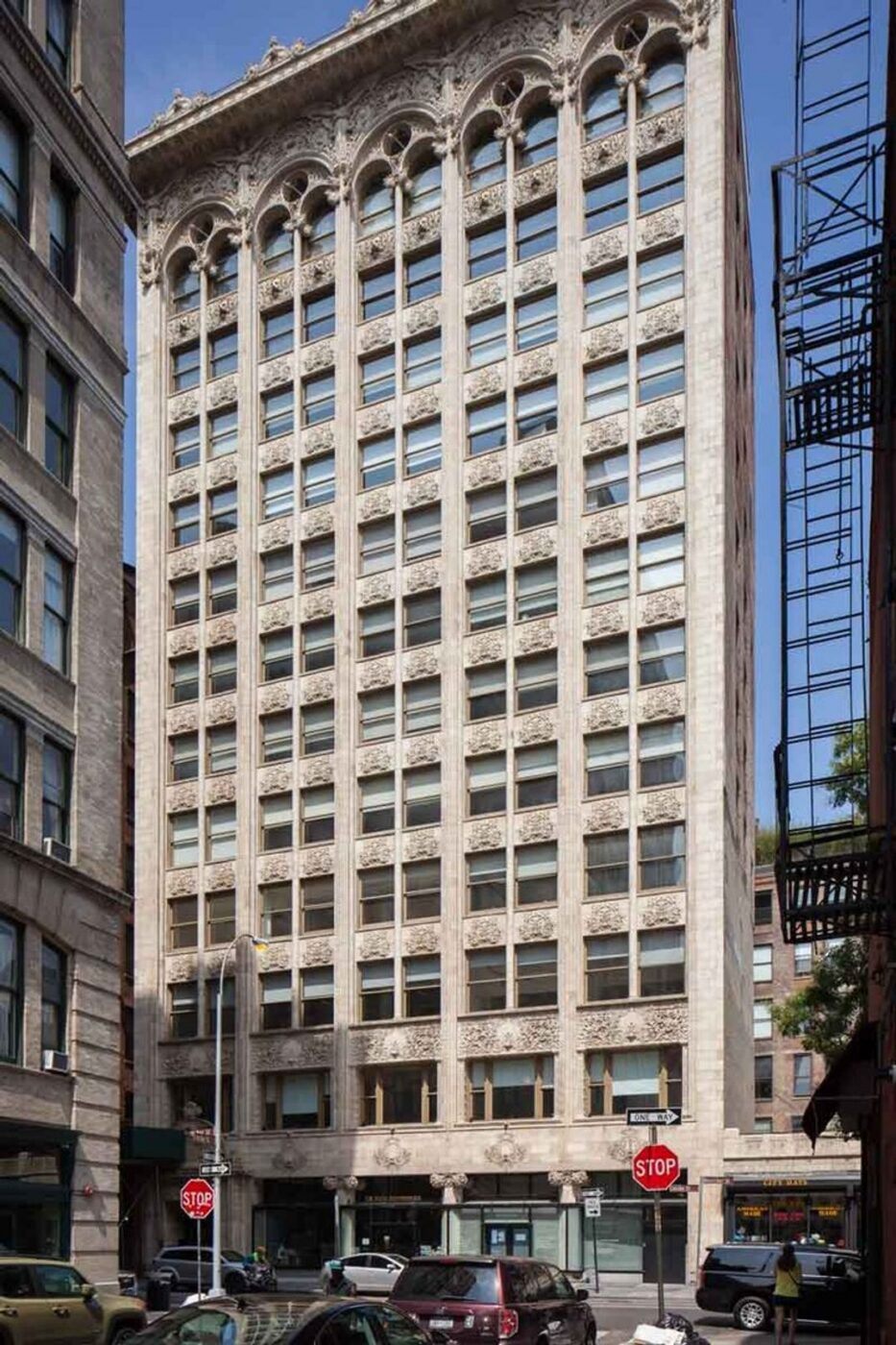
Constructed from 1897-99 in the Chicago School style, at twelve stories tall, the Bayard-Condict Building (65-69 Bleecker Street) was one of New York City’s first true skyscrapers and is its only building designed by renowned architect Louis H. Sullivan. The design is an exemplar of Sullivan’s iconic, ornamental style with heights made possible by then-newly-introduced iron-and-steel structural framing technology.
The original client, the Bayard Family, for which the building is named, has lineage tracing back to colonial New York City. They hired Sullivan to tear down the previous building on the lot and create a new commercial build for the United Loan and Investment Company.
The white glazed terra cotta cladding on the primary Bleecker Street facade features floral and foliate ornamental detailing throughout, with the entryway as its focal point featuring projecting, flanking ornamental piers with similar leafy and organic ornamental forms. These ornamental details connect throughout the facade creating a seamless unification of form, a hallmark of Sullivan’s style, who famously stated that these new large-scale commercial and office buildings should be “a proud and soaring thing, rising in sheer exultation that from bottom to top it is a unit without a single dissenting line.” Click here to learn more.
Wanamaker Annex
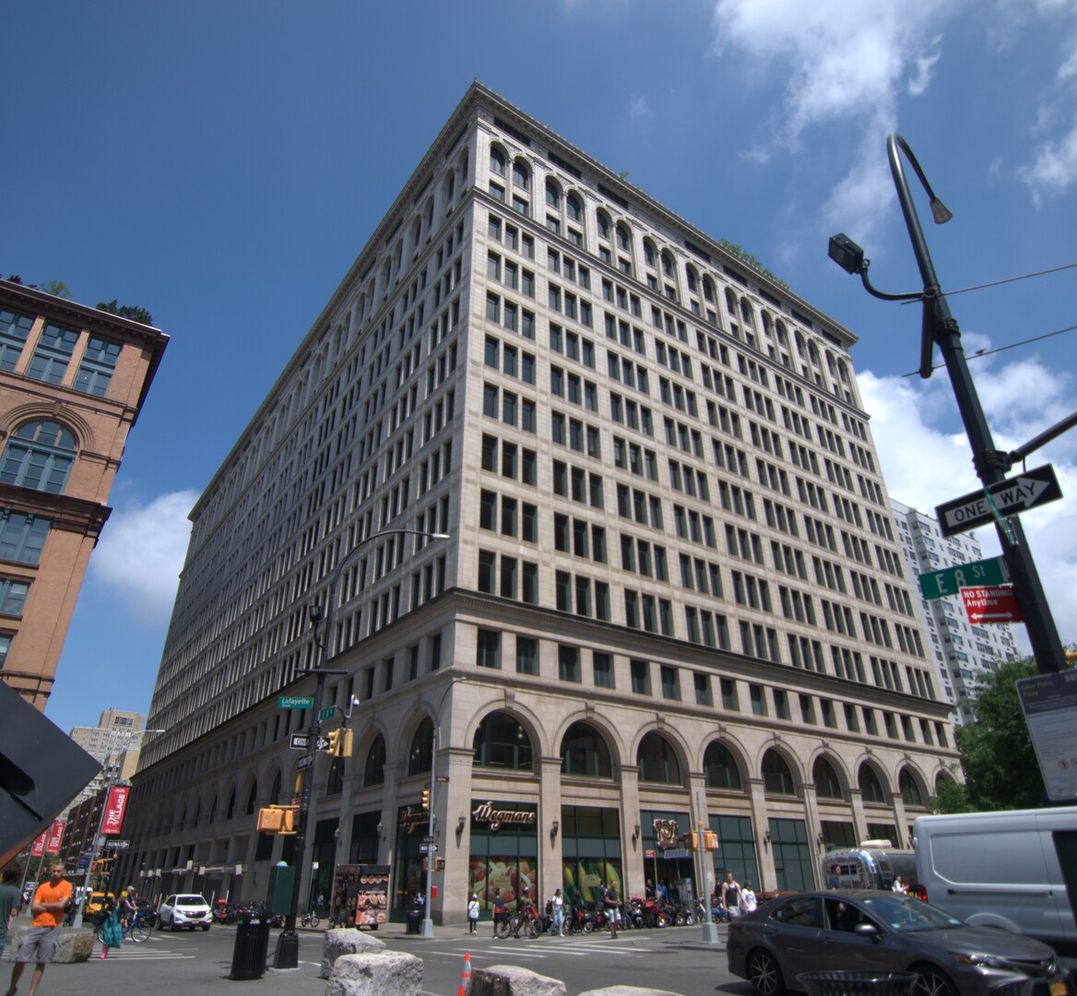
756-770 Broadway (aka 133-147 E 8th Street; 42-58 Fourth Avenue) was designed as a Renaissance Revival style department store by architects D.H. Burnham & Co. of Chicago. It was built in two stages, in 1903-07 and 1924-25, for John Wanamaker, as an annex to his earlier store building, located on Broadway across East 9th Street. Wanamaker’s had become one of the leading department stores in the city, and the company continued to expand in the neighborhood, additionally constructing 726-730 Broadway (for which the five most southerly houses of Colonnade Row were demolished, also within the NoHo Historic District), which was used for the storage of its delivery trucks, carpenters’ and upholsterers’ shops, and workshops for repairing and tuning pianos.
Wanamaker’s Department Store closed in early 1955, and the ground floor retail space was later leased to Kmart, which remained there until 2021. In 2024, the supermarket Wegmans opened in the space. You can read more about this architectural and retail history here.
684 Broadway
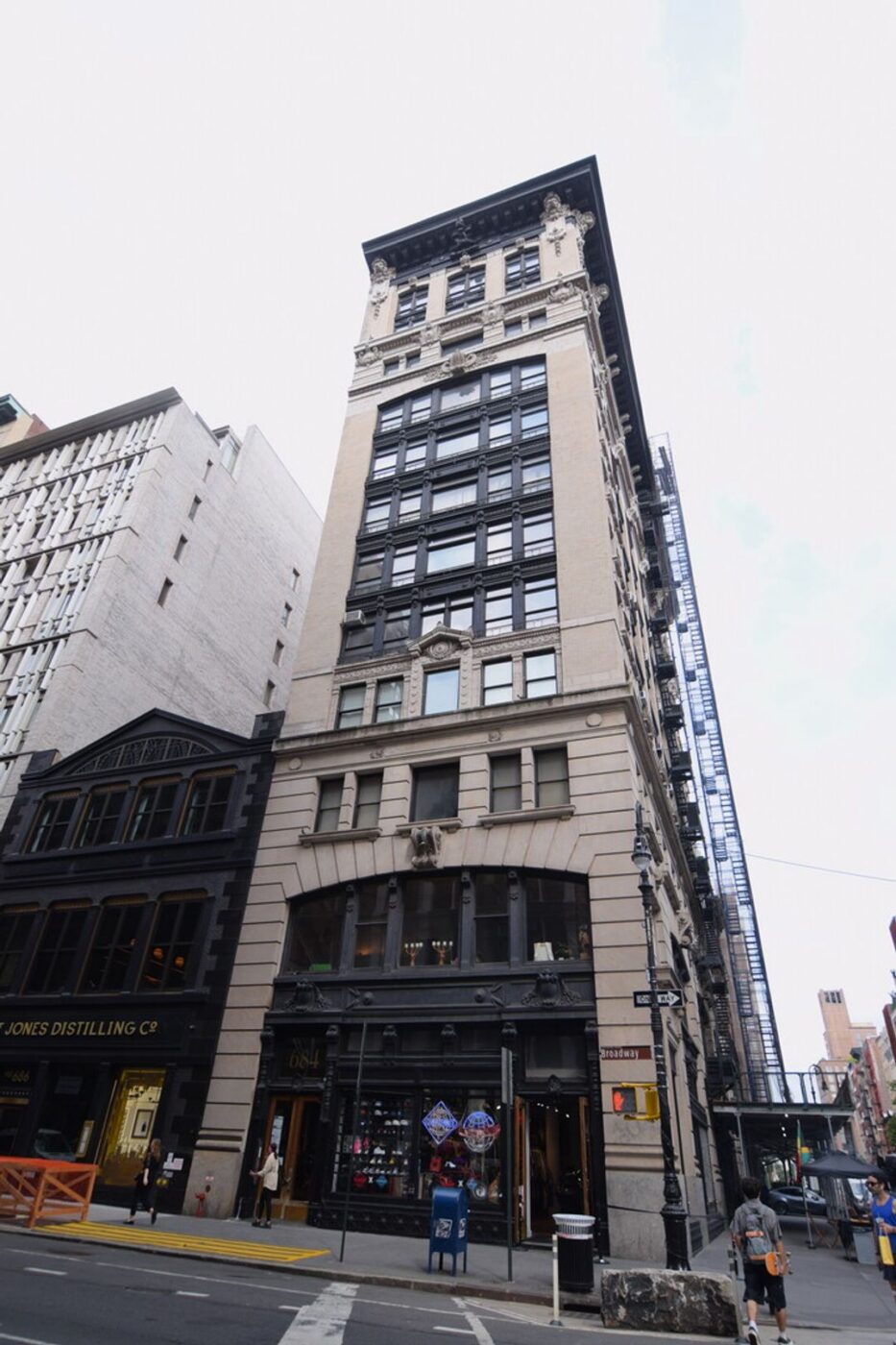
This Renaissance Revival style store and lofts building was designed by Frederick C. Browne and constructed in 1905 for Philip Braender, at a time when the earlier five-and six-story loft buildings that lined this section of Broadway were being replaced by taller commercial buildings. Philip Braender appears to have been related to the president of the Braender Rubber and Tire Company of New Jersey and the Braender Building and Construction Company of New York, of the same name. Braender also commissioned 693-699 Broadway, located across the street from this building and also within the NoHo Historic District, in 1908.
To achieve 684 Broadway’s twelve-story height, Browne incorporated an innovative method of concrete arch floor construction. The building now houses joint living/working quarters at its upper floors.
740-744 Broadway (aka 436-440 Lafayette Street; 2 Astor Place)

This Beaux Arts style loft building was designed by architect Francis H. Kimball and built in 1910-12 for the Orlando B. Potter Trust. Potter was a lawyer and a prominent figure in New York politics, achieving recognition by developing a plan for a national banking system and currency that was adopted by Congress in 1863. Potter had several other real estate holdings in Manhattan, including 444 Lafayette Street (1875-76), 746-750 Broadway (1881-83), and 4-8 Astor Place (1890), all within the NoHo Historic District, as well as the Potter Building at 35-38 Park Row (1883-86), a designated New York City individual landmark.
This twelve-story building is composed of a steel frame with limestone, brick, and terra cotta facing. It features five symmetrical bays along the Broadway facade, including a historic granite entryway with a prominent keystone and carved sculptural elements. The similarly designed Astor Place facade has four bays, with a historic storefront at its easternmost bay, and a subway entrance at the base.