
Chinese-American History in Greenwich Village and the East Village, Part II
The Asian-American story is often told through the lens of the West Coast or the bustling streets of Manhattan’s Chinatown. But the Chinese-American history of Greenwich Village and the East Village is just as vital. Here, an impressive yet frequently overlooked roster of individuals and organizations played a pivotal role in the national story, particularly within the realms of civil rights and the arts.
While Chinatown was a residential and commercial hub, the Village was often where Chinese intellectuals, radicals, and artists found a “third space” to work and collaborate with other marginalized groups. It is here that rights were won in the face of discrimination, innovations in painting, writing, and sculpture took place, and people confronted challenges and secured opportunities.
Yun Gee, 51 East 10th Street
Yun Gee (February 22, 1906 – June 5, 1963) is the quintessential “Village” artist. He was a painter, poet, philanthropist, teacher, writer, and inventor whose work bridged the gap between Chinese traditionalism and Western Modernism/Cubism. He lived and worked in the Village precisely because it allowed him to be “avant-garde” in a way Chinatown did not.
Gee was the first Chinese-American artist to hold an important position in the history of Western contemporary art. Considered one of the great Modernist avant-garde painters, Gee was the first Chinese-born artist invited to join the Société des Artistes Indépendants, the first Chinese artist to display his work internationally, the first Chinese artist to show at MoMa, and the first Chinese artist to show in the salons of Paris.
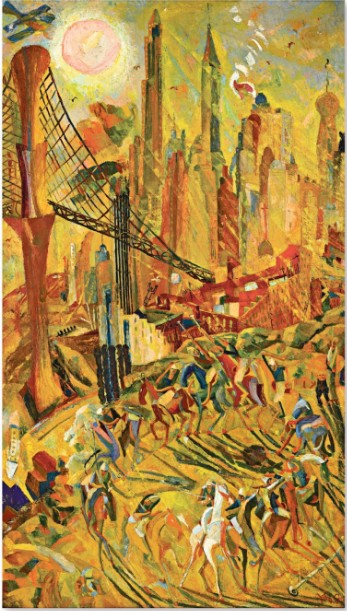
His art made frequent reference to his Chinese heritage either through form, style, or subject matter. He also developed his own signature style, Diamondism, which was derived from Cubism, and he promoted it through his art, writings, and teachings. From 1942 until his death in 1963, Gee lived and worked at 51 East 10th Street. Also in 1942, he married Helen Wimmer, who opened the country’s first commercial gallery focused on photography — Limelight photography gallery at 91 Seventh Avenue South, in Greenwich Village.
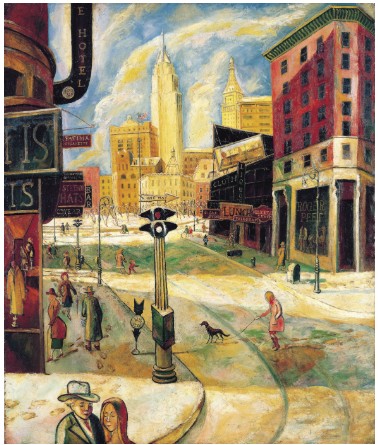
While living at 51 East 10th Street, Gee taught classes and wrote about his theory of Diamondism. In 1943, Gee staged an exhibition at the Milch Galleries on West 57th Street to raise funds for the Music Box Canteen. Located at 68 Fifth Avenue (12th/13th Streets), the Music Box Canteen was a celebrated World War II entertainment venue for GIs described at the time as “one of the most famous metropolitan service centers, and…‘a home away from home’ to thousands of servicemen.” This was not Gee’s first exhibit to benefit the allied forces; he had held others, the proceeds of which went to the British and American Ambulance Corps. The following year, in 1944, Gee’s work was showcased in the group exhibition “Portrait of America.” His work completed during his time at 51 East 10th Street includes Wanamaker Fire (1956), Old Broadway in Winter (1943-44), and Nude in Studio (1952).
Gee was also an inventor. He designed a four-dimensional chess game, and in 1950 received a patent for a tongue- and lip-holding device “for aiding correct English speech.” There were even reports by a few periodicals from the time about project plans he started in 1946 for a tunnel to the moon, which he apparently began constructing in his own backyard in 1949. The project was budgeted at $9,000,000, but as reported in 1949, there were no financial backers as of that date. Gee passed away in 1963. Unlike Gee’s many other lifetime achievements, the moon tunnel was never completed.
Martin Wong, 157 Avenue B & 6 Bond Street
Martin Wong (July 11, 1946 – August 12, 1999) was an openly gay Chinese-American artist who played a key role in New York City’s downtown art scene of the 1980s and early 1990s. Although he was an artist in his own right, his most impactful cultural contribution may be his early recognition of graffiti as an art form.
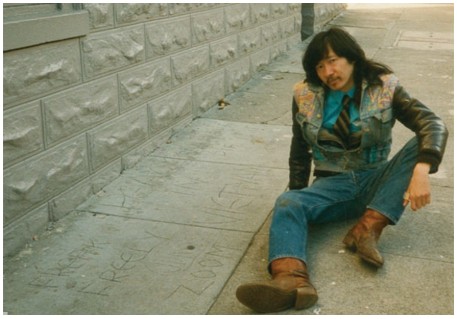
Wong was born on the West Coast, and started his art career at a young age, exhibiting around San Francisco. According to the Martin Wong Foundation, “his earliest works reflect[ed] the psychedelic era and his interest in the diverse cultures of Asia,” and included paintings, ceramics, and calligraphy that referenced Eastern mythologies and artistic traditions, local scenes of San Francisco, and toys. While in San Francisco, Wong completed outdoor exhibitions with the San Francisco Arts Festival, and created stage sets and props for a local alternative/queer theater troupe, The Angles of Light.
Wong moved to the Lower East Side in 1978, living at the Meyers Hotel on Stanton Street and at 141 Ridge Street. During his time in lower Manhattan, Wong was involved in the downtown urban art scene and the local Chinese-American community. He befriended and collaborated with other artists such as Kiki Smith, David Wojnarowicz, and Keith Haring, among others. According to the NYC LGBTQ Historic Sites Project, the “most important friendship” to Wong was with Miguel Piñero, writer and co-founder of the Nuyorican Poets Café. Through Piñero, Wong developed strong ties with the local Puerto Rican Loisaida community. At one point, Wong and Piñero were lovers and lived together at Wong’s Ridge Street apartment.
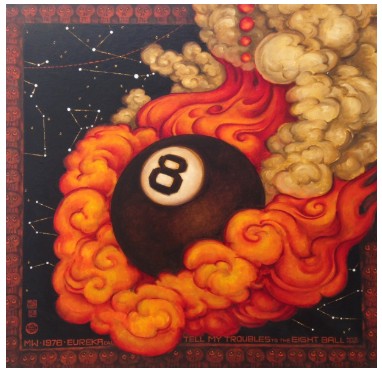
Wong’s artworks produced during his time in NYC included depictions of daily street life, sociopolitical issues like gentrification and displacement of low-income residents, the plight of Chinese-Americans from the Chinatowns of Manhattan and San Francisco, homerotic themes, and cultural references to ancient Chinese art.
According to his New York Times obituary, Wong showcased at the Blinderman’s Semaphore Gallery spaces in SoHo (462 West Broadway) and the East Village (157 Avenue B) in 1984, 1985, and 1986. His final show was at the P.P.O.W. Gallery in SoHo in 1998. His work could also be seen in The Metropolitan Museum of Art, the Whitney Museum of American Art, MoMA, and the New-York Historical Society, and has been featured in numerous global exhibitions.
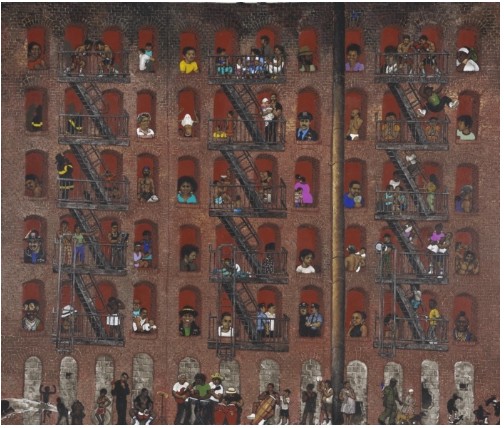
Wong was not a graffiti artist himself, but very early on recognized the artistic and cultural value of the work of his graffiti artist friends, and became a passionate collector of their art. “No one thought what we did had any longevity, but Martin loved street culture”, said Aaron SHARP Goodstone. He befriended many NYC graffiti writers while working at Pearl Paint, a well-loved Canal Street art supply store. He was drawn to the omnipresent graffiti writing he saw throughout the streets of New York and began collecting the drawings, paintings, and sketchbooks of his friends through purchase or trade. The collection he amassed is evidence of Wong’s preternatural eye for the cultural and esthetic significance of graffiti.
On April 8, 1989, Wong, along with Peter Broda, opened a graffiti art museum on the top floor of a townhouse at 6 Bond Street, the first permanent (though short-lived) home of hip hop art and ephemera. Their “Museum of American Graffiti” was envisioned as a space where graffiti could be admired by a larger public and officially join the broader dialogue of the art world. For a time, Wong’s art and life were a fulcrum around which the burgeoning hip hop street art cultures and the downtown art scene pivoted.
Wong’s legacy lives on through the vast collection he donated to the Museum of the City of New York in 1994, five years before he passed away. In 2014, the Museum of the City of New York exhibited nearly 150 of the works in Wong’s collection in the show “City as Canvas: Graffiti Art From the Martin Wong Collection.” Highlights of “City as Canvas” include Lee Quiñones’s “Howard the Duck” (1988), an oil painting; “Wicked Gary’s Tag Collection” (1970-72), which includes numerous tags, including ones by Phase2, Riff 170 and Coco 144; Lady Pink’s “The Death of Graffiti” (1982); and a variety of works by Keith Haring, another notable artist in the Greenwich Village/East Village and NoHo scene.
Wong moved back to San Francisco in 1994 and continued to make art until he passed away due to AIDS-related complications in 1999.
I.M. Pei, Silver Towers
I.M. Pei (April 26, 1917 — May 16, 2019) was a world renowned Chinese-American architect whose acclaimed designs include the Louvre Pyramid of Paris and the National Gallery of Art’s East Wing in Washington D.C., as well as a number of New York City structures including the Four Seasons Hotel New York and the Sundrome of JFK airport.
In 1964 to 1967, I.M. Pei & Associates designed University Village/Silver Towers, located between West Houston and Bleecker Streets, and Mercer Street and LaGuardia Place. The design represents an important moment in the evolution of Pei’s career and in the evolution of modern design in general.
These buildings, their overall arrangement within this superblock, and their placement within the surrounding landscaping and larger street grid, are an unusually sensitive and sophisticated manifestation of 1960s modern design. They are some of New York’s most successful examples of cast-in-place concrete architecture, and perhaps its most successful residential design from this era.
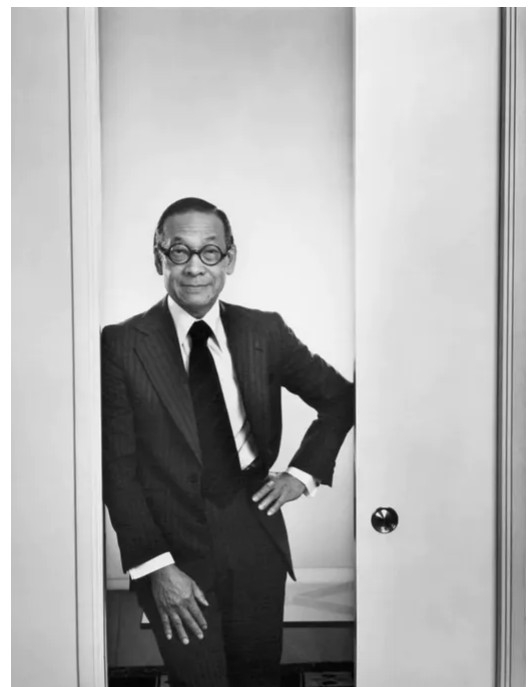
In typical Pei fashion, the design not only conveys the desire for structural truth and transparency typical of traditional modernism, but also displays a stylish, carefully articulated abstraction, acknowledges and subtly relates to the larger urban fabric around it, and gently shapes the experience of the pedestrian at street level. University Village/Silver Towers exhibits the synthesis of structural expressionism and the recognition of context and user which Pei would exemplify in his later designs, and which would inform the work of other pre-eminent late 20th and 21st century architects such as Richard Meier and Peter Eisenmann.
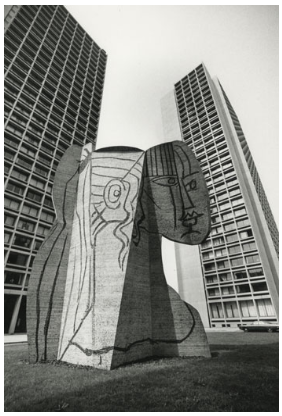
The design won the American Institute of Architects National Honor Award and the City Club of New York’s Albert S. Bard Award in 1967. Pei won the Pritzker Prize for Architecture in 1983 for his body of work up to that point in time. In 1966, Fortune Magazine dubbed Silver Towers one of “Ten Buildings That Climax an Era.”
Following the plan of I.M. Pei, the complex includes an enlargement of a 1954 cubistic work by Pablo Picasso. The piece was completed by Picasso’s collaborator, the Norwegian sculptor Carl Nesjar, in 1968. The shape of the sculpture plays off the “pinwheel” layout of the three Silver Towers buildings.
Village Preservation proposed and successfully fought to have University Village/Silver Towers designated as an individual NYC landmark in 2008.
Mabel Ping-Hua Lee, Fifth Avenue
Mabel Ping-Hua Lee (October 7, 1897 – 1966) was born in Guangzhou, China. Lee’s father, a pastor, moved to the United States when she was roughly five years old to pursue Baptist-missionary work. Lee remained in China where she studied Chinese classics, absorbed American ideas, and practiced English at a missionary school. Lee moved to New York at age eight, where she attended Erasmus Hall Academy in Brooklyn.
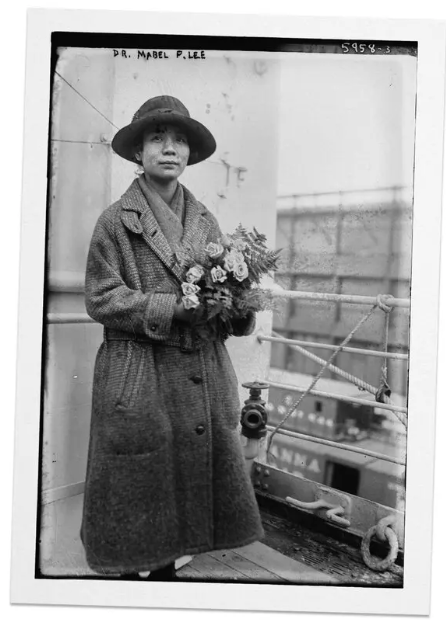
Lee became an activist as a teenager and she prominently helped lead 10,000 marchers in NYC’s first women’s suffrage parade on May 4, 1912. At just 16 years old, Lee joined other Chinese-American women riding on horseback along the march route, from Washington Square Park to 27th Street. Both The New York Tribune and The New York Times wrote articles about her activism prior to and during this landmark event. Lee’s presence challenged stereotypes of Asian women, although minorities including Asian and Black women faced discrimination within the Suffrage movement. To learn more, explore our Woman’s Suffrage History Map here.
In 1912, Lee enrolled at Barnard College, where she joined the Chinese Students’ Association and wrote feminist essays for “The Chinese Students’ Monthly.” In 1915, she gave a speech at the Women’s Political Union’s Suffrage Shop, in which she encouraged the Chinese-American community to uplift the education and civic participation of women. Following her graduation from Barnard, Lee became the first Chinese-American woman to receive a Ph.D. in economics, from Columbia University. She published her research in the book “The Economic History of China.” When her father passed away in 1924, Lee assumed his role as the director of the First Chinese Baptist Church of New York City.
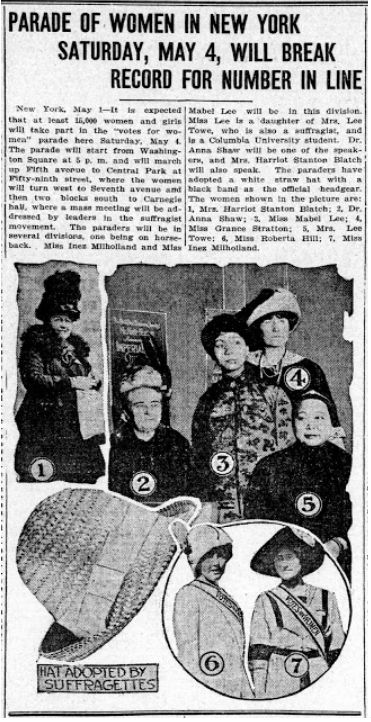
Lee was also the founder of the Chinese Christian Center, which became a vital resource to help the Chinese community overcome social and economic barriers. This community center provided a health clinic, kindergarten, vocational training, and English classes. Though New York women gained the right to vote in 1917, and the 19th Amendment ending all gender-based voting discrimination was ratified in 1920, Chinese-American immigrant women and men could not vote until 1943. The Chinese Exclusion Act prohibited Chinese-American immigrants from obtaining United States citizenship and therefore voting rights. It remains unknown whether Lee ever became a U.S. citizen and voted here.
Click here to see more historic images and newspaper clippings of Mabel Ping-Hua Lee.
Most of these entries, and 200 more just like it, are part of our Civil Rights & Social Justice Map. Explore this map covering not only Asian American but Black, Hispanic, LGBTQ+, and women’s civil rights history, among others.